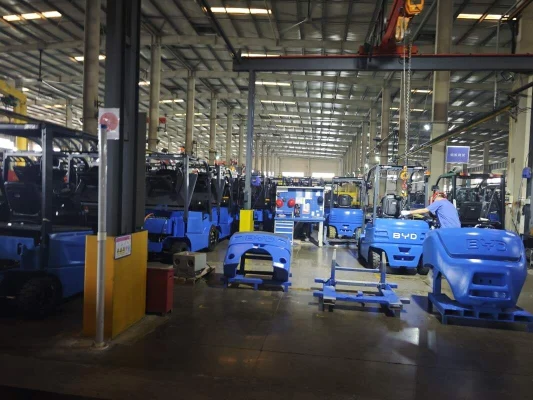
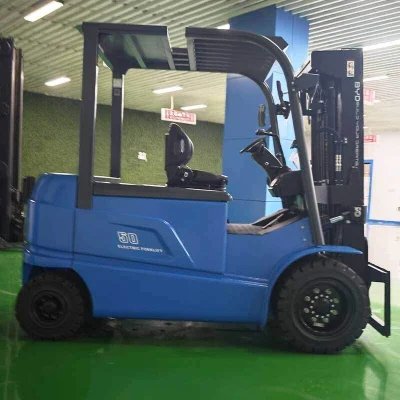
BYD ECB35 Four-Wheel Counterbalance Electric Forklift: Charging Infrastructure Questions to Resolve Before Delivery
News 04/11/2026
A BYD ECB35 four-wheel counterbalance electric forklift will only perform as expected when the charging side of the project is settled before the truck arrives. The most important questions concern the battery and charger configuration supplied with the truck, the available power at the intended charging location, the daily duty cycle and shift pattern, and who will own and maintain the charging equipment. Because the ECB35 is a lithium-powered counterbalance truck, charging decisions differ from those of a lead-acid fleet: opportunity charging and fast charging may be possible, but only within the limits the manufacturer specifies. This article sets out the questions a buyer should resolve before delivery, using a general warehouse and loading-dock context rather than claiming measured results.
Start with the Truck and Battery Configuration
Charging infrastructure cannot be planned in isolation from the truck. The first step is to confirm exactly what the delivered ECB35 will include. The model name alone does not tell a buyer the battery capacity, charger type, connector standard or onboard charging capability, so these items must come from the supplier’s technical documentation and quotation.
Questions to put to the supplier
- Which battery capacity and voltage does the quoted ECB35 configuration use, and what documents state this?
- Is a charger included, optional or supplied separately, and what input power does it require?
- Does the truck support onboard charging, and if so, what supply does that require?
- What charging connector and cable length come with the package?
- What ambient temperature range applies to operation, storage and charging, according to the manufacturer?
- What does the battery management system permit in terms of partial charging, charging during breaks, and charging at the end of a shift?
These are verification questions, not assumptions. If the supplier cannot provide written figures, the buyer should treat the point as unresolved and avoid designing the electrical installation around guessed values.
Match the Charging Plan to the Duty Cycle
The charging plan should follow how the truck will actually be used. A single-shift operation with a long overnight window has different needs from a multi-shift warehouse where the truck must return to work quickly. Before delivery, record the following:
- Number of shifts per day and approximate hours of actual truck use in each shift.
- Typical and peak load weights, lift heights and travel distances, since these affect energy use.
- Break patterns and where the truck can stand while charging.
- Whether the truck will charge in one fixed location or across several sites.
- Seasonal temperature conditions in the charging area.
A hypothetical example clarifies the logic without supplying invented performance figures. Suppose a distribution warehouse runs two shifts and plans to charge during a mid-shift break plus an overnight window. The buyer needs to know whether the manufacturer permits that pattern, how long a full charge takes with the proposed charger, and what reserve the operation should keep when a truck returns early. The answers must come from the supplier’s charger and battery documentation, not from general industry averages.

Common planning mistakes
- Ordering the truck before confirming the electrical supply capacity at the charging bay.
- Assuming a standard wall socket will support the chosen charger.
- Planning charging positions without checking aisle width, door clearances and fire-safety requirements.
- Leaving charger ownership, installation and maintenance responsibilities undefined between the site, the electrical contractor and the forklift supplier.
Site, Power and Safety Checks Before Delivery
Charging infrastructure is a site project as much as a vehicle option. The following table lists the points that most often delay commissioning, together with the evidence a buyer should request.
| Check area | Why it matters | Information to confirm |
|---|---|---|
| Electrical supply | Charger input requirements determine cabling and protection | Voltage, phase, current and connection type from the charger datasheet; capacity confirmed by a qualified electrician |
| Charging location | Affects access, ventilation and housekeeping | Dedicated bay or shared area; floor marking; clearance from racking and pedestrian routes |
| Temperature | Lithium battery charging and storage have limits | Manufacturer-stated operating, storage and charging temperature ranges; actual site conditions across the year |
| Fire and emergency arrangements | Local rules may govern battery charging areas | Applicable site and insurance requirements; supplier guidance on charger placement |
| Ownership and service | Defines who responds when charging fails | Warranty terms, service contacts, spare charger availability and response arrangements |
Where the site cannot meet a stated requirement, the correct response is to change the plan or seek written guidance from the supplier, not to assume the truck will cope. Buyers should also confirm whether the charger and battery are covered by the same warranty and what documentation is needed to keep that warranty valid.
Questions about charging behaviour
Ask the supplier to explain, in writing, how the battery management system handles charging when the battery is partly discharged, how the truck signals a low state of charge, and what the operator should do if a charge is interrupted. These details belong in the operator briefing and the delivery handover, not in a folder opened after the first problem appears.
Frequently Asked Questions
Can the ECB35 be charged during short breaks?
That depends on the battery and charger configuration supplied and the limits the manufacturer specifies. Ask the supplier to confirm in writing whether opportunity charging is approved and under what conditions. Do not treat it as a standard feature of every configuration.
What electrical supply should be installed before the truck arrives?
The charger documentation should state the required voltage, phase, current and connection type. A qualified electrician should then verify that the site can supply it safely. Without the charger datasheet, any installation plan is provisional.
Can the truck charge in a cold or unheated area?
Charging and storage temperature limits must come from the manufacturer’s documentation. Record the actual temperatures the charging area reaches, including winter nights, and compare them with the stated ranges. If the site falls outside those limits, discuss heating, relocation or an alternative charging arrangement with the supplier.

Who should maintain the charger?
Responsibility should be agreed before delivery. Confirm warranty coverage, service contacts and what routine checks the operator or maintenance team is expected to perform. Leaving this open often causes avoidable downtime.
Before signing off the delivery, assemble the truck and charger datasheets, the site electrical confirmation, the charging plan and the agreed service contacts into one handover pack. Then ask the supplier to confirm that the proposed charging routine fits the quoted configuration. Buyers who want to discuss the BYD ECB35 four-wheel counterbalance electric forklift should share their load weights, lift heights, shift pattern, charging location and available power so the configuration and charging questions can be answered against real conditions.