BYD Lithium Forklift: How to Set Lift and Lower Speeds That Match Operator Cycle Times on a Four-Wheel Counterbalance Electric Forklift
News 07/11/2026
A BYD lithium forklift used in a four-wheel counterbalance electric forklift role rarely has one “correct” lift and lower speed. The correct setting is the one that lets your operators complete a pallet move within their cycle time without making loads unstable, overloading the hydraulics, or forcing the truck to work against its own safety limits. Speed tuning is therefore a cycle-time exercise, not a performance upgrade. This article explains how to measure the real cycle, which settings to adjust, what to verify with your supplier, and where the limits sit.
The guidance below applies to four-wheel counterbalance electric forklifts. It does not cover three-wheel trucks, reach trucks, stackers, pallet movers, order pickers, tow tractors, or automated guided vehicles, which have different stability and hydraulic behaviour.
Start With the Cycle, Not the Speed Setting
Before changing any parameter, break the operator cycle into timed segments. A typical pallet move in a warehouse or loading area includes approach, fork entry, lift to travel height, travel, lift to racking height, fine positioning, lowering, and fork withdrawal. Only the lift and lower segments respond directly to hydraulic speed settings; the rest depends on layout, aisle width, and operator technique.
A practical way to collect this data is a simple observation sheet. Record, ten or twenty times, the following:
- Start and end height of each lift, measured against racking beams or the trailer bed
- Load weight and pallet condition, including any overhang or damaged deck boards
- Whether the truck is stationary or creeping while lifting
- Time spent waiting on the hydraulics versus time spent positioning
- Any hesitation, re-lift, or re-approach caused by the load shifting
This record tells you whether lift speed is genuinely the bottleneck. In many operations, the slowest part of the cycle is fork entry or travel, and raising hydraulic speed only adds risk without shortening the cycle. If lift and lower time is a small share of the total, leave the settings close to the factory configuration and look at layout or training instead.
Which Adjustments Actually Change Lift and Lower Speed
On a four-wheel counterbalance electric forklift, lift and lower speed are influenced by several interacting elements. The exact adjustment method, parameter names, and access permissions differ between models and software versions, so treat the list below as a checklist of what to ask about rather than a universal procedure.
Hydraulic flow and valve settings
Lift speed depends on pump flow delivered to the lift cylinders; lower speed depends on the controlled return flow through the lowering valve or proportional valve. Some trucks allow a controlled lowering rate to be set so that a heavy load descends predictably. Ask your supplier which parameters are adjustable on the specific model, which are locked at the factory, and what diagnostic tool or access level is needed.
Drive mode and hydraulic priority
Many electric trucks link hydraulic response to a selected drive mode. A mode that prioritises travel may reduce simultaneous lift performance, while a mode that prioritises hydraulics may feel different during combined travel and lift. Confirm how the modes interact on the model you are considering, and whether operators can switch them without a supervisor code.
Battery state and temperature
Hydraulic output depends on the electrical supply available to the pump motor. A lithium battery near a low state of charge, or one operating outside its comfortable temperature window, may deliver different performance from a fully charged pack at normal temperature. This is a general characteristic of battery-electric systems; the actual limits should come from the manufacturer’s data sheet and battery management system documentation, not from assumptions.
Load, height, and attachment effects
Lift speed and stability are affected by load weight, load centre, lift height, and any attachment fitted. A clamp, rotator, or extended fork carriage changes the load centre and the remaining capacity, and therefore how the truck should be operated. Do not treat a speed setting validated on an empty fork as valid for a full-rated load.
Matching Settings to Real Work Without Creating Risk
Speed settings should be chosen segment by segment, because a fast lift to travel height and a fast lift to full racking height carry different risks. The table below summarises the main trade-offs and the information to request from the supplier.
| Setting or factor | Why the operation cares | What to verify with the supplier | Typical trade-off |
|---|---|---|---|
| Lift speed to travel height | Shortens the most frequent segment of the cycle | Whether the parameter is adjustable, the permitted range, and the test load used | Faster lift can increase load sway and hydraulic heat |
| Lift speed to high racking | High lifts take longer and need stable positioning | Rated capacity at the actual lift height and load centre | Aggressive settings reduce margin at height |
| Lowering rate control | Predictable descent protects loads and racking | Whether controlled lowering is standard, optional, or factory-set | Very slow lowering adds cycle time on every put-away |
| Drive mode and hydraulic priority | Combined travel and lift behaviour affects smoothness | Mode definitions and operator switching permissions | One mode cannot optimise both travel and lift |
| Battery condition and charging routine | Consistent hydraulic response across a shift | Recommended operating and charging temperature range, opportunity-charging guidance | Frequent top-ups may suit some shifts but not others |
| Tyres, floor, and aisle width | Stability and safe stopping distance | Recommended tyre type and aisle requirements | Higher speed needs more stopping distance |
Use the table to build a trial plan. Change one parameter at a time, run the same load and route, and compare timed segments rather than overall impressions. Keep a written record of the original settings so that any change can be reversed if it does not deliver a real cycle-time benefit.
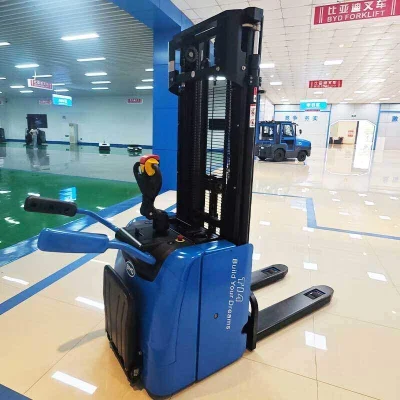
As a hypothetical example, a warehouse moving sealed pallets between a trailer bed and two racking levels might find that lift to travel height dominates the cycle. A modest increase in that segment, combined with a controlled lowering rate, could reduce the working cycle while leaving high-level lift settings conservative. In another operation with frequent high-bay put-away, the same change might simply move the bottleneck and add risk. The right answer depends on measured data.
Commissioning, Training, and Ongoing Checks
Once settings are agreed, treat them as part of commissioning rather than a one-off adjustment. A practical sequence is:
- Confirm the load chart and rated capacity at the actual lift height and load centre, including any attachment.
- Verify the hydraulic and battery parameters that the supplier permits you to change, and record the factory values.
- Run timed trials with representative loads, including a worst-case pallet.
- Train operators on the revised response, especially fine positioning at height and lowering near people or racking.
- Review performance after a full shift and again after several weeks, since wear, temperature, and battery condition all affect hydraulic response.
Common mistakes include tuning speed using empty forks, raising lift speed to compensate for a poor layout, allowing operators to change modes without a record, and ignoring the effect of attachments on remaining capacity. Another frequent error is assuming that a setting accepted on one truck will behave identically on another of the same model; verify each unit during commissioning.
If you are evaluating a BYD lithium forklift, the most useful step is to share your actual duty cycle: load weights, lift heights, aisle widths, floor and ramp conditions, shift pattern, and charging windows. Those inputs let the supplier recommend a configuration and confirm which speed-related parameters are adjustable, which are fixed, and what test conditions apply. No speed setting can compensate for a truck that is the wrong capacity or type for the task.
Frequently Asked Questions
Can I increase lift speed on a BYD lithium forklift without affecting capacity?
Capacity is determined by the truck’s stability and structural design at a given load centre and lift height, not by the speed setting alone. However, faster lift can increase load sway and dynamic forces, so any adjustment must stay within the manufacturer’s permitted range and be validated with representative loads. Ask the supplier which parameters are adjustable and what limits apply to your configuration.
Why does lowering speed matter as much as lifting speed?
Lowering is when loads are most often placed near racking, floors, and people. A controlled, predictable descent reduces impact damage and helps operators position pallets accurately. Excessively slow lowering, on the other hand, adds time to every put-away. The aim is a rate that is stable and repeatable across the loads you actually handle.
Does battery charge level change hydraulic performance during a shift?
Battery-electric systems can deliver different performance as state of charge and temperature change. The exact behaviour depends on the battery management system and the manufacturer’s settings. Check the recommended operating and charging temperature range and plan charging around your shift pattern so that performance stays consistent where it matters.
Is a four-wheel counterbalance electric forklift suitable for every warehouse layout?
No. Four-wheel counterbalance trucks are a common general-purpose choice for loading, unloading, and horizontal transport, but narrow aisles, very high lifts, or specialised handling may call for a different truck type or a different configuration. Confirm aisle width, turning radius, lift height, and load centre against the supplier’s data before committing.
What information should I prepare before requesting a speed configuration?
Prepare load weights and dimensions, lift heights, racking and aisle dimensions, floor and ramp conditions, attachments, shift length, charging windows, and any temperature extremes. Also note the cycle segments you have timed and the current settings. This lets the supplier confirm the feasible configuration and the tests needed to validate it.