Electric Forklift Battery Sizing: Matching Voltage and Capacity to Four-Wheel Counterbalance Load Charts
News 07/11/2026
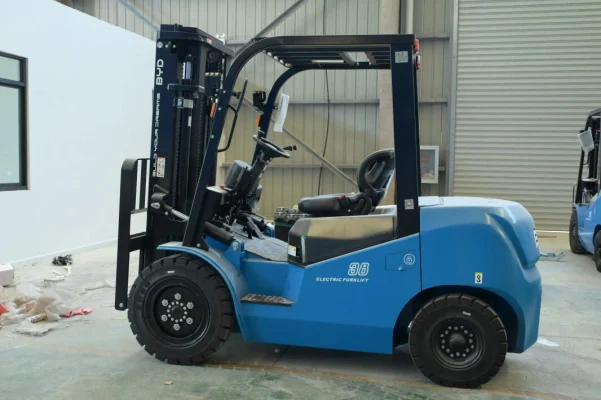
Choosing an electric forklift battery begins with the load chart, not the battery catalog. A four-wheel counterbalance electric forklift’s lifting ability depends on voltage, battery capacity and, critically, battery weight. The battery acts as part of the counterweight, so a lighter or smaller battery can reduce rated capacity or shift the load center. This guide explains how to read a load chart, match voltage and capacity, and verify that a proposed battery keeps the truck within its rated limits.
Start With the Load Chart, Not the Battery Label
A load chart states the maximum load at a given load center and lift height. It is developed with a specific battery weight and voltage. If you replace the battery with one of different weight, the chart may no longer apply. Before comparing ampere-hour ratings, confirm three items on the truck’s data plate and load chart: nominal voltage, minimum battery weight, and the load center used for the rating.
Load charts typically show capacity at a 500 mm or 600 mm load center, but the exact value must come from the manufacturer’s documentation. A battery that is too light can make the truck unstable when lifting near rated capacity. A battery that is too heavy may exceed the truck’s structural limits or alter handling. Neither condition is acceptable without written approval from the truck manufacturer.
Voltage: Match the Truck’s Nominal System
Voltage matching is straightforward but unforgiving. A four-wheel counterbalance electric forklift is designed around a nominal voltage, commonly 48 V, 80 V or 96 V. The battery must match that nominal voltage. Installing a battery of a different nominal voltage is not a valid way to gain capacity or speed; it can damage the controller, motor and charging system.
Voltage also affects current draw. At a given power level, a higher-voltage system draws less current, which can reduce resistive losses in cables and motors. However, you cannot change voltage without confirming that the truck’s components are rated for it. Treat voltage as a fixed design parameter and select a battery that matches the truck’s nameplate.
Capacity and Battery Weight: The Trade-Off That Governs Runtime
Ampere-hour capacity determines runtime between charges, but it also affects battery weight and physical dimensions. A larger-capacity battery generally weighs more and occupies more space. The goal is to choose the smallest capacity that meets the duty cycle while staying within the truck’s approved battery weight range and compartment dimensions.
To estimate the required capacity, gather the following information from the operation:
- Shift length and the number of shifts between charging opportunities.
- Actual load weight and lift height during a typical cycle.
- Travel distance and surface conditions.
- Any attachments that add weight or shift the load center.
- Ambient temperature and any high-temperature areas.
These factors determine energy consumption per hour. Without measured data, use the truck manufacturer’s duty-cycle guidance or ask the battery supplier to calculate capacity from your operating profile. Do not assume that a larger battery always solves runtime problems; if the truck’s compartment or counterweight limit cannot accommodate it, the installation may be unsafe or non-compliant.
Verification Steps Before Purchase
Before ordering a battery, verify the following against the truck’s documentation and the battery supplier’s data sheet:
- Nominal voltage matches the truck nameplate.
- Battery weight falls within the minimum and maximum allowed by the truck manufacturer.
- Dimensions fit the battery compartment, including any restraint system.
- Connector type and polarity match the truck’s receptacle.
- Charging profile is compatible with the chosen charger and available power supply.
If any item cannot be confirmed, request written clarification from the truck manufacturer or a qualified battery supplier. A load chart is only valid when the battery matches the specified weight and voltage.
Frequently Asked Questions
Can I use a battery with a higher ampere-hour rating if it fits?
Only if the battery weight and dimensions remain within the truck manufacturer’s approved range and the load chart still applies. A higher capacity often means more weight; exceeding the approved weight can affect stability and structural limits.
Does a higher-voltage battery increase lifting capacity?
No. Lifting capacity is determined by the truck’s hydraulic and structural design, not by battery voltage. Voltage must match the truck’s nominal system. Changing voltage without manufacturer approval can damage electrical components.
How do I know the required capacity without measured data?
Use the truck manufacturer’s duty-cycle guidelines and consult the battery supplier with details of shift length, load weight, lift height and travel distance. A calculation based on your operating profile is more reliable than a rule of thumb.
What happens if the battery is lighter than the minimum specified weight?
The truck may become unstable when lifting near rated capacity because the battery contributes to counterweight. Always use a battery that meets the minimum weight stated on the load chart or data plate.