Lithium Ion Forklift Procurement: Duty Cycle Questions Buyers Should Answer Before Sizing a Four-Wheel Counterbalance Electric Truck
News 05/11/2026
A lithium ion forklift purchase goes wrong most often not because the truck is poorly built, but because the duty cycle was never written down. Before you compare models or request a configuration, describe how the four-wheel counterbalance electric truck will actually work: how heavy the loads are, how high they go, how long each shift runs, and when the battery can charge. Those four answers shape capacity, battery size, charging strategy, and the acceptance checks you write into the order.
This guide lists the duty cycle questions to settle during procurement, why each one changes the specification, and what to ask the supplier to confirm in writing.
Start with the Load, Not the Truck
Rated capacity means little until you attach it to a load center and a lift height. A four-wheel counterbalance electric forklift is rated at a stated load center, and capacity typically falls as the load center moves forward or the mast raises the load. Collect the following before sizing:
- Heaviest load including pallet, packaging, and any attachment
- Load dimensions and the actual load center
- Maximum lift height and the height at which the heaviest load travels
- Any attachment, since added weight and offset reduce usable capacity
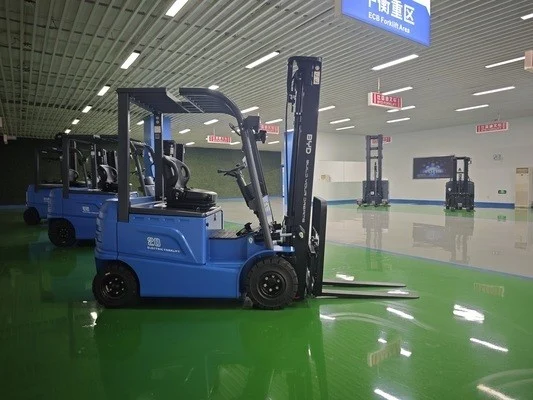
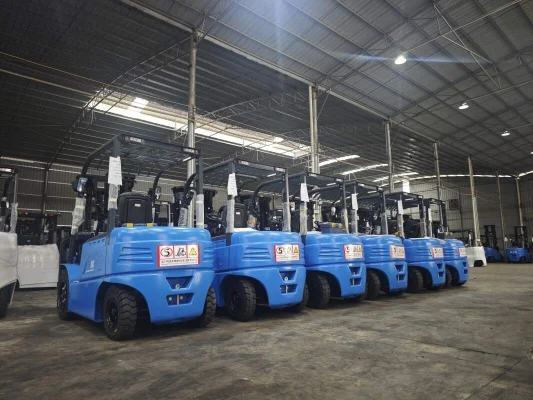
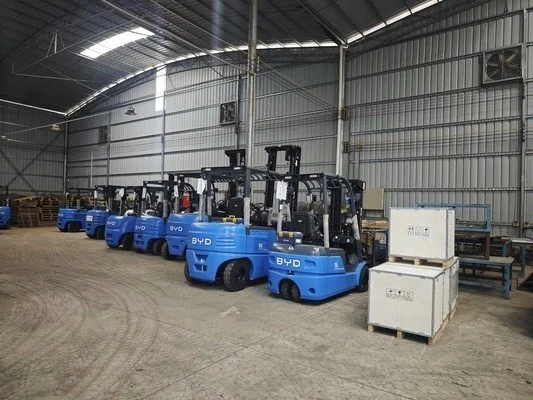
Ask the supplier to state the capacity at your real load center and lift height, not only the headline rating. If the answer is a single number with no conditions, request the underlying capacity chart. Our sales team can review these figures against the available比亚迪 four-wheel counterbalance electric forklift configurations once your load data is clear.
Quantify the Duty Cycle in Numbers
Duty cycle is the pattern of work, and it drives both battery sizing and motor thermal load. Write it down as a simple table rather than a description.
| Question | Why it matters |
|---|---|
| How many hours per shift, and how many shifts per day? | Sets energy demand and whether opportunity charging fits |
| What share of the shift is actual lifting and travel versus waiting? | Separates continuous work from intermittent use |
| How many pallet moves per hour at peak? | Reveals peak demand that averages hide |
| What is the heaviest load moved most often? | Links typical work to rated capacity |
| How far does the truck travel per trip, loaded and empty? | Affects energy use and cycle time |
A truck that lifts a few heavy loads an hour faces a different energy profile from one that runs near-continuous light cycles. Do not average these away; give the supplier both the typical and the peak hour.
Charging Windows, Infrastructure, and Shift Patterns
The lithium ion forklift advantage in charging is real but conditional. Opportunity charging only helps if the truck actually returns to a charger during breaks and if the electrical supply supports it. Confirm:
- Available charging windows: lunch, shift change, overnight
- Charger location relative to the work area
- Supply voltage and capacity at the charging point, verified by your electrical team
- Whether a spare battery or a second truck is needed to cover charging time
- Ambient conditions at the charging area, including temperature extremes
Ask the supplier to explain the recommended charging regime and the assumptions behind it. Battery and charger specifications must come from the manufacturer’s technical documentation; treat any cycle-life or runtime figure without stated test conditions as unverified.
Aisle, Floor, and Environment Checks
Physical conditions decide whether a four-wheel counterbalance truck suits the site at all. Measure rather than estimate:
- Aisle width and turning clearance at the tightest point
- Floor condition and any ramps, with gradient and length
- Doorway and lift-gate dimensions
- Indoor, outdoor, or mixed use, and exposure to dust, moisture, or washdown
- Traffic patterns shared with pedestrians or other vehicles
Four-wheel counterbalance trucks are a common general-purpose choice in factories, loading docks, and warehouse transfer, but they are not the right answer everywhere. Narrow aisles or very high racking may point to a different truck type, and a supplier should say so honestly rather than force a fit.
Procurement Questions and Acceptance Points
Turn the duty cycle into a written requirement. In the inquiry, include load data, lift heights, shift pattern, charging windows, aisle dimensions, floor and ramp details, and the environment. Ask the supplier to respond with:
- Proposed model and capacity at your stated load center and lift height
- Battery and charger specification with the source document
- Recommended charging regime and its assumptions
- Delivery, commissioning, training, and spare parts arrangements
- Warranty terms and what is excluded
At acceptance, verify the delivered configuration against the agreed specification, confirm capacity markings and the capacity chart, and check that the charger and battery match the order. Record any deviation before signing off. Prices, lead times, and options should be confirmed in a formal quotation; this article does not quote figures.
Frequently Asked Questions
How detailed should the duty cycle be in an inquiry?
Detailed enough that the supplier can size capacity and battery without guessing. Include peak loads per hour, heaviest load, lift height, shift length, and charging windows. A short table is more useful than a paragraph.
Can one lithium ion forklift cover two shifts?
It depends on energy use per shift and the charging windows available. Some operations can opportunity-charge during breaks; others need a spare battery or a second truck. Ask the supplier to show the calculation behind any claim.
What if my loads vary widely?
Size for the heaviest routine load at its actual load center and height, then check whether the lighter, faster cycles change the energy picture. State both patterns so the supplier can propose a configuration that covers the real range.
Which documents should I request before ordering?
Ask for the capacity chart, battery and charger specifications, the recommended charging regime, warranty terms, and the commissioning and training scope. Verify each against your duty cycle before approving the order.