Electric Forklift for Sale Near Me: How to Verify Rated Capacity Against Your Heaviest Lift and Load Center
News 08/11/2026
When you search electric forklift for sale near me, the first number most listings show is rated capacity. That figure is a starting point, not a guarantee. A four-wheel counterbalance electric forklift rated at 3,000 kg at a 500 mm load center will not safely lift 3,000 kg when the load center moves to 700 mm. Before you compare local listings or request a quote, confirm three things: the weight of your heaviest real load, where that load’s center of gravity actually sits, and the load center and lift height at which the rated capacity applies.
This guide walks through how to read a capacity plate, measure load center, and match a machine to your duty without relying on assumptions. Numbers below are illustrative examples only; always confirm values against the manufacturer’s technical data sheet and the plate on the specific unit you are considering.
Reading the Capacity Plate the Way It Was Written
Every counterbalance forklift carries a data plate that states rated capacity at a specified load center and, often, at a specified lift height and mast type. Those conditions are part of the rating. A capacity figure quoted without them is incomplete.
What the Plate Tells You
- Rated capacity: the maximum mass the manufacturer allows under the stated conditions.
- Load center: the horizontal distance from the vertical face of the forks to the load’s center of gravity.
- Lift height and mast: capacity can decrease as the carriage rises, so the rating may apply only to a stated height.
- Attachment: side shifters, clamps, or other attachments add weight and move the effective load center forward, which reduces usable capacity.
A common mistake is treating the headline number as universal. If your plate reads 2,500 kg at 500 mm load center, that is the limit at 500 mm. Move the load center outward and the allowable mass falls. The exact reduction comes from the manufacturer’s capacity chart or load moment data, not from a rule of thumb.
Why Load Center Changes Everything
Capacity is fundamentally about stability: the load’s weight multiplied by its distance from the front wheel axis (load moment) must stay within what the chassis and counterweight can resist. Increase the distance and you must reduce the weight to keep the moment within limits. That is why a pallet that fits comfortably at 500 mm may exceed the rating at 600 mm or 700 mm.
Matching Your Heaviest Lift to a Real Load Center
Start with the load, not the truck. The goal is to find the worst-case combination of weight and load center in your operation, then confirm the forklift you buy is rated at or above that combination at the lift height you actually use.
Step 1: Identify the Heaviest Lift, Not the Average
List the loads you handle and note the heaviest. Include the pallet or container weight, not just the goods. If you handle several product lines, the heaviest single item often differs from the most frequent item. Both matter: the heaviest sets the capacity floor, and the most frequent shapes your cycle and battery needs.
Step 2: Measure Load Center, Do Not Guess
Load center is half the depth of a uniformly distributed load, measured from the fork face. A standard 1,200 mm deep pallet loaded evenly gives a load center near 600 mm, not 500 mm. Oversized, offset, or unevenly stacked loads push the center further out. Measure the actual pallet depth and note any overhang. If loads are irregular, use the most unfavorable realistic position.
Step 3: Compare Against the Capacity Chart
Ask the seller to provide the capacity chart or load moment data at your measured load center and your maximum lift height. Do not accept a single headline figure. If the chart is unavailable, treat the listing as unverified and request the plate photo and technical data sheet.
| Check | What to Confirm | Why It Matters |
|---|---|---|
| Heaviest load | Goods plus pallet mass | Sets the minimum rated capacity |
| Load center | Half pallet depth from fork face | Determines allowable mass at that distance |
| Lift height | Maximum working height | Capacity may fall as carriage rises |
| Attachment | Type and added weight | Reduces usable capacity and shifts load center |
Turning the Numbers into a Buying Decision
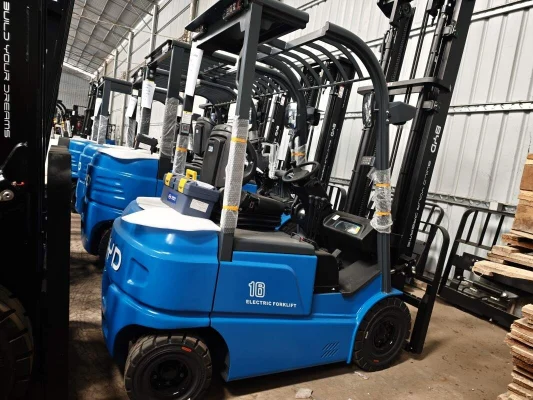
Once you have a verified load center and heaviest load, the buying conversation becomes specific. A four-wheel counterbalance electric forklift is a common general-purpose choice in factories, loading docks, and warehouse transfers, but suitability still depends on your aisle width, floor surface, ramps, shift length, and charging arrangements.
Questions to Bring to the Seller
- What rated capacity applies at my measured load center and maximum lift height?
- Does the quoted capacity include any attachment fitted to the unit?
- What are the aisle width, turning radius, and gradeability figures?
- What battery and charger configuration is supplied, and what charging window does my shift pattern allow?
- Which parameters are confirmed by the technical data sheet, and which still need verification on the unit?
When you contact us, share your heaviest load, pallet dimensions, required lift height, aisle width, floor conditions, and shift pattern. That information lets us check a four-wheel counterbalance electric forklift configuration against your duty rather than quoting a headline capacity. We only state specifications supported by the manufacturer’s published data; anything not yet confirmed will be flagged as such.
Common Errors That Lead to Under-Sized Trucks
Buyers most often go wrong by using the average load instead of the heaviest, assuming a 500 mm load center for standard pallets, ignoring attachment weight, and comparing capacity figures without checking lift height. A truck that looks adequate on paper can be marginal in practice once these factors are included. Confirm each one before committing.
Limits Worth Stating Plainly
Capacity verification does not confirm that a given model suits every task. Narrow aisles, steep ramps, outdoor surfaces, and specialized attachments can each change the recommendation. If your operation involves equipment outside the four-wheel counterbalance category, that equipment should be assessed separately; we do not present other truck types as alternatives we supply.
Frequently Asked Questions
Is the rated capacity the same as the maximum weight I can lift?
Only under the conditions stated on the plate. Rated capacity applies at a specified load center, and often at a specified lift height and with a defined attachment. Outside those conditions, the allowable mass is different and must be taken from the capacity chart.
How do I measure load center on a pallet?
Measure the pallet depth along the fork direction and divide by two, assuming the load is evenly distributed. Measure from the vertical face of the forks to the estimated center of gravity. Offset or uneven loads require a more conservative estimate.
Can I add a side shifter without losing capacity?
Generally no. An attachment adds weight at the carriage and moves the effective load center forward, both of which reduce usable capacity. The manufacturer’s data should state the derated capacity with the attachment fitted.
What should I send when requesting a quote?
Provide your heaviest load including pallet weight, pallet dimensions, maximum lift height, aisle width, floor and ramp conditions, and daily shift and charging pattern. These details let the seller check a four-wheel counterbalance electric forklift configuration against your actual duty.