Electric Forklift Truck Procurement: Confirming Site Electrical Capacity and Charger Placement Before Ordering a Four-Wheel Counterbalance Unit
News 08/11/2026
Ordering a four-wheel counterbalance electric forklift is a capacity decision as much as a truck decision. Before you confirm the purchase order, you need to know whether your building can deliver the charging power the battery requires, where the charger can physically sit, and who owns the electrical work. Get these answers wrong and the truck arrives on schedule while the charging infrastructure does not. The checks below follow the order most procurement teams should use: load calculation first, then placement, then contract terms.
Start With the Charging Load, Not the Truck Spec Sheet
Battery chargers draw significant power, and that draw is a site-level constraint. The truck’s datasheet tells you battery voltage and capacity; it does not tell you whether your existing distribution board has spare capacity at the end of a shift when several trucks charge at once.
Collect these inputs before you request a quotation:
- Battery voltage and rated capacity from the manufacturer’s technical data, plus charger input voltage and current.
- Number of trucks charging simultaneously at peak, not the average across the day.
- Shift pattern and opportunity-charging intent, since frequent top-ups change the charger type and the connected load.
- Available supply at the proposed charger location: spare breaker capacity, cable route, and distance from the distribution board.
- Charger efficiency and power factor, where the manufacturer publishes them, because input current is not simply output power divided by voltage.
Do not estimate these figures yourself from battery size alone. Ask the charger and forklift supplier to state the input current and recommended protection rating in writing, then have a qualified electrician confirm the site can supply it. If the supplier cannot provide charger input data, treat the electrical plan as incomplete and do not sign the order.
Charger Placement: Clearances, Ventilation and Traffic
Placement is usually the item that delays installation, because a charger needs wall space, ventilation, a cable route and a safe position out of vehicle traffic. Walk the site with the layout in hand and check each point.
Physical and electrical clearances
Confirm the manufacturer’s required clearance around the charger, the mounting height, and whether the unit is floor-standing or wall-mounted. Check that the cable reaches the parking bay without crossing a walkway or becoming a trip hazard, and that the connector can be stowed off the floor. Verify the charger location stays within the cable route distance the electrician can support.
Ventilation and environment
Lead-acid charging can release gas and needs ventilation; lithium-ion charging behaves differently, but the charger still has thermal limits. Ask the supplier which battery chemistry the charger is configured for and what ventilation or ambient temperature limits apply. Do not assume a space that suited an older lead-acid bay will suit a new installation without checking.
Traffic and access
The charging bay should let the truck park squarely, with room to connect and disconnect without reversing into racking or blocking a fire exit. If the only free wall is in a busy aisle, the placement is wrong regardless of electrical convenience.
What to Put in the Enquiry and the Order
A useful enquiry gives the supplier enough to propose a configuration and gives you a basis to compare offers. Include the following, and ask the supplier to confirm each item in the quotation rather than in a phone call.
| Item | What to state or request |
|---|---|
| Application | Load weight, load centre, lift height, aisle width, floor surface and any ramps |
| Duty | Shifts per day, hours of operation, peak simultaneous charging |
| Electrical supply | Site voltage and frequency, spare capacity confirmed by an electrician |
| Charger | Model, input current, protection rating, connector type, cable length |
| Battery | Chemistry, voltage, capacity, and charging regime the supplier recommends |
| Scope split | Who supplies and installs cabling, isolators, protection and signage |
| Acceptance | Commissioning checks, documentation and handover items |
Keep the scope split explicit. Electrical installation is normally the buyer’s responsibility and must be carried out by a qualified contractor; the forklift supplier’s responsibility usually ends at the charger terminals. Ambiguity here is a common source of delay and disputed cost.
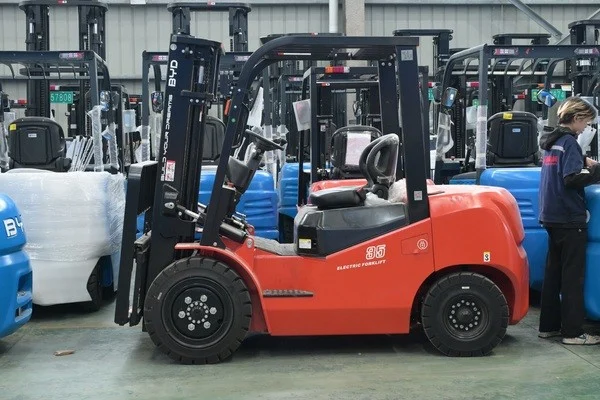
This is also the point to ask about the specific four-wheel counterbalance electric forklift configuration you intend to buy: battery capacity matched to your shift pattern, charger type, and whether the site’s supply supports the charging regime the supplier proposes. Share your actual load, lift height and shift data so the recommendation rests on your conditions rather than a generic package.
Acceptance Checks and Common Mistakes
Before final payment, verify that the installed system matches the agreed documents. Confirm the charger model and protection rating against the quotation, check that the supply was tested and labelled, and confirm the commissioning record shows the battery and charger were charged and checked together. Ask for the operating instructions and the recommended charging routine in writing.
Recurring mistakes worth guarding against:
- Ordering the truck before confirming spare electrical capacity, then discovering an upgrade is needed.
- Assuming the charger arrives with cabling and protection included.
- Choosing a charging bay that blocks an aisle or a fire exit.
- Planning simultaneous charging at peak without checking the resulting demand.
- Accepting verbal assurances about charger input current instead of written data.
If any item remains unconfirmed, hold the order or make it conditional on the electrical survey. A short delay at the procurement stage is cheaper than a truck parked without a working charger.
Frequently Asked Questions
Can I use an existing charger with a new forklift?
Only if the charger matches the new battery’s chemistry, voltage and charging profile, and the supplier confirms compatibility in writing. A charger configured for a different battery type may be unsuitable even when the connector fits.
Who arranges the electrical installation?
In most projects the buyer engages a qualified electrical contractor, while the forklift supplier provides the charger and its connection requirements. Confirm the split in the quotation before ordering.
How much space does a charger need?
Clearances, mounting height and ventilation requirements vary by charger model. Use the manufacturer’s installation instructions rather than a rule of thumb, and check the space before the equipment is delivered.
What if the site supply is insufficient?
The options depend on the shortfall and the building’s electrical design, and may involve a supply upgrade, a different charger configuration, or a revised charging schedule. Have an electrician assess the site before committing to a truck specification.