Planning Battery Charging Windows and Spare Battery Strategy When You Buy a Four-Wheel Counterbalance Electric Forklift Truck
News 04/11/2026
Charging windows and spare battery decisions should be settled before you approve an order, not after the truck arrives. A four-wheel counterbalance electric forklift truck only delivers the shift coverage you expect when its battery capacity, charger output, break pattern and charging location all match the work schedule. This procurement guide sets out the information you need to collect, the questions to put to a supplier, and the points to confirm before acceptance. Exact runtimes, recharge durations and battery counts depend on the specific model and the manufacturer’s technical data, so treat every figure below as a parameter to verify rather than a value to assume.
Start With the Duty Cycle, Not the Battery Catalogue
Battery planning begins with how the truck is actually used. Two operations with identical load weights can place very different demands on a battery once lift height, travel distance, attachment use and operator breaks are counted. Before discussing battery options, document the following.
- Shift pattern: hours operated per shift, shifts per day, and days per week, including seasonal peaks.
- Load profile: typical and maximum load weight, load centre distance, and whether attachments change the effective capacity.
- Work cycle: average lift height, travel distance per cycle, number of lifts per hour, and time spent idling or waiting.
- Break structure: whether operators take fixed meal breaks, staggered breaks, or no scheduled pause during the shift.
- Environment: ambient temperature range, indoor or outdoor operation, floor conditions and ramp gradients.
These inputs determine whether a single battery can cover a full shift with opportunity charging, or whether a second battery or a different charging routine deserves serious consideration. Suppliers cannot size a battery responsibly from load capacity alone.
Charging Window Options and Their Trade-offs
A charging window is simply the period when the truck is parked and the battery can accept charge. The practical question is whether those windows are long enough, frequent enough and located close enough to the work area. The table below summarises the common approaches and the conditions each one suits.
| Approach | Typical fit | Points to confirm |
|---|---|---|
| Single daily charge during a long off-shift window | One shift per day with a generous overnight pause | Charger output, available charge time, and whether the battery reaches a full state before the next shift |
| Opportunity charging during breaks and idle periods | Multi-shift operations with predictable pauses and a charger near the work area | Whether the battery and charger are rated to accept partial charges, and how the supplier defines acceptable charging practice |
| Spare battery with a swap routine | Long or continuous shifts where charging time inside the shift is unavailable | Swap procedure, handling equipment, storage location, and the additional floor space required |
| Fast or high-rate charging | Schedules with short windows and high utilisation | Manufacturer approval, charger compatibility, thermal limits, and effect on battery life as stated in the technical documentation |
None of these options is universally better. A single overnight charge keeps the fleet simple but leaves little margin when a shift runs long. Opportunity charging reduces the need to hold spare batteries but depends on disciplined break timing and charger placement. A spare battery protects uptime but adds handling, storage and capital cost. Confirm which of these the supplier supports with the specific battery and charger combination you are buying, and ask what charging behaviour the warranty expects.
Questions That Shape the Charging Window
- Where will the charger be installed, and how far is that from the busiest part of the route?
- What electrical supply is available at that location, and does it match the charger input requirements?
- Can the truck be parked safely at the charger without blocking aisles or fire exits?
- Who connects and disconnects the battery, and is that task covered in operator training?
- What ventilation and temperature conditions does the charging area provide?
Spare Battery Strategy: When a Second Battery Earns Its Place
A spare battery is justified when the operating schedule cannot tolerate the truck standing still while charging, or when a single battery cannot reliably cover the required hours. It is rarely justified when charging windows already exceed the time needed to restore the battery and the truck has idle periods during the shift.
Work through the decision in this order:
- Map the actual truck timeline across a full week, marking every period when the truck is parked and could be charging.
- Compare that available time with the recharge time the supplier states for the proposed battery and charger under your operating conditions.
- Identify the gaps where the truck would be needed but the battery would not be ready.
- Test whether rescheduling breaks, adding a charger closer to the work area, or adjusting shift handover closes those gaps.
- Only then evaluate whether a spare battery, with its handling equipment and storage space, is the more economical answer.
If a spare battery is the right answer, confirm the battery model, capacity, weight and connection type match the truck, and that the swap method is safe and practical with the equipment you have. Ask the supplier to state the storage conditions and the recommended state of charge when a battery is held in reserve. These details belong in the purchase documents, not in a verbal aside.
Information to Give a Supplier Before Asking About Batteries
- Shift and break schedule, including weekend and peak-season patterns.
- Measured or estimated operating hours per battery charge.
- Load weights, lift heights and any attachment use.
- Charging location, electrical supply and available parking space.
- Whether a battery swap is acceptable operationally, and who would perform it.
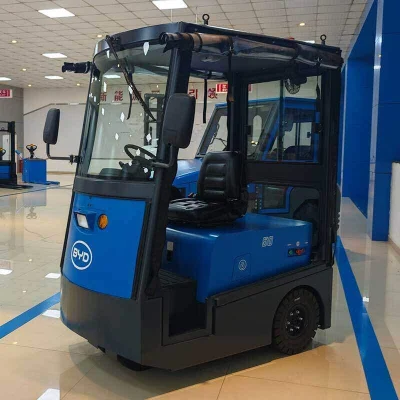
With these details, a supplier can propose a battery and charger combination and explain the assumptions behind it. Without them, any recommendation is guesswork. This is also the point to ask about the selection and configuration of our BYD four-wheel counterbalance electric forklifts, including lithium battery options, so the proposal reflects your actual schedule.
Acceptance Checks and Documents to Confirm
Charging and battery arrangements are easy to overlook during delivery because attention falls on the truck itself. Add the following to the acceptance checklist.
- Battery model, capacity and voltage match the order and the truck’s specification plate.
- Charger model, input supply and output rating match the battery and the installed electrical supply.
- Charging procedure and any restrictions are explained to the operators who will use the truck.
- Spare battery, if purchased, arrives with the correct connection type and any handling equipment specified.
- Documentation covers battery care, charging practice, storage conditions and warranty terms.
Record any deviation in writing and resolve it before signing acceptance. A mismatch between charger and battery, or a charging routine that conflicts with the warranty, can shorten service life and complicate claims later.
Frequently Asked Questions
Can one battery last a full shift?
That depends on the battery capacity, the duty cycle and the charging opportunities within the shift. Provide the supplier with your operating hours, load profile and break pattern, and ask them to state the assumptions behind any runtime claim. Do not accept a figure without knowing the conditions it applies to.
Is opportunity charging bad for the battery?
Not necessarily, but it depends on the battery chemistry and the manufacturer’s instructions. Some lithium battery systems are designed to accept partial charges, while other arrangements have different expectations. Ask the supplier to confirm in writing what charging behaviour their warranty supports.
How much space does a spare battery need?
The space depends on the battery dimensions, the handling method and the storage conditions the supplier specifies. Plan the storage location and the swap route before ordering, and confirm the floor loading and access requirements with the supplier.
What should I include in a battery and charger enquiry?
Include your shift schedule, operating hours per charge, load weights, lift heights, charging location and electrical supply. These details let the supplier propose a configuration and explain its limits rather than offering a generic package.