Selecting a Four-Wheel Counterbalance Electric Fork Lift Truck: Matching Load Capacity and Lift Height to Confined Production Areas
News 02/11/2026
Choosing a four-wheel counterbalance electric forklift truck for a cramped production area is rarely a matter of picking the biggest capacity rating on the data sheet. The real constraint is the relationship between three numbers: the load you must move, the height you must reach, and the load center at which that load sits. A truck that lifts its rated capacity at a 500 mm load center may handle noticeably less once the load is deeper or the forks are raised. In tight production space, that gap between the rated figure and the working figure is where unsafe or impractical choices hide. This guide walks through the conditions to check, the trade-offs to expect, and the questions to settle before requesting a configuration from a supplier.
Why Confined Production Areas Change the Capacity Question
Open warehouses tolerate compromises that narrow production bays do not. When aisles are tight, the truck must be short enough and maneuverable enough to turn inside the available space, and every extra millimeter of counterweight or battery box has to earn its place. Two consequences follow.
First, the rated capacity printed on the truck is a test condition, not a promise about your load. Manufacturers rate capacity at a stated load center, commonly 500 mm or 600 mm, and at a stated lift height. Move the load center outward — a wide pallet, an offset load, a bulky tote — and the safe capacity falls. Raise the load toward maximum lift height and stability margins tighten further.
Second, confined areas often impose height limits of their own: roof trusses, sprinkler lines, cable trays, or mezzanine edges. A truck chosen only on lift height may fit the racking but not the building. The selection task is therefore to find the combination of capacity, lift height, load center, and physical size that satisfies the tightest constraint in the room, not the most generous one on the brochure.
Separating Rated Capacity from Working Capacity
Treat the rated capacity as an upper bound that applies only under the manufacturer’s stated test conditions. Your working capacity is lower whenever any of the following differ from those conditions: load center greater than the rated value, lift height above the rated height, attachments such as a side shifter or clamp that move the load forward, or uneven floors that tilt the mast. Ask the supplier to state the capacity at your actual load center and your actual lift height, and put both numbers in writing.
Matching Load Capacity to Real Loads and Attachments
Start with the heaviest unit load, not the average. Then add the weight of any pallet, stillage, or fixture that travels with the goods, because the truck carries that too. A load that looks light on the shipping document may be considerably heavier once packaging and handling equipment are included.
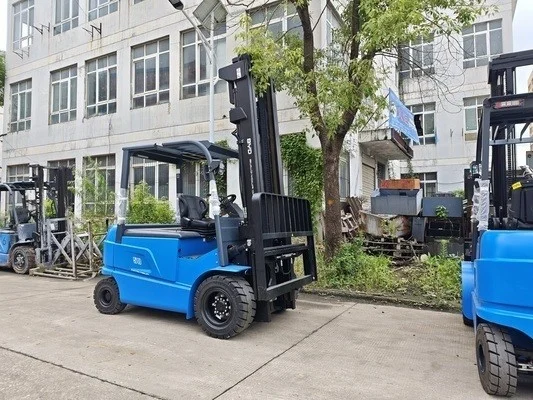
Next, measure the load center. This is the horizontal distance from the vertical face of the forks to the center of gravity of the load. A standard pallet loaded symmetrically often sits near the rated load center; a long crate, a drum on a pallet, or an overhanging load does not. If you cannot measure it, estimate conservatively and confirm with the supplier.
Attachments deserve particular attention. A side shifter, a fork positioner, or a clamp adds weight to the carriage and pushes the load further forward. Both effects reduce the capacity available at the forks. The capacity lost depends on the specific attachment, so request the derated figure rather than assuming a small percentage.
Checklist: Data to Collect Before Asking about Capacity
- Heaviest unit load, including pallet or stillage weight
- Load dimensions and the resulting load center
- Required lift height, measured to the fork surface at the highest pick and place point
- Any attachment planned, with its model
- Floor condition and any ramps or slopes on the route
- Available aisle width at the tightest point, including doorways and corners
- Building height limits along the travel path
Lift Height, Load Center, and the Stability Trade-Off
Lift height and capacity interact. A truck rated to lift a given load at 3,000 mm may not be rated to lift the same load at 6,000 mm, because the mast and hydraulic system are sized around a defined duty. When your racking or production line requires high placement, confirm the capacity at that height specifically.
There is also a geometric limit. Higher lifts generally require a taller mast, and taller masts can reduce overhead clearance when collapsed and increase the truck’s overall height. In a building with low trusses or ductwork, a high-lift specification may simply not fit. The practical approach is to measure the highest point you must reach and the lowest overhead obstruction along the route, then ask what mast options sit between them.
| Selection Factor | What to Confirm | Common Mistake |
|---|---|---|
| Capacity | Rated capacity at your load center and lift height | Using the headline rating with a deep or offset load |
| Lift height | Capacity at the highest required placement point | Assuming capacity is constant through the lift range |
| Mast height | Collapsed height against overhead obstructions | Checking only the extended height |
| Attachments | Derated capacity with the attachment fitted | Ignoring attachment weight and forward offset |
| Footprint | Turning radius and aisle width at the tightest point | Measuring only the main aisle |
What Confined Space Really Demands
In narrow production areas, the limiting factor is often not capacity but geometry. A four-wheel counterbalance electric forklift needs room to turn, and its rear counterweight swings outward during a turn. Measure the tightest aisle, the doorway width, and the corner radius along the actual route. If the route includes a ramp, check that the truck can handle the gradient with the load, because gradeability figures also depend on load and are not constant.
Where space is genuinely very tight, other truck types exist, but they serve different duties and should not be treated as interchangeable with a counterbalance truck. The counterbalance design remains a common general-purpose choice in production and warehousing because it can lift, travel, and stack from floor level, but that versatility comes with a footprint that must be checked against your aisles.
Turning Selection Data into a Practical Configuration
Once the load, load center, lift height, and aisle dimensions are known, the configuration question becomes manageable. Work through it in this order:
- Set the working capacity. Take the heaviest load, add packaging, and confirm the load center. Ask the supplier what capacity is available at that load center and at your required lift height.
- Fix the lift height. Identify the highest pick and place point, then confirm capacity at that height and the collapsed mast height against overhead obstructions.
- Account for attachments. If a side shifter or other attachment is needed, obtain the derated capacity rather than estimating it.
- Check the footprint. Compare turning radius and truck dimensions with the tightest aisle, doorway, and corner on the route.
- Review the duty cycle. Consider shift length, travel distance, and charging or battery-swap arrangements. A truck that meets the load and height requirements but cannot complete a shift without a long charge is not a practical match.
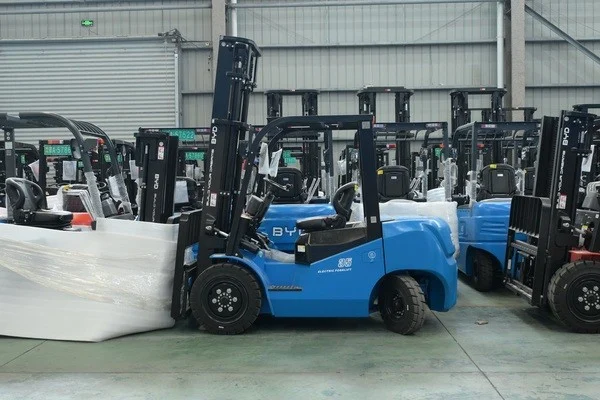
This site supplies BYD four-wheel counterbalance electric forklifts, including lithium-battery models. If you share your actual load, load center, lift height, aisle width, floor and ramp conditions, and shift pattern, the selection and configuration discussion can focus on the models and options that genuinely fit, rather than on a generic capacity class.
Frequently Asked Questions
Can I use the rated capacity as my working limit?
No. Rated capacity applies at the manufacturer’s stated load center and lift height. A deeper load center, a higher lift, or an attachment reduces the safe working capacity. Confirm the figure at your actual conditions in writing.
How do I measure the load center?
Measure horizontally from the vertical face of the forks to the center of gravity of the loaded pallet or container. For symmetrical loads this is often close to half the load depth, but irregular or overhanging loads need individual assessment. When uncertain, estimate conservatively and verify with the supplier.
Does a higher lift always mean a larger truck?
Not always, but higher lift usually requires a taller mast, which affects collapsed height and overhead clearance. Check both the extended height you need and the collapsed height against obstructions along the route.
What should I send when requesting a configuration?
Provide the heaviest load with packaging, load dimensions, required lift height, any attachment, tightest aisle and doorway dimensions, floor and ramp conditions, and shift and charging patterns. These details let the supplier propose a realistic configuration instead of a nominal capacity class.