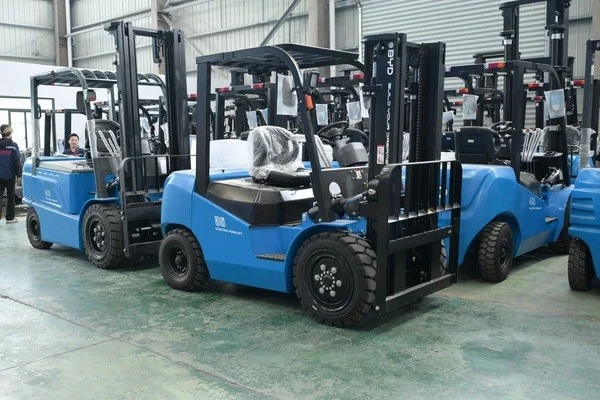
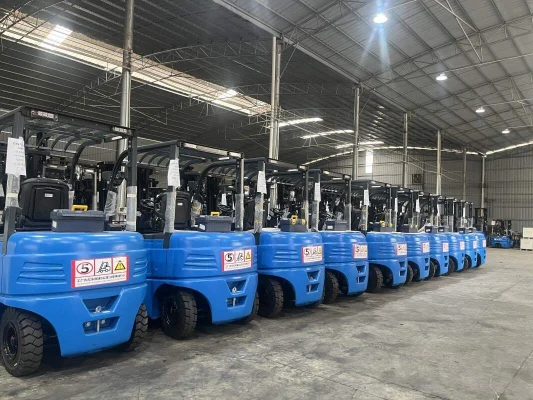
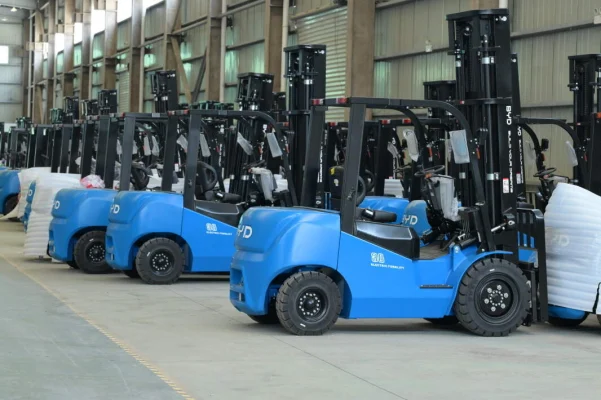
5 Ton Forklift Price: Why Motor Duty Rating and Controller Configuration Shift Four-Wheel Counterbalance Electric Forklift Cost
News 07/11/2026
A 5 ton forklift price cannot be quoted from load capacity alone. Two machines rated at 5,000 kg can carry very different price tags once you compare motor duty rating and controller configuration. Motor duty rating describes how hard the drive and hydraulic motors are expected to work across a shift, while controller configuration covers the power electronics that regulate those motors, manage battery current and set how smoothly the truck accelerates, lifts and brakes. Together they influence component selection, thermal design and the amount of engineering a supplier must put into a four-wheel counterbalance electric forklift. This article explains what each factor changes, which questions to ask a supplier, and where the real cost boundaries sit.
Why a 5 Ton Rating Is Only the Starting Point
Rated capacity is a useful headline figure, but it is measured under defined conditions. A 5,000 kg rating normally applies at a stated load center, often 500 mm or 600 mm, and at a stated lift height. Move the load further out or lift it higher, and the safe capacity falls. That is why two trucks with the same nominal rating can differ in counterweight, mast section, axle sizing and hydraulic pressure.
Buyers comparing quotes should therefore treat the capacity figure as an entry condition rather than a specification. The more revealing differences usually sit in the duty rating of the motors and the architecture of the controller. A truck built to run occasional light handling and a truck built to run repeated heavy cycles may look similar in a brochure, but they are not the same product.
Motor Duty Rating: What It Changes and Why It Costs More
Motor duty rating expresses the operating pattern a motor is designed to tolerate. Standards such as IEC 60034-1 describe duty types, including continuous duty (S1) and short-time or intermittent duty (S2, S3). A motor rated continuous duty is intended to run under load without a defined rest period. A motor rated intermittent duty is intended to run under load a defined portion of a cycle and then rest.
In practical terms, duty rating affects three cost drivers:
- Thermal margin. A higher duty rating usually means more copper, better insulation class or a larger frame, all of which raise material cost.
- Cooling. Motors expected to work harder need more effective heat removal, whether through fan cooling, airflow paths or temperature monitoring.
- Protection and derating. The controller may need to limit current or torque under certain temperatures, and that protection logic has to be engineered and tested.
Duty rating is not a performance guarantee by itself. It is a design intent that must be matched to the actual work cycle. A buyer who specifies continuous duty but then operates short bursts with long idle periods may be paying extra without benefit. Conversely, a buyer who specifies a light duty rating but runs back-to-back loading cycles may see thermal protection intervene.
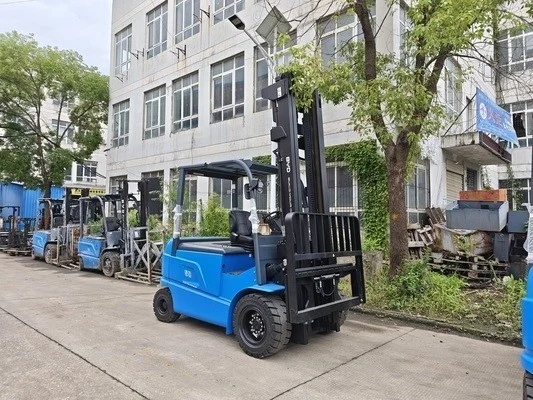
How to Describe Your Duty Cycle to a Supplier
Instead of asking only about motor duty rating, describe the work. Useful details include the average load weight, the number of lift and travel cycles per hour, the lift height, the distance travelled, the gradient, the ambient temperature and the number of hours per shift. These inputs let a supplier match the motor and controller configuration to the job rather than to a label.
Controller Configuration: The Hidden Cost Variable
The controller governs how electrical energy reaches the drive and hydraulic motors. Configuration choices influence cost in ways that are not always visible on a specification sheet.
Power stage and current capacity
A controller must handle the current the motors demand, including short peaks during acceleration and lifting. Higher current capacity generally requires more robust power semiconductors, larger busbars and more heat sinking. Suppliers should state the controller rating and the conditions under which it applies.
Control strategy and tuning
Controllers can be configured to prioritise smoothness, responsiveness or energy efficiency. Tuning a 5 ton truck so it feels stable with a heavy load at height may require different parameter sets than tuning a truck used mainly to shuttle pallets at low height. The engineering time behind that tuning is part of the cost.
Battery and charging integration
With lithium battery models, the controller must communicate with the battery management system to manage current limits, state of charge and temperature. The depth of that integration, and the safety logic around it, varies between suppliers. Buyers should ask which battery parameters the controller monitors and what happens when limits are reached.
Diagnostics and service access
Diagnostic capability, fault logging and service access affect lifetime ownership cost. A controller with clearer fault reporting may reduce troubleshooting time, but it may also add cost at purchase. This is a trade-off worth discussing openly rather than assuming.
What a Quote Should Clarify Before You Compare Prices
Price comparisons are only meaningful when the underlying scope is similar. The checklist below helps separate genuine cost differences from configuration differences.
| Item to confirm | Why it matters |
|---|---|
| Rated capacity and load center | Determines whether the 5 ton rating applies to your actual load position |
| Lift height and mast type | Affects capacity, structural sizing and cost |
| Motor duty rating and insulation class | Indicates design intent and thermal margin |
| Controller rating and configuration | Affects performance, protection logic and diagnostics |
| Battery type, capacity and charging method | Shapes shift coverage and charging infrastructure requirements |
| Tyres, fork dimensions and attachments | Changes load handling and may reduce rated capacity |
| Warranty terms and service scope | Part of total cost, not an optional extra |
Where a supplier cannot confirm a parameter, ask what test condition it refers to. A number without a condition is difficult to compare. This is especially true of current ratings, duty ratings and capacity figures.
Operating Conditions That Shift the Cost Balance
Consider a hypothetical application: a warehouse handling 5,000 kg pallets at low height, with short travel distances and moderate cycle counts. In that setting, a truck configured with a moderate duty rating and a well-tuned controller may be adequate, and paying extra for heavy-duty thermal design may not return value. Now consider a different hypothetical: an outdoor yard with gradients, longer travel and repeated lifting to height across a full shift. Here the thermal margin and current capacity become more relevant, and a lower-cost configuration may reach its limits sooner. Neither scenario proves a general rule; both show why the work cycle should drive the specification.
Frequently Asked Questions
Does a higher motor duty rating always mean a higher price?
Usually it adds cost because of larger frames, better insulation or more cooling, but the total price also depends on the controller, battery and mast. A higher duty rating on one component does not by itself define the machine price.
Can I compare two 5 ton forklift prices directly?
Only after confirming capacity at your load center, lift height, motor duty rating, controller configuration, battery and warranty scope. Quotes with different scopes are not directly comparable.
Is controller configuration relevant to a lithium battery truck?
Yes. The controller must work with the battery management system to manage current, temperature and state of charge. The depth of that integration is a configuration choice and should be confirmed with the supplier.
What information should I prepare before requesting a quote?
Load weight and dimensions, load center, required lift height, aisle width, floor and gradient conditions, cycle counts per hour, shift length and charging arrangements. These details let a supplier propose a four-wheel counterbalance electric forklift configuration that matches the job. Buyers seeking a比亚迪 four-wheel counterbalance electric forklift can share these inputs to discuss selection and configuration.