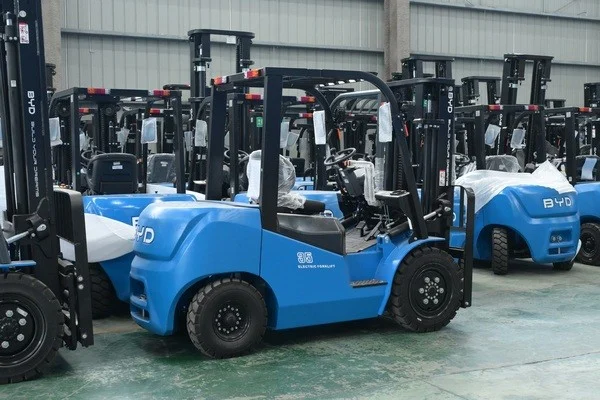
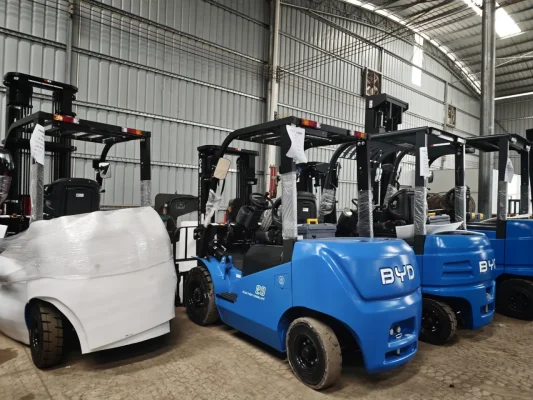
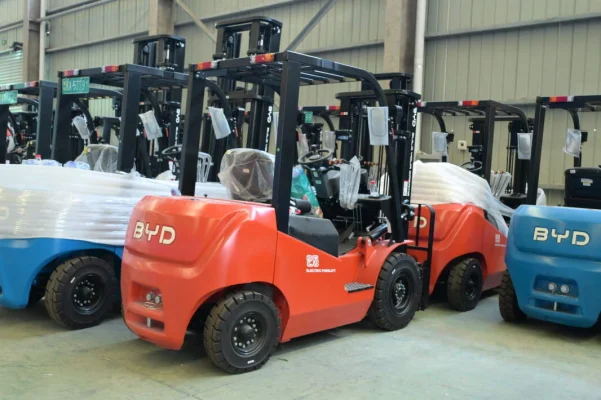
BYD ECB35 Four-Wheel Counterbalance Electric Forklift: Battery and Charger Compatibility Checks Before Ordering
News 07/11/2026
Ordering a BYD ECB35 four-wheel counterbalance electric forklift involves more than confirming load capacity and lift height. Battery and charger compatibility directly affect uptime, charging efficiency, and long-term operating cost. This article outlines the key checks you should perform before finalizing an order, based on the actual operating conditions and the technical specifications provided by the manufacturer.
Operating Conditions That Drive Battery and Charger Choices
The first step is to understand your application. A four-wheel counterbalance electric forklift like the BYD ECB35 is a common choice in warehouses, manufacturing plants, and distribution centers. However, the specific demands of your operation—shift patterns, load weights, lift heights, and ambient conditions—determine the appropriate battery and charger configuration.
Shift Patterns and Duty Cycle
How many hours per day does the forklift operate? Single-shift operations may allow opportunity charging during breaks, while multi-shift operations might require battery swapping or fast charging. The duty cycle—the ratio of working time to total time—affects how deeply the battery is discharged and how frequently it needs charging. Provide your actual shift schedule and average run time per shift to your supplier.
Load and Lift Requirements
The rated load capacity and lift height influence energy consumption. Heavier loads and higher lifts require more power, which can impact battery drain. Confirm the maximum load weight and lift height you need, and check that the forklift’s rated capacity at the required load center meets your demands. The manufacturer’s data sheet will specify capacity at different load centers.
Ambient Temperature and Environment
Temperature extremes can affect battery performance and charging. If you operate in cold storage or hot environments, you must verify the battery and charger’s operating temperature range with the manufacturer. Do not assume standard specifications apply; request the exact temperature limits for both discharge and charge cycles. Additionally, consider exposure to dust, moisture, or corrosive substances, which may require additional protection.
Battery and Charger Compatibility Checks
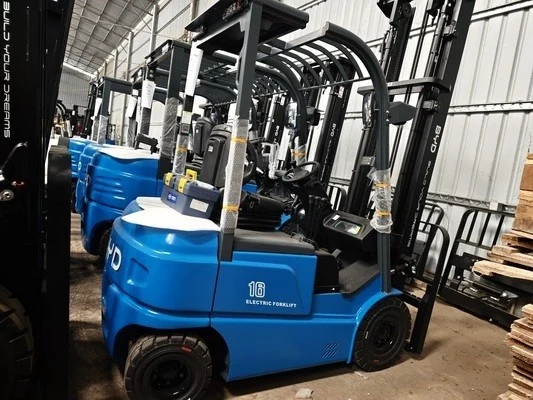
Once you understand your operating conditions, you can evaluate the battery and charger options. The BYD ECB35 typically uses lithium iron phosphate (LiFePO4) batteries, which have specific charging requirements. Compatibility involves voltage, capacity, charging profile, and communication between battery and charger.
Voltage and Capacity Matching
The battery voltage must match the forklift’s electrical system. The ECB35 is designed for a specific voltage, so ensure the battery you select is compatible. Capacity, measured in ampere-hours (Ah), determines runtime. Choose a capacity that covers your shift requirements with a safe margin, considering battery aging. The manufacturer’s specifications will list the standard battery capacity and optional sizes.
Charging Profile and Charger Type
Lithium batteries require a charger with a compatible charging profile—typically constant current/constant voltage (CC/CV). Using an incompatible charger can damage the battery or reduce its lifespan. Confirm that the charger’s output voltage and current align with the battery’s specifications. Also, consider charger type: onboard vs. off-board, and charging speed (e.g., standard vs. fast charging). Fast charging may require a higher-power charger and adequate infrastructure.
Communication and Safety Features
Modern lithium batteries often include a battery management system (BMS) that communicates with the charger to ensure safe charging. Verify that the charger supports the BMS protocol used by the battery. This communication helps prevent overcharging, over-discharging, and thermal events. Ask your supplier about the compatibility of the BMS and charger, and whether any additional configuration is needed.
Physical Compatibility and Installation
Check the physical dimensions and weight of the battery to ensure it fits the battery compartment and does not affect the forklift’s stability. The charger’s installation location should be considered: it requires appropriate power supply, ventilation, and clearance. Ensure that the charger’s connectors match the battery’s connectors, and that the charging cable length is sufficient for your parking arrangement.
Frequently Asked Questions
Can I use an existing lead-acid charger with a lithium battery?
No, lead-acid chargers are not compatible with lithium batteries because they use different charging profiles. Using a lead-acid charger on a lithium battery can cause damage or safety hazards. Always use a charger specifically designed for lithium batteries and matched to the battery’s specifications.
What information should I provide to the supplier to ensure compatibility?
Provide details on your shift pattern, average run time, load weight, lift height, ambient temperature range, and available charging time. Also, specify your power supply characteristics (voltage, phase, frequency) and any space constraints for the charger. This information allows the supplier to recommend a compatible battery and charger configuration.
How do I verify the battery and charger specifications?
Request the manufacturer’s technical data sheets for both the battery and charger. Check that the voltage, capacity, charging profile, and communication protocol match. If possible, ask for a compatibility statement or certificate from the manufacturer. Do not rely on verbal assurances; insist on documented specifications.
What are the key considerations for cold storage applications?
Cold temperatures reduce battery capacity and can affect charging. Verify the battery’s operating temperature range and whether it has built-in heating. Confirm the charger’s operating temperature range and whether it can be installed in a cold environment. Also, check for any special cold-weather packages, such as low-temperature hydraulic oil and sealed connectors, which may be available as options.
Pre-Order Checklist and Supplier Questions
Before placing your order, gather the following data and discuss them with your supplier to ensure a smooth integration.
- Operating data: shift schedule, average run time per shift, maximum load weight, maximum lift height, load center, ambient temperature range, and any special environmental conditions.
- Charging infrastructure: available power supply (voltage, phase, frequency), charging location, available charging time, and space for charger installation.
- Battery and charger specifications: voltage, capacity, charging profile, BMS communication protocol, physical dimensions, and weight.
- Documentation: manufacturer’s data sheets, compatibility certificates, and warranty terms for battery and charger.
Ask your supplier:
- What battery capacity do you recommend based on my operating data?
- Is the charger compatible with the battery’s BMS? What communication protocol is used?
- What are the operating temperature limits for discharging and charging?
- Are there any optional configurations for cold storage or harsh environments?
- What is the expected battery life under my operating conditions, and what warranty is provided?
- Can you provide references or case studies of similar applications? (Note: verify the relevance and authenticity of any references.)
By systematically checking these points, you can avoid compatibility issues and ensure that your BYD ECB35 four-wheel counterbalance electric forklift delivers reliable performance. Always rely on the manufacturer’s technical documentation and consult with your supplier to confirm specifications that are not covered here.