BYD ECB Forklift Pre-Purchase Checklist: Verifying Mast, Hydraulics, and Battery Records on Used Four-Wheel Counterbalance Units
News 05/11/2026
A used BYD ECB forklift can be a sensible purchase only when the mast, hydraulic system, and battery records support the asking price and the duty you plan to run. This checklist organizes the verification work into a sequence you can follow during an inspection, with each section listing the evidence to request and the conditions that should make you pause. It applies to four-wheel counterbalance electric forklifts; other truck types fall outside the scope discussed here.
Start With the Machine Identity and Paper Trail
Before touching the mast or hydraulics, confirm that the machine is what the seller says it is. Record the data plate details, hour meter reading, and any model or serial markings, then compare them against the documents provided. A mismatch between the plate and the paperwork deserves a written explanation.
Ask the seller to supply the following, and note which items are missing rather than accepting verbal assurances:
- Original purchase or import documentation, where available
- Service and repair history, including major component replacements
- Battery documentation: pack type, capacity, age, and any replacement or repair records
- Charger documentation and the charging profile used
- Records of accident damage, mast repair, or structural welding
- Inspection or safety check reports the seller holds
Missing records are not automatically disqualifying, but they shift risk to you. Price the absence of documentation into your decision, and treat undocumented repairs as unknown rather than assumed acceptable.
Mast and Carriage Inspection Points
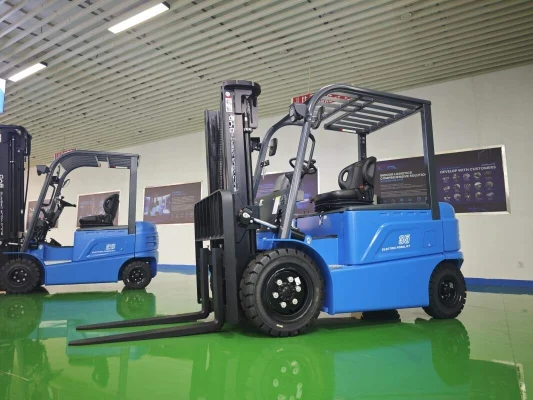
The mast carries the load and absorbs most of the wear on a used truck. Inspect it with the carriage lowered, then repeat key checks at partial and full lift where site safety permits. Look along the rails and channels with a light at an angle; cracks, deep gouges, and deformation are reasons to stop and seek expert assessment.
What to Check on the Mast Structure
- Rail straightness and visible bending or twist
- Welds at rail joints, cross members, and mounting points
- Chain condition: elongation, twisted links, corrosion, and equal tension across chains
- Chain anchor pins and adjusters, including locking provisions
- Rollers and their wear, plus any flat spots or looseness in the channels
- Carriage and fork heel wear, fork tip alignment, and fork locking pins
- Hose routing along the mast, with chafing or crushed sections noted
Operate the lift through its full range and watch chain tension and roller movement. Uneven chain tension, a jerking raise, or a carriage that drifts indicates adjustment or repair work is needed. Confirm the rated capacity and load center shown on the plate, and check that the mast specification matches the lift height and capacity you actually need.
Hydraulic System Verification
Hydraulic faults are often cheap to fix and occasionally expensive, so separate the two during inspection. Begin with a cold machine, note the reservoir level, and look under the truck after operation to identify leak points.
Leaks and Component Condition
- Cylinder rod surfaces: scoring, pitting, or chrome damage
- Cylinder seals and glands: weeping or drips after a lift cycle
- Hoses and fittings: abrasion, bulging, cracked covers, and loose connections
- Valve block and pump area: residue that indicates a slow leak
- Reservoir, breather, and filters: contamination or overdue service evidence
Function Tests
With the truck on level ground and the area clear, raise and lower the mast, tilt forward and back, and check that movement is smooth and controlled. Watch whether the load holds position when the lever returns to neutral. Slow drift, unusual noise from the pump, or a spongy response points to internal leakage or air in the system. Record fluid color and smell; burnt or milky fluid suggests overheating or water ingress and warrants a closer look at service history.
Ask what hydraulic oil was used and when it was last changed. Where records are absent, plan a fluid and filter service after purchase and include that cost in your budget.
Battery and Charging Records on Used Electric Trucks
Battery condition strongly influences the value of a used electric counterbalance truck, and it is the area where paperwork matters most. Request the pack’s documented capacity, voltage, age, and any cell or module replacement history. Compare those records with the physical pack and the charger supplied.
Documents to Request
- Battery pack identification and manufacturer information
- Date of manufacture or first use, and any replacement dates
- Service events, including repairs or module changes
- Charger model and the charging routine followed
- Any state-of-health or capacity test results the seller holds
If no test results exist, ask whether a capacity check can be arranged before purchase. A short trial shift that reflects your real workload is more informative than a brief demonstration. During the trial, note the starting state of charge, hours worked, and remaining charge; this gives you a practical sense of whether the pack suits your shift pattern.
Charging Conditions to Confirm
Check that the charger matches the pack and that your site’s power supply can support it. Confirm where charging will take place, ventilation, and whether opportunity charging fits your schedule. These are selection questions as much as inspection questions, and they should be settled before you commit.
When you request a quote on a used or new BYD four-wheel counterbalance electric forklift, share your load weight, lift height, aisle width, floor and ramp conditions, shift pattern, and charging arrangements. Those details let the supplier confirm which configuration suits your operation instead of guessing.
Frequently Asked Questions
How much battery documentation should a used BYD ECB forklift include?
At minimum, look for pack identification, age, and any repair or replacement history. Capacity test results are valuable but not always available. Where records are thin, arrange a trial shift or a capacity check before agreeing a price.
Can I accept a used forklift with no service history?
You can, but treat every undocumented system as unverified. Budget an independent inspection and a baseline service covering hydraulic fluid, filters, and safety checks, and negotiate accordingly.
What mast wear should rule out a purchase?
Cracks, significant deformation, or damaged structural welds need expert assessment and may make the truck unsuitable. Chain elongation beyond the manufacturer’s limit and badly worn rollers also point to repair costs that should be reflected in the price.
How do I check hydraulic performance during a viewing?
Cycle the mast through its full range on level ground, test tilt functions, and watch for drift, noise, and leaks. Check rod surfaces and hose condition. Any uncertainty about internal leakage should prompt a pressure test by a qualified technician.