BYD Forklift for Sale: Matching Rated Capacity and Load Center to Your Heaviest Industrial Loads
News 01/11/2026
When you search BYD forklift purchasing options, the critical question is not just price or brand. The real challenge is ensuring the forklift you choose can safely handle your heaviest loads at the required height and load center. This guide explains how rated capacity and load center interact, and how to match a four-wheel counterbalance electric forklift to demanding industrial applications. We focus on BYD four-wheel counterbalance electric forklifts, including lithium-powered models, because that is our sales scope. Other forklift types are mentioned only to clarify boundaries, not as purchase recommendations.
Why Rated Capacity and Load Center Matter in Heavy Industrial Loads
Rated capacity is the maximum weight a forklift can lift at a specified load center and lift height, as defined by the manufacturer. Load center is the horizontal distance from the vertical face of the forks to the center of gravity of the load. As load center increases, the forklift’s safe lifting capacity decreases. Industrial loads often have irregular shapes, long extensions, or off-center weights, which shift the effective load center outward. Ignoring this can lead to tipping, structural stress, or loss of stability.
For example, a load with a 600 mm load center may reduce capacity compared to a standard 500 mm load center. The exact reduction depends on the forklift model and must be confirmed with the manufacturer’s load chart. Never assume the rated capacity on the data plate applies to all load shapes and heights.
Selecting a BYD Four-Wheel Counterbalance Electric Forklift: Key Parameters and Configurations
This section walks through the specifications that directly affect performance in heavy industrial settings. We use a general industrial context: manufacturing plants, warehouses, and loading docks with heavy pallets, machinery parts, or dense materials. The same principles apply to other heavy-load scenarios.
Load Capacity and Load Center
Why the industry cares: Heavy industrial loads often exceed 2,500 kg and may have load centers beyond 500 mm. Underestimating capacity leads to unsafe operation. How to verify: Request the manufacturer’s load capacity chart showing capacity at various load centers and lift heights. Confirm the actual weight and center of gravity of your heaviest loads. Trade-offs: Higher capacity models may have larger dimensions or reduced maneuverability. Lithium batteries can affect counterweight needs; confirm with the supplier.
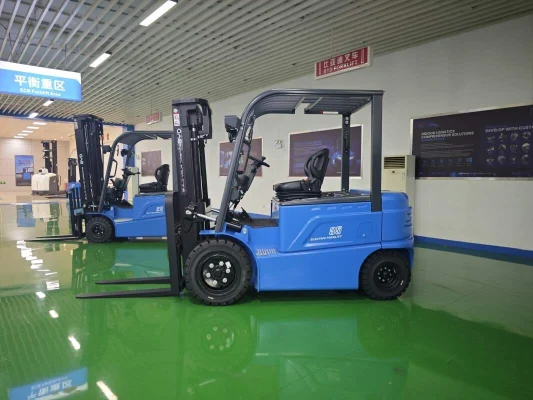
Lift Height and Mast Configuration
Why the industry cares: Lift height affects stability and capacity. Higher lifts reduce capacity. How to verify: Specify the maximum lift height you need and check the capacity at that height. Consider mast type (standard, full-free lift, etc.) based on overhead obstructions. Trade-offs: Taller masts may reduce overhead clearance and require more space. Ensure the mast fits your building’s clear height.
Attachments and Their Impact
Why the industry cares: Attachments such as clamps, rotators, or extenders change the load center and add weight, reducing net capacity. How to verify: Ask the supplier for a capacity rating with the specific attachment. The attachment’s weight and extended load center must be accounted for. Trade-offs: Attachments may require hydraulic modifications and increase maintenance needs.
Battery and Charging Configuration
Why the industry cares: Heavy loads and long shifts demand reliable power. Lithium batteries offer opportunity charging but require appropriate charging infrastructure. How to verify: Confirm the battery voltage and capacity match the forklift’s requirements. Check the charging time and available charging stations. Trade-offs: Lithium batteries may have higher upfront cost but can reduce battery swapping. Ensure the charger is compatible and installed safely.
Dimensions and Maneuverability
Why the industry cares: Heavy loads often require wide aisles and strong floors. How to verify: Measure your aisle widths, turning radius needs, and floor load capacity. Compare with the forklift’s dimensions. Trade-offs: Larger capacity forklifts may have wider turning radii, requiring more aisle space.
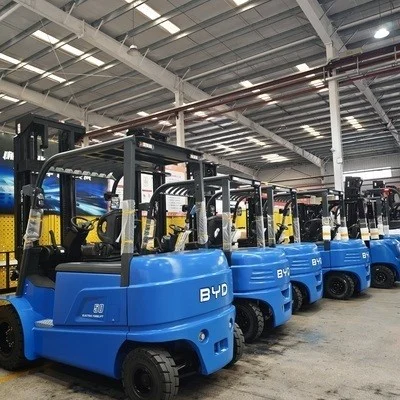
Use the table below to organize your verification process. The table lists key parameters, associated risks, documents to request, and whether an item is standard, optional, or needs factory confirmation. Always confirm with the supplier; not all options are available on every model.
| Parameter | Industry Risk | Documents to Request | Configuration Status |
|---|---|---|---|
| Rated capacity at load center | Overloading, tipping | Load capacity chart | Standard (specific values vary) |
| Lift height capacity | Reduced capacity at height | Capacity at max lift height | Standard |
| Attachment capacity rating | Net capacity reduction | Attachment capacity plate | Optional (needs confirmation) |
| Battery type and charging | Insufficient runtime, charging delays | Battery specification sheet | Standard/optional (confirm) |
| Turning radius and aisle width | Collision, inefficient movement | Dimension drawing | Standard |
| Floor load capacity | Floor damage | Floor load calculation | Site-specific (verify) |
Frequently Asked Questions
How do I determine the load center of my heaviest load?
Measure the distance from the vertical face of the forks to the center of gravity of the load. For irregular loads, use a scale and balance method or consult an engineer. If the load is palletized, the load center is typically half the pallet depth plus any overhang. Always use the actual load center, not an assumed value.
Can I use a standard four-wheel counterbalance forklift in a cold storage environment?
Cold storage may require special configurations such as cold-resistant hydraulic oil, sealed connectors, and battery heating. Not all standard models are suitable. You must confirm the operating temperature range with the manufacturer. Our BYD four-wheel counterbalance electric forklifts can be configured for various environments, but the specific temperature limits and required options must be verified with our team based on your actual conditions.
What should I check if my loads exceed the rated capacity at the required load center?
You may need a higher-capacity model or adjust your handling method to reduce the load center. Never exceed the rated capacity. Consult the load chart and consider using attachments that shift the load center inward. If loads are consistently heavy and off-center, a larger forklift may be necessary.
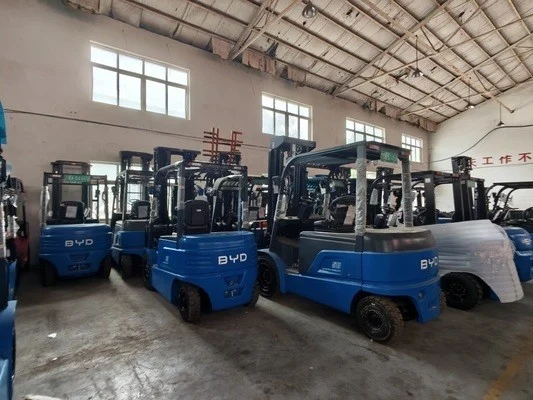
Are BYD lithium batteries suitable for heavy-duty applications?
Lithium batteries can provide consistent power and opportunity charging, which suits multi-shift operations. However, the battery must be sized correctly for your workload. Confirm the battery capacity, charging time, and cycle life with the supplier. We do not make unsupported claims about battery life or performance; request the technical data sheet from our team.
What information should I prepare before requesting a quote?
Gather the following: maximum load weight, load center dimensions, required lift height, aisle widths, floor conditions, operating hours per shift, charging infrastructure, and any special environmental conditions (e.g., cold, dust, moisture). This helps us recommend the right configuration and avoid costly mistakes.
To discuss your specific requirements and explore BYD four-wheel counterbalance electric forklift configurations, contact our team with your load data and operational details. We will help you verify the right capacity and options, without overselling or guessing.