Electric Forklift Battery Cable and Connector Sizing: Matching Current Draw on Four-Wheel Counterbalance Trucks
News 06/11/2026
Cable and connector sizing on a four-wheel counterbalance electric forklift is a chain of dependencies: the battery voltage and capacity, the current the truck actually draws, the length of the run, the connector rating, and the duty cycle that heats everything up. Get one link wrong and the weakest component becomes the bottleneck, causing voltage drop, heat, or nuisance shutdowns. This guide explains how to reason about that chain and which values you must obtain from the truck and battery documentation before ordering parts.
One caution up front: cable and connector selection is a safety-relevant electrical decision. The correct approach is to confirm every value against the manufacturer’s technical data, then have the final assembly verified by a qualified technician. The principles below help you ask the right questions; they do not replace the truck builder’s specifications.
Why Current Draw, Not Battery Capacity, Drives Cable Selection
A common mistake is to size cables from the battery’s amp-hour rating. Capacity tells you how long the truck can work between charges; it does not tell you how much current flows at any instant. Cable and connector sizing follows the instantaneous and continuous current, plus the allowable temperature rise.
On a four-wheel counterbalance electric forklift, current draw varies widely by operation:
- Travel and steering: relatively modest and steady current.
- Lifting a loaded carriage: a short, high-current burst from the hydraulic pump motor.
- Acceleration and grade climbing: traction motor current that rises with load and slope.
- Simultaneous functions: lift while traveling, which can stack demands.
Because these peaks are brief but repeated, the cable must handle short-term heating without excessive voltage drop, while connectors must survive repeated mating cycles and the heat soak that follows heavy use. The truck’s electrical documentation should state the rated or design current of the main power circuit, and often the fuse or breaker rating. Treat those published values as the starting point, not an estimate you invent.
Reading the Sizing Chain: Voltage Drop, Length, and Duty Cycle
Every element between the battery terminals and the controllers adds resistance. The practical consequences are voltage drop under load and heat in the conductor and terminals. Both matter on a battery-powered truck, where the battery is the only source and a sagging supply can trip protection or reduce performance.
Voltage and current
Higher-voltage systems carry the same power at lower current, which generally eases cable and connector demands. However, do not compare systems by voltage alone; a higher-voltage truck may also have larger motors and higher current. Confirm the nominal voltage and the design current together.
Cable length and routing
Longer runs increase resistance and voltage drop. Battery cables on a counterbalance truck are usually short, but routing around the counterweight, through the battery compartment, and to the connector adds length. Bends, tight bundles, and heat sources along the route affect how much current a given cable can carry safely. Where the manufacturer specifies a maximum length or a routing requirement, follow it.
Duty cycle and ambient conditions
A truck working a single shift with long idle periods has a different thermal profile from one in continuous multi-shift operation. Ambient temperature in the battery compartment, ventilation, and whether the connector is exposed to dust or moisture all influence the choice. These are conditions you should describe when asking a supplier to confirm a configuration.
Connector and contact rating
The battery connector is a component with its own current rating, contact resistance, and mating-cycle life. It must match the cable gauge and the truck’s receptacle, and it must be rated at least the circuit’s design current under the intended duty. Mixing a high-current cable with an undersized connector simply moves the weak point. Also confirm the housing keying and polarity arrangement so the battery cannot be connected incorrectly.
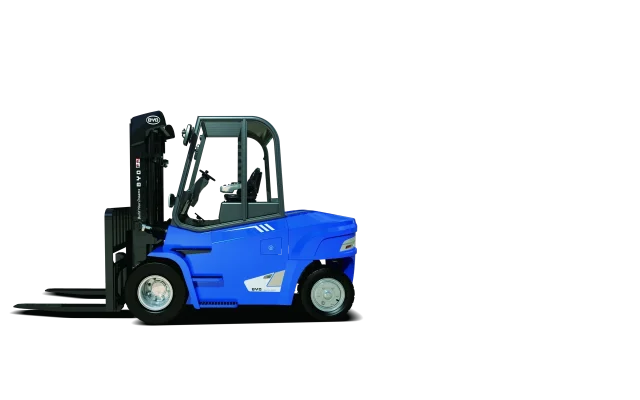
A Practical Selection Sequence
The following sequence keeps the decision grounded in verifiable data rather than guesswork. It applies to four-wheel counterbalance electric forklifts, including lithium-battery models, where the battery and truck documentation should be read together.
- Collect the truck’s electrical data. Nominal voltage, controller input current or rated power circuit current, fuse or breaker rating, and the manufacturer’s cable specification if published.
- Collect the battery data. Nominal voltage, capacity, continuous and peak discharge ratings, and the connector type specified by the battery supplier.
- Confirm the design current. Use the lower of the truck’s protective device rating and the circuit’s rated current as your ceiling, and verify that the battery can supply it.
- Check cable ampacity at the actual conditions. Use the cable manufacturer’s tables, adjusted for ambient temperature, bundling, and routing. Do not assume a value without checking the table’s basis.
- Check voltage drop. Estimate the drop at design current over the actual run length, and compare it with the truck builder’s allowable limit. If no limit is published, ask.
- Match the connector. Verify current rating, contact type, housing keying, and mating-cycle life against the duty cycle and the truck’s receptacle.
- Document the assembly. Record cable gauge, length, lug type, crimp method, connector model, and torque values so future replacement matches the original.
A simple worksheet helps compare options. The table below shows the decision points; the values themselves must come from your documentation.
| Decision point | What to confirm | Typical source |
|---|---|---|
| Design current | Rated circuit current or protective device rating | Truck electrical manual |
| Cable ampacity | Table value adjusted to ambient and bundling | Cable manufacturer data |
| Voltage drop | Calculated at design current over actual length | Calculation plus truck builder limit |
| Connector rating | Current, keying, mating cycles | Connector datasheet |
| Battery compatibility | Voltage, discharge rating, connector type | Battery technical data |
Common Mistakes and How to Avoid Them
Most problems trace back to a few recurring errors. These are general observations about electrical assemblies, not claims about any specific product’s measured performance.
- Sizing from amp-hours. Capacity is an energy measure, not a current rating. Use design current and the protective device rating.
- Ignoring the connector. A correctly sized cable joined by an underrated connector leaves the circuit limited by the connector.
- Assuming shorter is always safe. Short runs reduce voltage drop, but routing, bend radius, and heat exposure still matter.
- Reusing damaged or mismatched parts. Corroded lugs, loose terminals, and incorrect crimps raise resistance and heat. Replace rather than improvise.
- Skipping the duty-cycle question. A configuration adequate for light use may not suit continuous multi-shift work; state the duty when requesting confirmation.
If your operation involves a four-wheel counterbalance electric forklift and you are unsure which cable and connector configuration matches your truck, share the truck model, battery voltage and capacity, lifting height, load weight, shift pattern, and charging routine. Those details let a supplier check the configuration against published data instead of guessing. Where documentation is missing, request it before purchase; a missing value is a reason to pause, not to fill the gap with an assumption.
Frequently Asked Questions
Can I use a larger cable than the original?
Sometimes a larger gauge is acceptable and reduces voltage drop, but it must still fit the lugs, connector housing, and routing space, and it must be compatible with the truck’s terminals. Confirm with the truck builder or a qualified technician before changing the original specification.
Does a lithium battery change the cable sizing?
Lithium batteries can have different discharge characteristics and may include their own battery management limits. The cable and connector must still be rated for the truck’s design current and the battery’s specified connector type. Use the battery supplier’s technical data together with the truck documentation.
How often should battery cables and connectors be inspected?
Inspection frequency depends on duty cycle and environment. Look for frayed insulation, discolored or heat-damaged terminals, loose connections, and worn connector contacts. Follow the truck manufacturer’s maintenance schedule and have any suspect part replaced.
What information should I give a supplier when requesting a configuration?
Provide the truck model and voltage, battery type and capacity, rated or design current if known, connector type, cable length needed, operating environment, and shift pattern. These details allow the supplier to check the proposal against published specifications.