Comparing Maintenance Intervals and Service Access Requirements When Buying Warehouse Electric Forklifts
News 02/11/2026
Maintenance intervals and service access decide how much unplanned downtime a warehouse electric forklift creates over its working life. When you compare four-wheel counterbalance electric forklifts, the useful comparison is not a single number of service hours. It is the combination of three things: what the manufacturer requires, how quickly a technician can reach the components that wear, and whether your operating pattern fits the stated interval. A truck with a long nominal interval but crowded service points can still cost more downtime than one with shorter intervals and clear access.
This comparison sets out the dimensions that matter, the questions to put to any supplier, and the conditions under which one approach suits a site better than another. Specific figures, such as service hour intervals, torque values and fluid capacities, must come from the manufacturer’s technical documentation. Treat any number you cannot trace to that documentation as unconfirmed.
What Maintenance Intervals Actually Cover
Published intervals usually describe routine inspection and replacement tasks under defined operating conditions. They rarely mean the same thing across suppliers. Before comparing, separate the schedule into categories:
- Daily checks performed by the operator: fluid levels, visible damage, warning indicators, tyre condition.
- Periodic inspections performed by a technician: brakes, steering, hydraulic system, lift chain or mast condition, battery and charging system.
- Wear replacements: tyres, brake components, hydraulic filters, and battery-related items.
- Condition-triggered work: repairs or adjustments that depend on load profile, floor quality and environment rather than the calendar.
A meaningful comparison asks which of these categories the stated interval covers, and whether the interval is expressed in operating hours, calendar time, or both. A schedule that counts only operating hours can mislead a low-utilization site, where calendar-based checks such as fluid condition or battery inspection may fall due first.
Operating Conditions Change the Real Interval
Most schedules assume a reference duty cycle. Dust, humidity, cold storage, corrosive atmospheres, uneven floors and frequent heavy-load lifting all tend to shorten the effective interval. If your site differs from the reference conditions, ask the supplier to state how the schedule should be adjusted, or to confirm which tasks remain unchanged. Do not assume a published interval transfers unchanged to a demanding environment.
Service Access: The Overlooked Comparison Point
Service access describes how easily a technician can inspect, remove and replace the components that need attention. It affects downtime independently of the interval. Two trucks on the same schedule can differ substantially in the hours a workshop needs to complete the same task.
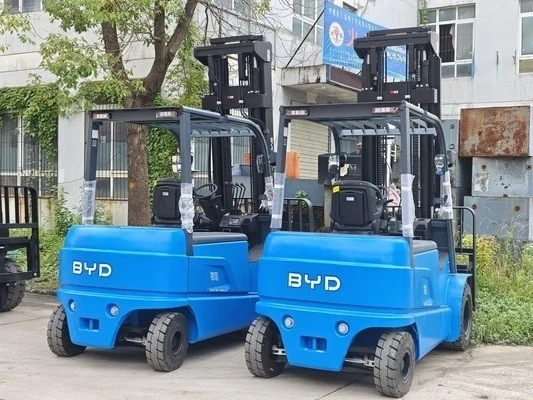
Useful access questions include:
- Does the battery compartment allow inspection and, where applicable, exchange without removing unrelated components?
- Are hydraulic filters and breathers reachable from ground level or a stable platform?
- Is the motor and controller area exposed through removable panels, and are fasteners captive or easily lost?
- Can brake and steering components be inspected without lifting the truck or dismantling the mast?
- Does the mast design allow chain inspection and lubrication along its full length?
- Are diagnostic ports and fault indicators accessible without opening guarded areas?
Access also has a safety dimension. Components that require awkward reaching, temporary supports or removal of guards increase the risk of error during service. A design that keeps routine checks simple supports consistent maintenance, which matters more than a marginally longer interval.
Battery and Charging Considerations
Lithium battery systems generally require less routine water maintenance than flooded lead-acid batteries, but they still have inspection and charging infrastructure requirements. Ask how battery state, charging connectors and the battery management system are checked, and whether those checks fit your shift pattern. The relevant comparison is the total routine workload your team and service provider must absorb, not one component in isolation.
Comparing Suppliers on Schedule and Access
The table below lists dimensions you can compare across suppliers without relying on unverified numbers. Fill each cell from the supplier’s documentation or a site demonstration, and leave cells blank where information is unavailable rather than estimating.
| Comparison dimension | What to request | Why it matters |
|---|---|---|
| Interval basis | Whether intervals are in operating hours, calendar time, or both | Determines which trigger arrives first at your utilization level |
| Reference conditions | The duty cycle and environment assumptions behind the schedule | Shows whether your site needs an adjusted plan |
| Task list | Which checks and replacements belong to each interval | Prevents comparing schedules that cover different work |
| Access points | Location and removal method for filters, battery, motor area, brakes | Indicates likely downtime during service |
| Diagnostics | Fault codes, diagnostic connection, and reset procedures | Supports faster fault finding and fewer repeat visits |
| Parts and support | Availability of wear parts and local service arrangements | Affects how quickly planned work resumes |
Where suppliers provide different interval lengths, treat the longer figure as a claim to verify. Ask what conditions support it and what work is excluded. A shorter schedule with clear tasks and easy access may suit a busy warehouse better than a longer schedule that depends on conditions you cannot meet.
Assumed Scenarios
The following are illustrative, not reported cases. In a single-shift warehouse with a smooth floor and moderate loads, a calendar-based inspection plan may align well with a schedule expressed in operating hours, because neither trigger dominates. In a multi-shift operation with heavy loads and frequent lifting, wear-related tasks are likely to arrive sooner, so access to brakes, tyres and hydraulic components becomes the more important comparison point. In a cold-store or dusty environment, inspection frequency may need review regardless of the nominal interval.
Questions to Settle Before You Buy
Bring your actual duty cycle, floor conditions, shift pattern and charging arrangements to the discussion. Ask the supplier to map the maintenance schedule onto those conditions and to explain how service access affects each task. Confirm which information comes from the manufacturer’s technical documentation and which is general guidance.
If you are evaluating a four-wheel counterbalance electric forklift, share your load weights, lift heights, aisle dimensions and shift pattern so the selection and configuration can be checked against your operation. Do not accept interval or access claims that cannot be traced to documentation, and do not assume a schedule designed elsewhere will transfer unchanged to your site.
Frequently Asked Questions
Are longer maintenance intervals always better?
No. A longer interval only helps if your operating conditions match its assumptions and the required tasks are genuinely covered. If access is poor or conditions are demanding, a shorter but clearly defined schedule can produce less downtime.
Can I adjust the manufacturer’s schedule to my operation?
Adjustments should follow the manufacturer’s guidance. Ask which tasks can be reviewed based on actual conditions and which must remain fixed. Keep a record of any change and the reasoning behind it.
How does service access affect total cost of ownership?
Access affects the labour time needed to complete inspections and repairs. It is one input among several, including parts, support arrangements and utilization. Compare it using documented task times where available rather than assumptions.
What should I ask during a demonstration?
Ask to see the battery compartment, filter locations, diagnostic connection and brake inspection points. Confirm how guards are removed and whether routine checks can be performed safely from ground level.