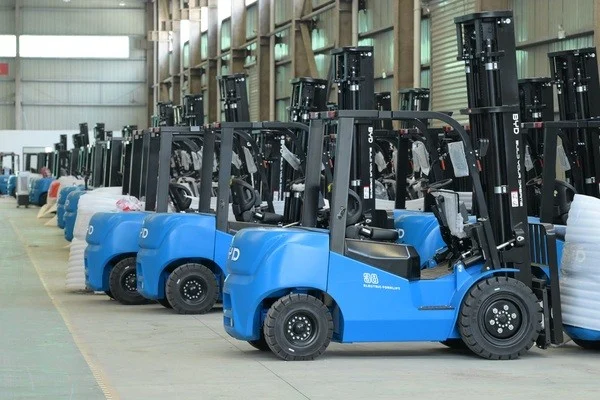
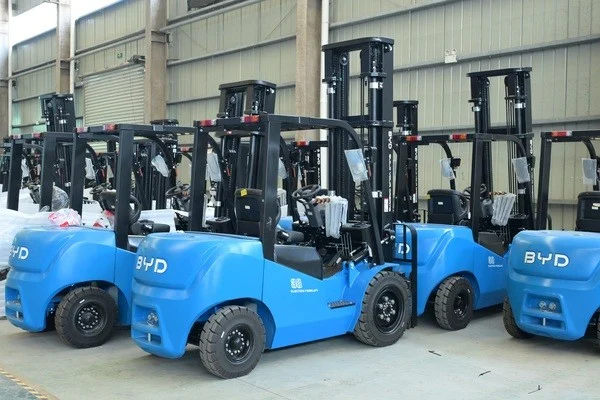
Four-Wheel Counterbalance Electric Forklift: Key Data Plate Checks When Confirming Rated Capacity at Your Actual Load Center
News 03/11/2026
Rated capacity on a four-wheel counterbalance electric forklift is not a single fixed number you can apply to every lift. The data plate states a capacity at a specified load center and lift height, and your real pallet may place the load farther out than that reference point. Confirming capacity at your actual load center means reading the plate carefully, understanding how the stated figures were derived, and checking whether the attachment, load shape and lift height on your floor still sit inside those limits. This guide walks through the plate checks that matter most when you match a machine to a real task.
What the Data Plate Actually Tells You
The capacity plate, sometimes called the nameplate or data tag, is the manufacturer’s declaration of the limits that apply to a specific truck configuration. It is not a general statement about the model line. Two trucks of the same nominal series can carry different ratings if they have different masts, attachments, counterweight arrangements or battery configurations.
Typical entries you should locate and read together include:
- Rated capacity — the maximum load mass the truck is rated to handle under the stated reference conditions.
- Load center — the horizontal distance from the vertical face of the fork to the center of gravity of the load, measured along the fork length.
- Lift height or mast stage reference — many ratings are tied to a specific lift height or mast configuration, and capacity may be reduced as the carriage rises.
- Attachment designation — if a side shifter, clamp or other attachment is fitted, the plate should reflect the derated capacity that applies with it.
- Truck identity and configuration details — model, serial number, battery type and voltage, and any notes tying the rating to a particular build.
Read these as a set. A capacity figure quoted without its load center and lift height reference is incomplete, and using it alone is one of the most common causes of overload.
Why Your Actual Load Center Rarely Matches the Plate
The plate load center is a reference dimension, usually based on a standard pallet position where the load sits tight against the fork shank. In daily work, several things push the true center of gravity farther out:
- Pallets loaded with an overhang beyond the fork tips.
- Loads that are not centered left to right, or that lean.
- Long or irregular goods whose mass sits well forward.
- Attachments that add thickness between the carriage and the load.
- Loads that are not compact or that shift during transport.
When the actual load center is greater than the plate reference, the safe capacity is lower than the number printed on the plate. The relationship is a moment balance: capacity multiplied by load center must stay within the truck’s stability limit. As the load center moves outward, the allowable load mass falls. The exact derating curve is a manufacturer figure and should be taken from the technical documentation supplied with the truck, not estimated from a rule of thumb.
A simple way to frame the check
Measure the horizontal distance from the fork face to where you believe the load’s center of gravity sits. Compare it with the plate load center. If your measured value is larger, the plate capacity no longer applies directly, and you need the manufacturer’s derated capacity at that distance. If you cannot establish the center of gravity with confidence, treat the load as more demanding than it looks and seek confirmation before lifting.
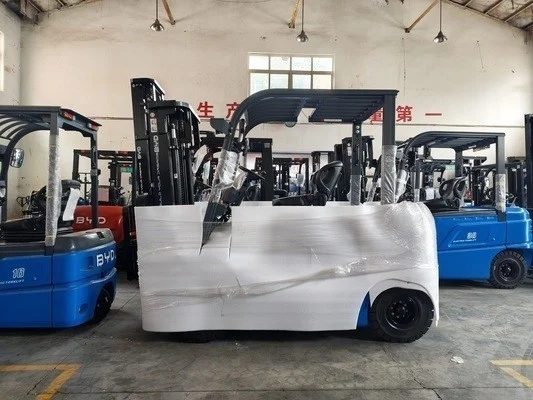
Step-by-Step Plate Verification Before You Lift
The following sequence suits a four-wheel counterbalance electric forklift used in general warehousing, loading and transfer work. Adapt the detail to your site rules, but keep the order.
1. Confirm the plate belongs to this truck
Match the model and serial number on the plate to the truck itself. Plates can be swapped, damaged or made illegible. A missing or unreadable plate is a stop condition, not a detail to work around; the truck’s rating cannot be verified without it.
2. Note every reference condition on the plate
Write down the rated capacity, load center, lift height reference, mast type and any attachment derating. Photograph the plate so the figures can be checked later against the load chart or manual.
3. Measure the load as it will actually travel
Use the real pallet, real packaging and real load distribution. Estimate the mass, locate the approximate center of gravity, and measure its horizontal distance from the fork face. Record the maximum lift height you need, not just the pick height.
4. Compare actual conditions with plate conditions
Check each reference dimension separately. A load that matches the plate load center but needs a greater lift height may still fall outside the rating. A load that matches the lift height but sits farther forward may also fall outside. Both must be satisfied at once.
5. Confirm the derated figure with documentation
Where your conditions differ from the plate references, obtain the manufacturer’s capacity chart or derating information. Do not interpolate between printed figures unless the documentation explicitly supports it.
6. Check the site conditions that affect stability
Floor condition, slope, aisle width and travel speed all influence how safely a given load can be handled. A rating verified on flat, sound concrete does not automatically transfer to a ramp or a damaged floor. Confirm these conditions with the people responsible for the area.
Common Mistakes That Invalidate a Capacity Check
Most capacity problems trace back to a handful of recurring errors rather than unusual loads.
- Treating the plate number as universal. The rated capacity applies at the stated reference conditions, not to every load the truck can physically pick up.
- Ignoring the attachment. Fitting an attachment without confirming the revised rating changes the load geometry and can reduce capacity.
- Using pick height instead of travel height. Capacity is often reduced at higher lift, and the load must be stable through the full travel path.
- Estimating mass from pallet count. Packaging, moisture and load density vary enough that counting units is not a reliable mass check.
- Assuming a heavier-rated truck solves every case. A larger nominal capacity still has a load center and lift height limit; the same verification applies.
- Overlooking battery configuration. The counterweight and battery arrangement are part of the truck’s rated configuration, and substituting components without confirmation can affect the rating.
None of these points requires special equipment to check, but each requires someone to actually read the plate and compare it with the task.
Applying the Check to a Real Selection Decision
Consider a hypothetical application: a warehouse handling palletized goods with an average mass near the truck’s rated capacity, occasional overhanging loads, and racking that requires lifting to several meters. The plate check would proceed as follows. First, confirm the plate capacity and its load center. Second, measure the overhanging pallets to see how far the center of gravity moves forward. Third, note the maximum lift height and compare it with the plate reference. Fourth, obtain the derated capacity that applies to the combination of the longer load center and the higher lift. If the derated figure falls below the real load mass, the task is outside the truck’s rating and needs a different approach: a different load arrangement, a different attachment, or a truck whose documented rating covers the actual conditions.
If you are evaluating a four-wheel counterbalance electric forklift and want to confirm whether a configuration suits your loads, the useful information to gather is the actual load mass, the measured load center, the required lift height, the attachment you intend to use, and the floor and aisle conditions. Those details let a supplier check the documented rating against your task rather than quoting a headline capacity. Where documentation is incomplete, the honest answer is that the figure needs confirmation, not that it can be assumed.
Frequently Asked Questions
Is the rated capacity on the plate the maximum I can lift?
It is the maximum load mass at the plate’s stated load center and lift height reference, with the listed configuration. If your load center is farther out or your lift height is greater, the applicable capacity is lower and must be confirmed from the manufacturer’s capacity information.
What happens if my load center is larger than the plate value?
The allowable load mass decreases as the load center moves outward. The plate number no longer applies directly. You need the derated capacity at your actual load center, which should come from the truck’s technical documentation rather than an estimate.
Does an attachment change the capacity?
Attachments can add weight and move the load farther from the carriage, and the plate should reflect the revised rating when one is fitted. If the plate does not clearly show the attachment configuration, confirm the rating with the manufacturer before use.
Can I use the same capacity figure at every lift height?
Not necessarily. Many ratings are tied to a specific lift height or mast configuration, and capacity may be reduced at greater heights. Check the plate and the capacity chart against the highest point your load will reach, not just the pick height.
What should I do if the plate is missing or unreadable?
Treat the truck as unverified until the rating can be established. Contact the manufacturer or an authorized service provider with the model and serial number to obtain the correct capacity information. Do not rely on memory, a similar truck or a previous plate.