Industrial Forklift Specification Review: Confirming Deck Load Limits and Floor Bearing Pressure Before Installing a Four-Wheel Counterbalance Electric Truck
News 05/11/2026
Installing a four-wheel counterbalance electric forklift requires more than checking aisle width and overhead clearance. Two structural checks often decide whether a site can accept the truck at all: the load limit of any deck, mezzanine, or trailer floor the truck will travel on, and the bearing pressure the truck imposes on the floor slab. This industrial forklift specification review explains what to confirm, how the numbers relate, and which documents to request before delivery. It addresses general engineering principles; actual limits must come from the building designer and the truck manufacturer’s data sheet.
Why Deck Load Ratings and Floor Pressure Are Separate Checks
A deck load rating is a structural capacity statement, usually expressed as a uniformly distributed load or a concentrated load at a specified location. Floor bearing pressure is the contact stress a wheel or outrigger applies to the slab. A truck can satisfy one check and fail the other. A mezzanine rated 5 kN/m² uniformly may still be overstressed by a single heavily loaded drive wheel, because the uniform rating assumes the load spreads across the deck. Conversely, a ground-bearing slab with adequate compressive strength may still need a joint or thickness review where wheel loads concentrate near edges, trenches, or expansion joints.
Treat the two checks as independent gates. Passing the deck rating does not confirm slab capacity, and a thick slab does not make an elevated deck suitable.
Information to Collect Before the Specification Review
Gather site and truck data together; either set alone is insufficient. The following list reflects common practice, not a substitute for a structural assessment.
Site-side documents
- Structural drawings or a design report identifying deck and slab capacity, including any posted load limits.
- Slab thickness, reinforcement, concrete strength class, and joint layout, where available.
- Traffic routes: ramps, dock levellers, elevator thresholds, trench covers, and any suspended sections.
- Clearance measurements at doorways, racking, and overhead obstructions.
Truck-side data
- Rated capacity and load centre from the manufacturer’s data sheet.
- Service weight, including battery, and axle load distribution.
- Wheel type, wheel diameter, and contact patch dimensions.
- Tyre or wheel pressure ratings and any restrictions on floor surface condition.
If any item is missing, mark it as unconfirmed rather than estimating. A specification review that relies on guessed slab thickness or assumed wheel loads is not a review.
Working Through Deck Load Limits
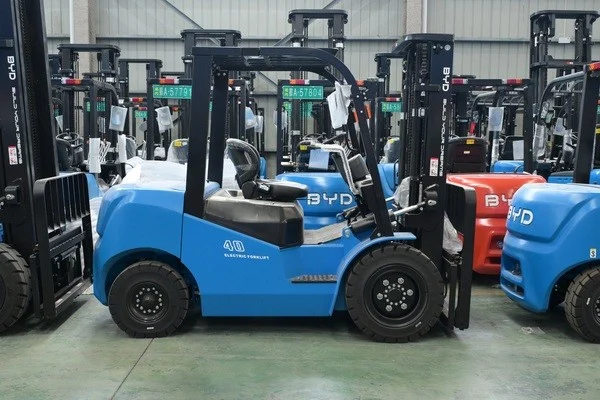
Deck checks usually begin with the posted rating and the truck’s actual configuration. A four-wheel counterbalance electric forklift concentrates much of its weight on the front axle, especially when carrying a load at the rated load centre. The relevant question is not only total weight but where that weight sits relative to the deck’s supporting members.
Questions to put to the building designer
- Does the posted rating cover a moving concentrated load, or only static storage?
- Are there restricted zones near edges, openings, or stair cores?
- Does the rating account the truck’s service weight plus the rated load, or only the payload?
- Are there dynamic effects from braking, turning, or travelling over joints that the rating already includes?
The answers determine whether the truck can use the deck at all, whether it must travel empty, or whether a route change is needed. Do not convert a uniform load rating into a wheel load by dividing by area; that shortcut ignores how decks actually carry concentrated loads.
Assessing Floor Bearing Pressure
Floor bearing pressure is often estimated from wheel load divided by contact area. That estimate is a starting point, not a final answer. Real contact areas change with load, tyre or wheel type, and surface condition. The manufacturer’s data sheet may provide wheel loads or permissible floor pressure; use those figures where available and state the assumptions when they are not.
Practical checks
- Compare calculated or published wheel pressure against the slab’s design capacity, allowing the building designer to judge acceptability.
- Inspect joints, cracks, and patched areas along the route; these are common weak points under repeated wheel loads.
- Check ramps and dock levellers separately; their ratings and surface conditions differ from the main slab.
- Confirm that wheel type suits the surface. Hard wheels on a worn or coated floor can behave differently from the assumption behind a simple pressure calculation.
Where the slab capacity is unknown, the honest conclusion is that bearing pressure cannot be confirmed. A site survey and structural input are then the next step, not a specification approval.
Hypothetical Installation Scenario: What the Review Would Show
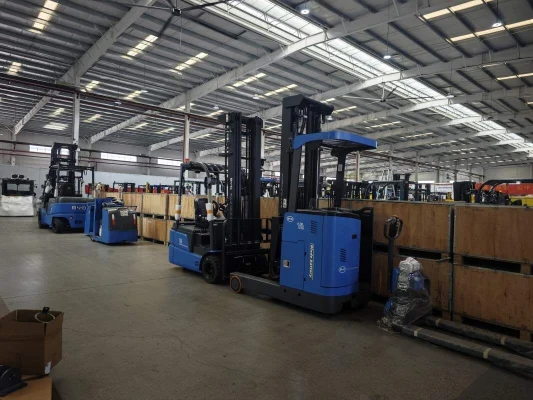
Consider a hypothetical warehouse where a four-wheel counterbalance electric forklift is proposed to move pallets between a ground-floor racking area and a raised loading deck. The deck has a posted uniform load limit, and the slab is described in drawings as reinforced concrete of a stated thickness. The truck’s data sheet lists service weight, rated capacity, and wheel loads.
A disciplined review would first confirm that the deck rating applies to moving concentrated loads and that the route avoids restricted edge zones. It would then pass the slab and joint details to the building designer alongside the truck’s wheel loads. If either answer is incomplete, the installation would be marked conditional: the truck may operate on the ground floor while the deck remains unapproved until structural confirmation arrives. This scenario is illustrative only; it does not describe a specific customer site or measured result.
Frequently Asked Questions
Can a four-wheel counterbalance electric forklift use a mezzanine rated for storage?
Not automatically. Storage ratings often assume distributed loads, while a forklift applies concentrated moving loads. The building designer must confirm that the rating covers the truck’s configuration and route.
Is floor bearing pressure the same as the truck’s total weight divided by four wheels?
No. Weight distribution is uneven, and contact areas vary. Use manufacturer wheel-load data where published, and have the building designer assess the result against slab capacity.
What if the slab drawings are unavailable?
Treat bearing pressure as unconfirmed. A site survey or structural assessment is needed before the truck is approved to operate in that area. Do not substitute a rule of thumb as evidence.
Does a lighter load always reduce the structural concern?
It can reduce wheel loads, but the truck’s service weight and axle distribution still matter, and dynamic effects remain. The review should use the actual operating configuration, not an assumed best case.
Before ordering, request the truck data sheet, confirm the building’s structural documents, and route both sets to the people responsible for the deck and slab. If you are evaluating a four-wheel counterbalance electric forklift, share your actual load, lift height, route, and floor details so the specification can be checked against real conditions rather than assumptions.