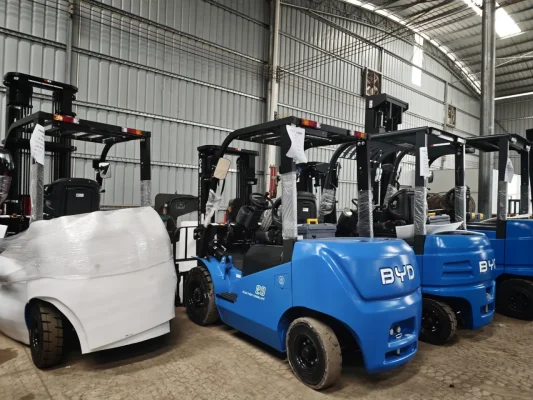
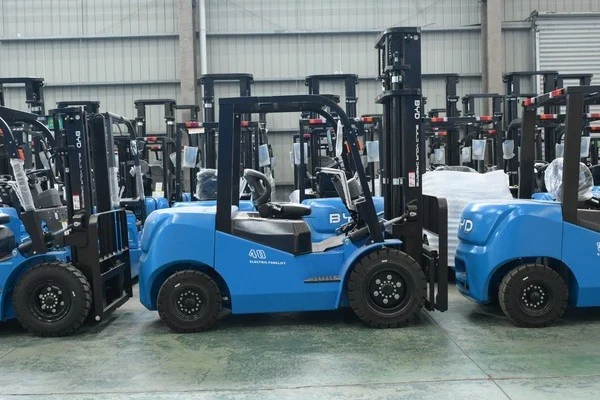
Four-Wheel Counterbalance Electric Fork Lift Truck: Checking Rated Capacity Against Actual Load Center and Lift Height
News 04/11/2026
A four-wheel counterbalance electric forklift rarely carries its rated capacity under the conditions a buyer actually faces. The number on the data plate assumes a specific load center and a specific lift height, and both assumptions shift once you handle deeper loads or stack higher. This article explains how rated capacity, load center, and lift height interact, how to read a capacity chart correctly, and which questions to settle before you specify a truck.
Why the Data Plate Number Is a Conditional Figure
Rated capacity is the maximum mass a truck can lift at a stated load center and lift height while remaining stable. It is a stability limit, not a hydraulic limit. A truck may physically raise a heavier load and still be unsafe, because the risk is tipping forward, not a failure of the lift system.
Two variables move that limit:
- Load center: the horizontal distance from the vertical face of the fork to the center of gravity of the load. Standard ratings usually assume a 500 mm or 600 mm load center.
- Lift height: as the carriage and load rise, the combined center of gravity rises and the truck’s remaining stability margin shrinks.
Manufacturers therefore publish a derated capacity at greater heights and longer load centers. The plate figure is the best-case value within the standard assumption, not a universal ceiling.
Reading a Capacity Chart Without Guessing
A capacity chart, sometimes printed on the plate and sometimes supplied as a separate document, lists permissible load values at combinations of load center and lift height. Read it as a grid, not a single number.
Find your real load center first
Measure the load, not the pallet label. The load center depends on how the goods sit on the forks:
- A uniformly packed pallet loaded flush to the fork heel typically sits close to the standard assumption.
- An overhanging load, an unevenly weighted pallet, or goods set back from the heel shifts the center of gravity.
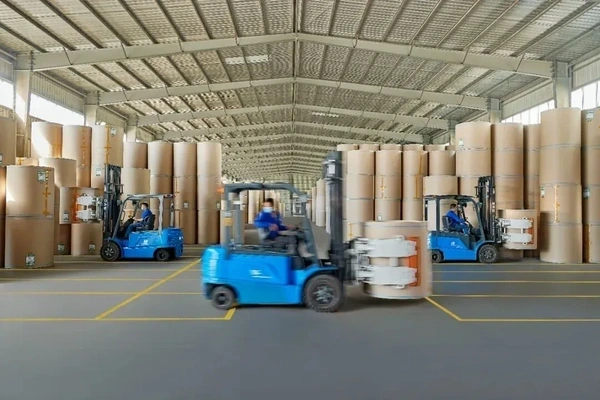
- Attachments such as a sideshifter or a clamp add forward distance and usually carry their own derating, which the attachment supplier should state.
If you cannot establish the load center from the actual packing pattern, treat the worst plausible case as your design value rather than the nominal one.
Then match the highest lift height you truly need
Use the maximum height at which the load must be handled, including rack beam height plus the clearance needed to enter and withdraw the pallet. A truck rated at full capacity to 3,000 mm may be rated considerably lower at 4,500 mm. The chart tells you which figure applies; do not interpolate silently between published points unless the manufacturer permits it.
A worked comparison, using assumed values
The table below is illustrative only. It shows the shape of a typical derating pattern so you know what to look for. Actual values must come from the capacity chart of the specific model you are considering.
| Load center | Lift height | Permissible load (illustrative) |
|---|---|---|
| 500 mm | Up to 3,000 mm | Full rated capacity |
| 600 mm | Up to 3,000 mm | Reduced, roughly 80–85% of rating |
| 500 mm | 4,500 mm | Reduced, roughly 80–90% of rating |
| 600 mm | 4,500 mm | Reduced further, roughly 65–75% of rating |
These percentages are placeholders to illustrate direction and magnitude, not published data. A real chart may derate more steeply, and the pattern differs between models and mast types.
Where Rated Capacity Checks Go Wrong in Practice
Most capacity problems trace back to a handful of recurring mistakes. Each is avoidable with a short check before the truck is ordered or the load is moved.
Buying on the headline number
Comparing trucks by rated capacity alone rewards the model with the most generous standard assumption, which may not be the one that suits your racking. Compare permissible load at your load center and your lift height instead.
Ignoring the attachment
Any attachment that moves the load forward reduces permissible capacity. The forklift supplier and the attachment supplier should both confirm the combined rating; assuming the base truck rating still applies is a common and serious error.
Treating a test lift as proof
A truck that lifts a load without tipping on a level floor has not been shown to be safe. Dynamic effects — braking, turning, lowering quickly, travelling with the load raised — reduce the margin further. Stability standards address these conditions, and the plate rating already accounts for them under defined assumptions; a one-off lift does not.
Forgetting the ground and the route
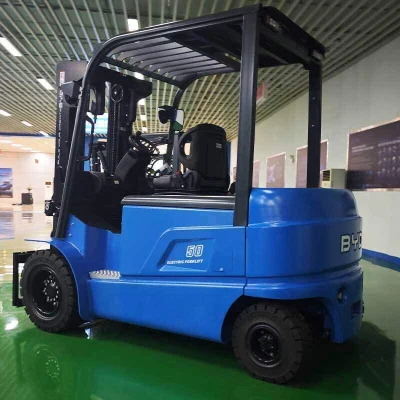
Slopes, uneven surfaces, floor joints, and outdoor use change the picture. A four-wheel counterbalance electric forklift is a common general-purpose choice in factories, loading areas, and warehouses, but suitability still depends on surface condition, gradient, aisle width, and the duty cycle. Ask the supplier to confirm the permitted slope and floor conditions from the technical documentation rather than inferring them.
Turning the Check into a Specification Request
Once you know your real load center and maximum lift height, the specification conversation becomes concrete. Gather the following before requesting a quotation:
- Maximum load mass and the packing pattern that produces it.
- Measured load center, including any overhang.
- Maximum lift height and the rack or stack configuration.
- Attachment type, if any, and its own capacity data.
- Aisle width, floor surface, ramps or gradients on the route.
- Shift pattern and charging window, which affect battery and charger configuration.
With these inputs, the supplier can confirm the permissible load at your actual conditions and recommend a configuration within the four-wheel counterbalance electric range. If any figure is uncertain, say so; a conservative assumption is cheaper than a truck that cannot handle the job. Where documentation is incomplete, ask which parameters still need verification and under what test conditions they were established.
Frequently Asked Questions
Does a higher-rated truck always handle my load?
No. A higher rating at the standard load center and low lift height does not guarantee adequate capacity at your load center and lift height. Compare the capacity charts at your actual conditions.
Can I exceed the rated capacity briefly?
No. The rating is a stability limit with defined assumptions. Brief overloads, especially with the load raised or while turning, remove the safety margin the rating provides.
How do I determine the load center of an uneven pallet?
Estimate the center of gravity from the actual weight distribution, and use the most conservative plausible value. If the packing is irregular, reposition or restrain the load, or confirm the figure with the truck supplier before lifting.
Does lift height matter if I only stack to a low level?
It matters less, but the chart still governs. Use the maximum height at which the load is handled, including clearance to enter the rack, and read the permissible load at that height.