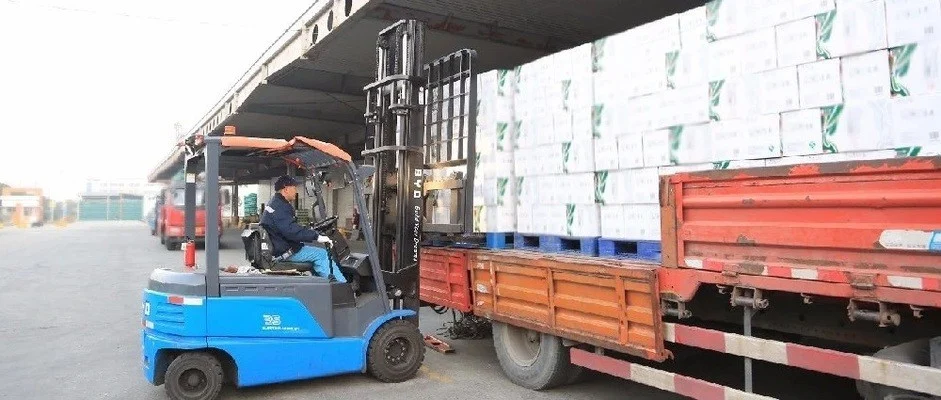
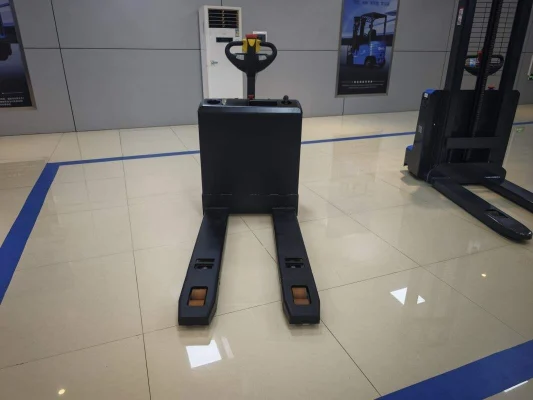
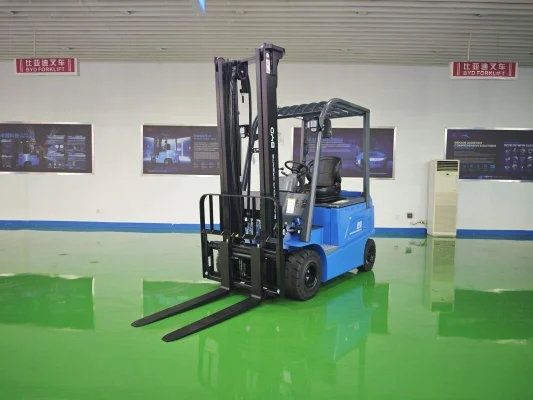
Four-Wheel Counterbalance Electric Forklift: How to Verify Mast Free Lift and Overhead Clearance Before Ordering
News 05/11/2026
When you order a four-wheel counterbalance electric forklift, mast free lift and overhead clearance directly affect whether the truck can work inside trailers, containers, and low-clearance buildings. Free lift is the height the forks rise before the mast channels begin to extend. Overhead clearance is the total height of the truck with the mast at its lowest position. Getting either wrong can mean a forklift that cannot enter a trailer, cannot stack at the required height, or cannot pass under a door header. This article explains how to verify both values before you place an order, using manufacturer data and your own site measurements.
Why These Two Specifications Matter
Free lift and overhead clearance determine whether a truck can load pallets into a trailer, work under mezzanine floors, or enter a building with a low door. In many warehouses, the difference between a standard mast and a full-free-lift mast is the difference between a truck that fits and one that does not.
Consider a hypothetical application: a distribution center receives goods in 53-foot trailers with interior height around 110 inches (2.8 meters), and the dock door header may be lower. A truck with a standard two-stage mast might have an overhead clearance of 85 inches (2.16 meters) collapsed, but its free lift may be only a few inches. As soon as the operator lifts the forks, the mast extends and overall height increases. If the trailer interior is lower than the extended mast height, the truck cannot lift inside the trailer. A full-free-lift mast allows the forks to rise to a certain height without mast extension, keeping overall height constant during that lift.
Overhead clearance becomes critical when the truck must pass under door tracks, sprinkler pipes, or low beams. Even with the mast collapsed, the truck’s overall height must be less than the lowest obstruction along its route. These two specifications are linked: a mast that provides high free lift often has a taller collapsed height because of additional lift cylinders and chain arrangements. The right combination depends on your site conditions.
Key Specifications to Verify
Before ordering, verify the specifications that affect free lift and overhead clearance. The table below summarizes the main parameters. Actual values vary by model and manufacturer; always request the technical datasheet for your specific configuration.
| Parameter | Why It Matters | What to Confirm with Supplier | Configuration Options |
|---|---|---|---|
| Free lift height | Determines how high forks rise before mast extension; critical for trailer and container work | Exact free lift value (mm or inches) of the proposed mast; confirm it meets your required lift height inside the trailer | Standard, full-free-lift, or high-free-lift mast; availability depends on model |
| Overhead clearance (collapsed height) | Total truck height with mast down; must be less than the lowest obstruction on route | Collapsed height with standard forks and any optional equipment (lights, mirrors) | Low-profile mast options; removing optional items may reduce height |
| Maximum fork height | Needed to stack at required rack levels | Rated capacity at maximum height; derating may apply | Triple-stage or two-stage mast; higher masts increase collapsed height |
| Load center and capacity | Free lift and overhead clearance affect capacity; verify capacity at your load center | Capacity chart showing how capacity decreases with load center and lift height | Attachments (side shifter) may reduce capacity and increase overhead clearance |
Free Lift Height
Free lift height is the distance the forks travel upward before the inner mast channel starts to rise. It is determined by mast design: a standard mast has minimal free lift, while a full-free-lift mast has a taller free-lift section. Inside a trailer or container, you need enough free lift to pick and place pallets without the mast extending beyond the trailer’s interior height. Ask the supplier for the free lift height of the exact mast model offered, then measure your trailer or container interior height and subtract a safety margin (e.g., 2–4 inches) to account for load height and suspension. Confirm that the mast’s collapsed height plus the free lift does not exceed the trailer interior height. Note that free lift is not the same as maximum fork height; a mast with high free lift may have a lower maximum fork height than a triple-stage mast.
Overhead Clearance and Mast Type
Overhead clearance is the overall height of the truck when the mast is fully lowered and the forks are at their lowest position. This value includes the mast, overhead guard, and optional equipment such as work lights, mirrors, or beacons. Obtain the collapsed height from the manufacturer’s datasheet specific to your configuration, then measure the lowest obstructions along your routes: door headers, trailer interiors, mezzanine clearances, sprinkler pipes, and light fixtures. The truck’s overhead clearance must be less than the lowest obstruction.
Mast type directly affects both values. A standard two-stage mast has limited free lift and a lower collapsed height, suitable where overhead clearance is not an issue. A full-free-lift two-stage mast provides free lift without mast extension, but its collapsed height may be taller due to additional components. A triple-stage mast offers high maximum fork height but typically has a taller collapsed height and may have limited free lift unless designed as full-free-lift. Specify the mast type when ordering and confirm both values; do not assume that a “full-free-lift” mast on one model matches another. If the standard configuration is too tall, ask about low-profile options and their trade-offs, such as lower maximum fork height or reduced capacity.
Load Center, Capacity, and Site Measurements
Free lift and overhead clearance are not independent of capacity. A mast with high free lift may have a different capacity rating because of the additional structure. The load center (distance from the fork face to the load’s center of gravity) also affects capacity, and attachments such as a side shifter add weight and shift the load center forward, reducing capacity and potentially increasing overhead clearance. Request a capacity chart showing rated capacity at your intended load center and lift height, and verify the truck can handle your heaviest pallet at the required height.
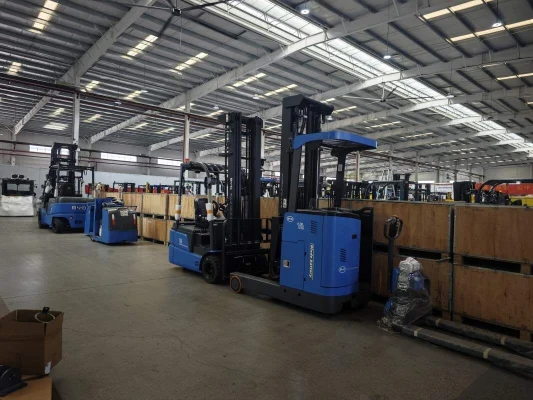
Before finalizing the order, conduct a route survey. Measure the interior height of trailers and containers you will load or unload, the height of door openings and overhead obstructions along travel paths, and clearance under mezzanines, conveyors, and sprinkler systems. Record the lowest clearance along each route and compare it with the truck’s overhead clearance and free lift specifications. If the truck cannot fit, consider alternative configurations, different routes, or a different forklift type.
Procurement Checklist and Supplier Questions
Use this checklist to gather information and verify specifications before ordering.
Data to Collect from Your Site
- Minimum interior height of trailers and containers (measured).
- Lowest overhead obstruction along all travel routes (measured).
- Required lift height inside trailers (e.g., to clear the trailer floor and stack two pallets).
- Maximum stacking height required in the warehouse.
- Heaviest pallet weight and load center (including pallet and any attachments).
- Floor conditions, slopes, and aisle widths.
- Ambient temperature range and any special environmental conditions (washdown, cold storage).
Questions to Ask the Supplier
- What is the free lift height of the proposed mast? Please provide the datasheet.
- What is the collapsed height of the truck with the proposed mast and any optional equipment?
- What is the maximum fork height and the rated capacity at that height?
- How does capacity change with load center and lift height? Please provide a capacity chart.
- Are there low-profile mast options that reduce collapsed height? What are the trade-offs?
- Can the truck be configured with necessary safety features (lights, alarms) without exceeding height limits?
Configuration Check Steps
- Compare the supplier’s free lift height with your required lift height inside trailers. Ensure free lift is at least the required lift height.
- Compare the truck’s collapsed height with the lowest obstruction on your routes. Ensure collapsed height is less than the lowest obstruction.
- Verify that the mast’s collapsed height plus free lift does not exceed trailer interior height.
- Check that the rated capacity at your load center and lift height meets or exceeds your heaviest load.
- Confirm that optional equipment (lights, mirrors, attachments) does not increase height beyond limits.
- Review the datasheet and drawings with the supplier to ensure all dimensions are clear.
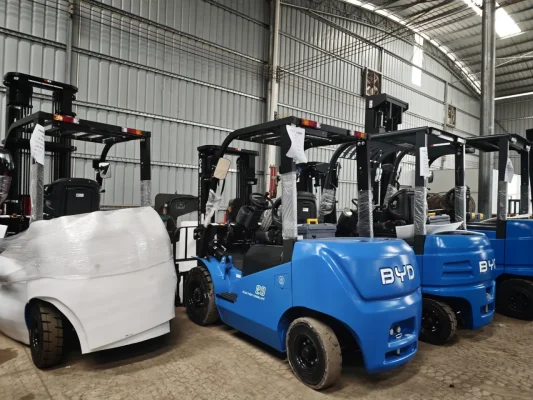
If you are considering a BYD four-wheel counterbalance electric forklift, provide your actual operating conditions, load weight, and lift height requirements to our team. We can help you select an appropriate mast and configuration based on the technical data available. No configuration suits all sites; verification against your measurements is essential.
Frequently Asked Questions
What is the difference between free lift and maximum fork height?
Free lift is the height the forks rise before the mast channels extend. Maximum fork height is the highest the forks reach when the mast is fully extended. A mast with high free lift allows lifting inside low-clearance areas without increasing overall height, but its maximum fork height may be lower than a mast designed primarily for high stacking.
Can I increase free lift after purchasing a forklift?
Generally, no. Free lift is determined by the mast design. Changing it would require replacing the mast, a major modification. It is more practical to specify the correct mast at the time of order. Consult the manufacturer about any possibility of retrofitting, but expect significant cost and potential capacity changes.
How do I measure overhead clearance accurately?
Use a measuring tape or laser distance meter to measure from the floor to the lowest point of obstructions along your travel routes. For trailers, measure the interior height at the entrance and at the deepest point, as it may vary. Consider the effect of suspension and load on trailer height, and add a safety margin of a few inches to account for measurement errors and load variations.
Does adding a side shifter affect free lift or overhead clearance?
A side shifter adds width and weight to the carriage, which may increase overall height slightly and reduce capacity. It does not directly change the mast’s free lift, but the attachment’s additional height must be considered in the collapsed height. Always include attachments when verifying overhead clearance and capacity.