Four-Wheel Counterbalance Electric Forklift Specifications: Matching Load Capacity and Lift Height to Warehouse Racking
News 31/10/2026
Choosing an electric forklift that suits your warehouse racking starts with two numbers: the load you need to move and the height you need to reach. Load capacity and lift height are not separate specifications; they interact through the load center and the mast design. A four-wheel counterbalance electric forklift rated at 2,000 kg at a 500 mm load center will not safely lift that same 2,000 kg to 6,000 mm if the mast and carriage are not rated accordingly. This article explains how to read a capacity chart, how racking geometry affects your choice, and which site conditions to verify before requesting a quotation.
Reading Load Capacity at the Actual Load Center
Forklift capacity is almost always stated at a specific load center, commonly 500 mm or 600 mm from the front face of the forks. The load center is the horizontal distance from that face to the center of gravity of the load. When the load center moves forward—because the load is deeper, the forks are longer, or an attachment is fitted—the safe capacity drops. Manufacturers publish a capacity chart or derating curve that shows the allowable load at each load center and lift height.
For warehouse racking, the practical load center is usually determined by pallet depth and any fork extension. A standard 1,200 mm deep pallet carried on 1,150 mm forks may sit close to the rated load center. A double-deep racking system or a pallet with an overhanging load will shift the center forward. In those cases, you must use the derated capacity, not the headline number on the data plate.
What to collect before checking a capacity chart
- Maximum pallet or load weight, including packaging and any attachments.
- Pallet depth and width, and the fork length you intend to use.
- Actual load center in millimetres, measured or estimated from the load geometry.
- Any planned attachment (side-shifter, clamp, rotator) that adds offset or weight.
If these details are not yet fixed, record the range you expect. A capacity chart can then show whether a given model remains within its rating across that range. Where the chart is unavailable, ask the supplier to confirm the rated capacity at your specific load center and lift height in writing.
Matching Lift Height and Mast Choice to Racking Geometry
Lift height is the maximum height the forks can raise the load. It must clear the top beam of the highest racking level you intend to serve, plus a free lift allowance to enter and withdraw the pallet without striking the beam above. Standard three-stage masts cover many warehouse profiles, but the required closed height and overhead guard height also matter, especially where racking is close to the roof or where sprinkler clearance is limited.
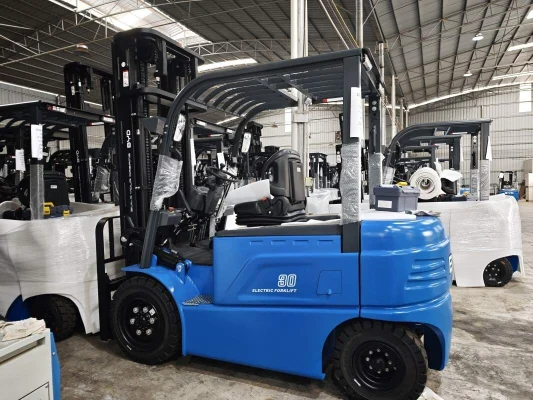
Racking beam spacing and the height of the top shelf determine the needed lift. If you serve a 5,500 mm top beam, a mast with a rated lift slightly above that figure gives room to lift the pallet clear. The same mast may have a lower capacity at full height than at ground level; always check the capacity at the intended lift height, not only at the load center. A four-wheel counterbalance electric forklift with a higher mast may also need a longer wheelbase or additional counterweight to maintain stability, which affects aisle width.
Questions that link racking to mast specification
- What is the highest beam level the truck must serve, and what clearance remains above it?
- Does the mast need free lift to enter racking with low overhead clearance?
- What is the closed mast height, and does it fit under doorways and sprinkler lines?
- Are there low-clearance areas where a shorter mast is required even if the top beam is lower?
Where racking is being planned or modified, share the beam elevations and aisle dimensions with the forklift supplier early. Mast selection and rack layout influence each other, and changes made after the truck is ordered can be costly.
Site Conditions and Specification Checks Beyond Capacity and Height
Capacity and lift height are the starting points, but a four-wheel counterbalance electric forklift must also suit the aisle, floor, and power environment. Four-wheel models generally have a larger turning radius than three-wheel designs, so aisle width becomes a key constraint. Measure the actual aisle width at the narrowest point, including any columns, and compare it with the truck’s right-angle stacking aisle requirement, which the supplier should provide.
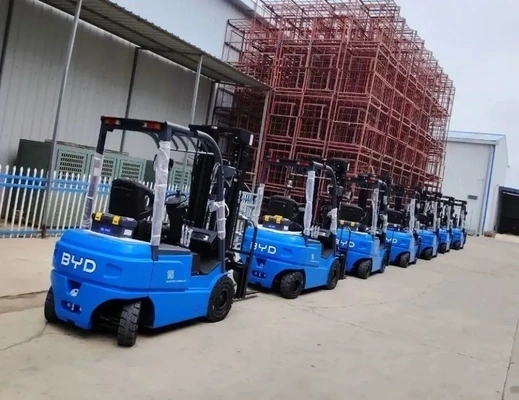
Floor condition and gradients affect stability and traction. Smooth concrete is common in warehouses, but damaged joints or ramps may require attention. Lithium battery models avoid battery changing if opportunity charging is available, but you must confirm the charging infrastructure and shift pattern. A single-shift operation with a suitable charger may need only one battery; multi-shift work may require a larger battery or a charging strategy. These are selection conditions, not performance claims, and should be verified against the manufacturer’s technical data.
Conditions to verify before requesting a configuration
- Aisle width at the narrowest point and the required right-angle stacking aisle.
- Floor surface, slope, and any thresholds or dock levellers.
- Shift pattern and available charging time and power supply.
- Environment: indoor, outdoor, cold store, or dusty areas, and any special requirements.
When these details are known, the supplier can propose a model and configuration within the four-wheel counterbalance electric range. Request the capacity chart, mast dimensions, and aisle requirements in writing so you can compare proposals on the same basis.
Frequently Asked Questions
Can I use the headline capacity if my pallets are standard depth?
Only if the actual load center matches the rating point and the lift height is within the chart. Standard pallet depth often keeps the load center close to the rated value, but fork length, pallet overhang, and attachments can move it forward. Check the capacity chart at your actual load center and lift height.
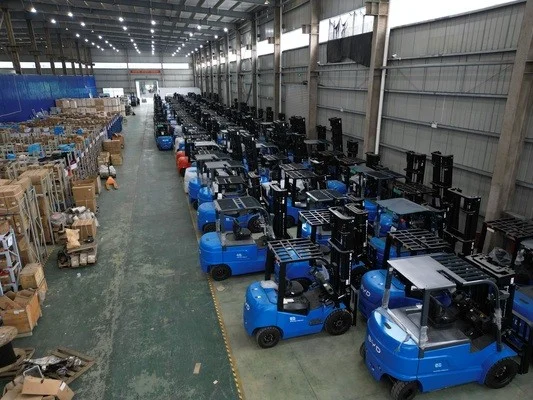
Does a higher lift height always reduce capacity?
Not always, but many masts have a lower capacity at full height than at lower levels. The reduction depends on mast design and the manufacturer’s rating. The capacity chart should state the allowable load at each height, and you should use the figure that applies to your highest racking level.
How do I know if a four-wheel counterbalance electric forklift fits my aisle?
Compare the measured aisle width with the right-angle stacking aisle dimension the supplier provides. This dimension depends on the truck’s wheelbase, overall width, and mast. If the aisle is tight, discuss alternatives such as a different mast or load handling approach, but do not assume a three-wheel or other type is automatically suitable without checking its own specifications.
What information should I prepare before asking for a quotation?
Provide maximum load weight and dimensions, load center, highest and lowest lift heights, aisle width, floor and slope conditions, shift pattern, charging availability, and any attachments. These details let the supplier confirm a suitable configuration and avoid later changes.