Four-Wheel Counterbalance Electric Fork Lift Truck Procurement: Verifying Residual Capacity When Adding Side-Shift and Clamp Attachments
News 03/11/2026
When you specify a four-wheel counterbalance electric fork lift truck with a side-shift or clamp attachment, the attachment changes more than the handling method. It adds weight and moves the load center forward, so the truck’s rated capacity at the fork tips no longer reflects what the truck can safely lift. Procurement teams need to verify residual capacity—the capacity remaining after the attachment is fitted—before the order is placed, not after the truck arrives on site.
This guide explains what to request from the supplier, how to read a residual capacity plate, and which documents belong in the purchase order. The focus is on four-wheel counterbalance electric models, including lithium-battery versions. Other truck types appear only where a boundary needs clarification.
Why Residual Capacity Changes with an Attachment
A forklift’s rated capacity is defined at a specific load center, usually 24 inches (600 mm) from the fork face, with a standard fork carriage and no attachment. A side-shift adds a carriage that moves laterally, and a clamp adds arms that grip the load. Both increase the distance from the front wheel axle to the load center and add their own weight. The result is a lower allowable load at the same load center, or a shorter allowable load center at the same load.
Three variables determine the new limit:
- Attachment weight: The attachment’s own mass reduces the payload the truck can carry.
- Load center shift: The attachment’s thickness moves the vertical load center forward, increasing the overturning moment.
- Lost load distance: The horizontal distance from the carriage face to the fork face changes, and the residual capacity plate must state the new value.
Without these figures, a buyer cannot confirm that the truck will handle the intended load. A common error is to compare only the truck’s base rated capacity with the load weight and ignore the attachment. Another is to accept a verbal assurance that the truck “will be fine” without a residual capacity calculation. Both leave the buyer exposed to overload, instability, and compliance problems.
Documents and Data to Request Before Ordering
Procurement should treat residual capacity as a technical requirement, not a sales detail. The following items belong in the request for quotation and the purchase order. Where a supplier cannot provide a value, the buyer should mark it as “to be confirmed” and obtain it before shipment.
Attachment specification sheet
Ask the attachment manufacturer (or the truck supplier acting as integrator) to provide the attachment model, weight, overall thickness, lost load distance, and the recommended capacity reduction method. The sheet should identify the attachment’s rated capacity and the load center at which that capacity applies.
Residual capacity calculation
The truck supplier should supply a written calculation showing the truck’s base capacity, the attachment weight, the new load center, and the resulting residual capacity at the required lift height. The calculation should state the assumptions, such as battery weight and mast type, because these affect the truck’s own stability.
Updated capacity plate
The truck must carry a capacity plate that reflects the attachment configuration. The plate should show the residual capacity at the relevant load centers and lift heights. Confirm that the plate will be fitted at the factory or by an authorized installer, and that the serial number of the truck and attachment are recorded.
Drawings and interface details
For a side-shift or clamp, request the carriage interface drawing, hydraulic requirements (flow and pressure), and any electrical connections if the attachment is powered. These details affect delivery lead time and installation cost, and they should be agreed before the order is finalized.
Compliance and test records
Ask which standards the truck and attachment are designed to meet and what test records will be supplied. Do not accept a claim of certification without the certificate or declaration. If the supplier cannot provide a specific document, record that fact and decide whether it is acceptable.
If you are comparing options, a short table helps keep the data visible:
| Item | What to record | Why it matters |
|---|---|---|
| Base rated capacity | Value and load center from the truck data sheet | Starting point for residual capacity |
| Attachment weight | From the attachment specification sheet | Reduces payload |
| Lost load distance | Distance from carriage face to fork face | Shifts load center forward |
| Residual capacity | Calculated value at required load center and lift height | Confirms the truck can handle the load |
| Capacity plate | Photo or drawing of the updated plate | Shows the configuration is documented |
Acceptance Checks and Common Procurement Mistakes
When the truck is delivered, verify the configuration against the purchase order before releasing payment. Check the attachment model and serial number, the capacity plate, and the hydraulic settings. Confirm that the residual capacity stated on the plate matches the calculation you approved. If the truck will be used at multiple lift heights, confirm that the plate covers the highest required height.
Common mistakes include:
- Ordering an attachment after the truck is delivered without recalculating capacity.
- Using a capacity plate that still shows the base rating.
- Assuming that a side-shift has negligible effect and skipping the calculation.
- Accepting a residual capacity figure without knowing the load center and lift height it applies to.
- Forgetting that battery weight and mast type can change the truck’s stability, so the calculation should match the actual configuration.
For a four-wheel counterbalance electric fork lift truck, the stability margin is generally greater than that of a three-wheel model, but that does not remove the need for a residual capacity check. The attachment still changes the load moment, and the check remains necessary.
If the intended load is close to the residual capacity, consider whether a larger truck or a different attachment is more suitable. Do not rely on counterweight additions or unapproved modifications to increase capacity; these can invalidate the truck’s design assumptions and create safety risks.
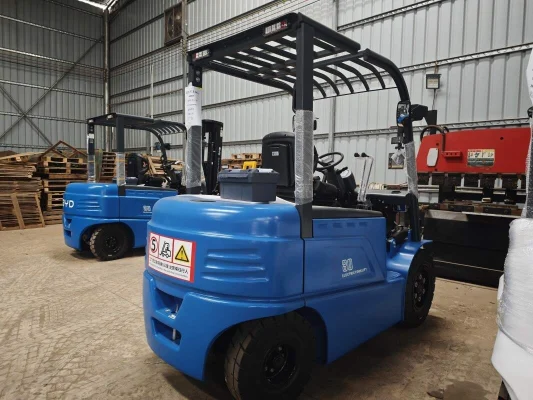
To move forward, gather the actual load weight, load center, required lift height, and attachment type. Share these with the supplier and ask for a written residual capacity calculation and a sample capacity plate. This site supplies BYD four-wheel counterbalance electric forklifts, including lithium-battery models; we can review your operating conditions and confirm which configuration data must be verified before you order.
Frequently Asked Questions
Does a side-shift always reduce capacity?
It usually does, because the side-shift adds weight and moves the load center forward. The amount depends on the specific attachment and truck. Ask the supplier for the residual capacity calculation rather than assuming a fixed reduction.
Can I use the truck’s original capacity plate after fitting an attachment?
No. The original plate reflects the base configuration. After fitting an attachment, the truck should carry an updated plate showing the residual capacity at the relevant load centers and lift heights. Using the original plate can mislead operators and fail an inspection.
What load center should the residual capacity be based on?
Use the actual load center of the loads you intend to handle, measured from the fork face. If loads vary, the calculation should cover the largest load center and the highest lift height in normal use. The supplier should state the load center on the calculation and the plate.
Is residual capacity different for lithium-battery models?
Battery weight affects the truck’s overall stability, and different battery types can have different weights. The residual capacity calculation should use the actual battery configuration. Confirm with the supplier that the calculation matches the battery type you are ordering.