How to Specify a Four-Wheel Counterbalance Electric Forklift: Load Capacity, Lift Height and Lithium Battery Checks Before Purchase
News 30/10/2026
An electric forklift for sale is only a good match when its rated load, lift height and battery system fit the work you actually do. A four-wheel counterbalance electric forklift is a common general-purpose choice in factories, loading bays and warehouse transfers, but the specification sheet needs to be read against your real duty cycle. Before you request a quotation, gather four numbers and three site facts: maximum load, load center, required lift height, aisle width, floor condition, ramp gradient and available charging time. This guide explains what to confirm and what to ask a supplier before committing.
Start With the Load, Not the Model Number
Rated capacity is not a single fixed figure. A forklift is rated at a stated load center, usually 500 mm or 600 mm from the fork face, and capacity falls as the load center moves forward. Long loads, non-standard pallets or attachments can shift the effective center and reduce safe capacity.
- Record the heaviest load you will lift, including packaging and any pallet weight.
- Measure the load center of your actual pallets, not an assumed value.
- Note any attachment, such as a clamp or extended forks, and ask how it affects the rating.
- Confirm the required lift height and whether loads are lifted to full height while travelling.
If your loads vary widely, specify against the heaviest realistic case rather than an average. The manufacturer’s data plate and technical documentation are the authority on capacity at a given load center and lift height; do not accept a single headline tonnage as sufficient.
Match Lift Height and Mast Choice to the Building
Lift height affects mast type, overall height and visibility. A standard duplex mast suits many low-level stacking tasks, while triple-stage masts allow higher lift with a lower collapsed height. Each configuration has trade-offs in cost, weight and forward visibility, so confirm the actual rack beam height and the clearance above it.
Site dimensions to measure
- Highest shelf or rack beam level you must reach.
- Free lift needed to enter racking or a container without striking the top.
- Overhead obstructions: doorways, sprinklers, lighting and roof trusses.
- Aisle width and turning radius available at each end of the aisle.
- Floor flatness, joints and any ramps or dock levellers on the route.
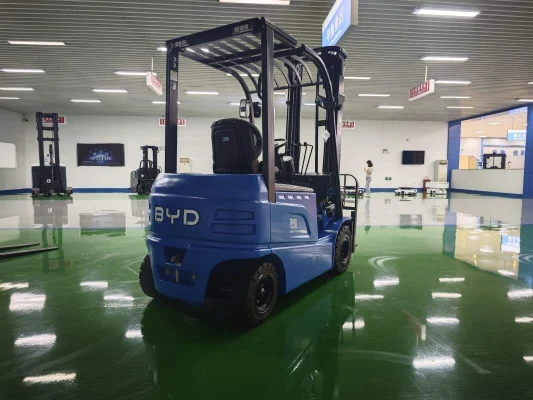
Provide these measurements to the supplier so the mast and chassis can be checked together. A four-wheel counterbalance electric forklift generally offers stability and a familiar driving feel, but its turning circle is larger than some compact designs, so aisle width deserves early attention.
Lithium Battery Checks Before You Sign
Lithium batteries change how a fleet is planned because opportunity charging is often possible, but the charging infrastructure and operating pattern still need to be confirmed. Ask the supplier to state the battery voltage and capacity, charger type and charging time from the manufacturer’s documentation, not from general assumptions.
Questions worth putting in writing
- What battery capacity is offered with the quoted configuration, and at what discharge depth is it rated?
- Which charger is supplied, what input power does it need, and where will it be installed?
- Can the battery be opportunity-charged during breaks, and what does the manufacturer permit?
- What operating temperature range applies, and does your site fall inside it?
- What maintenance, inspection and warranty terms apply to the battery and charger?
Charging time and shift pattern must be considered together. A single-shift operation with a long lunch break has different needs from a multi-shift operation with limited charging windows. Do not assume a battery will cover a full shift without checking the manufacturer’s stated capacity against your measured energy use; if that data is unavailable, ask what testing the supplier recommends.
Build a Specification and Acceptance Checklist
A clear written specification reduces the risk of receiving a machine that does not fit the aisle or the load. The table below lists items to confirm before order and again at delivery.
| Item | What to confirm |
|---|---|
| Rated capacity and load center | Capacity at your actual load center and lift height, per manufacturer data |
| Lift height and mast | Mast type, collapsed height, free lift and overhead clearance |
| Dimensions | Overall width, length, turning radius and aisle requirement |
| Battery and charger | Voltage, capacity, charger type, charging time and power supply |
| Tyres and floor | Tyre type suited to indoor floors or mixed surfaces |
| Documentation | Data plate, manuals, warranty terms and service arrangements |
At delivery, check the data plate against the agreed specification, confirm the charger matches the site power supply, and verify that the machine can enter and turn in the tightest aisle on your route. Ask the supplier which pre-delivery checks are performed and what operator familiarisation is included. Keep the signed specification with the machine records.
Frequently Asked Questions
Can a four-wheel counterbalance electric forklift work outdoors?
It can be used on some external surfaces, but suitability depends on tyre type, floor condition, weather exposure and the manufacturer’s rating. Confirm these points with the supplier rather than assuming indoor and outdoor use are equivalent.
How do I know which battery capacity to request?
Base the request on measured energy use per shift, charging windows and the manufacturer’s stated capacity. If you lack measured data, describe your shift pattern and load profile and ask the supplier to recommend a configuration with documented assumptions.
What should I send with a quotation request?
Send maximum load, load center, required lift height, aisle width, floor and ramp details, shift pattern, charging location and any attachments. This lets the supplier quote a configuration that can be checked against the site.
Is a higher lift height always better?
No. Higher lift often means a different mast with more weight, cost and reduced visibility. Specify the height you actually need and confirm free lift and collapsed height against your building.
To narrow the options, share your load, lift height and charging conditions with our team and ask which four-wheel counterbalance electric forklift configurations fit your site.