Electric Forklift Sale Guide: Matching Four-Wheel Counterbalance Capacity, Lift Height and Battery Configuration to Your Handling Duty Cycle
News 01/11/2026
An electric forklift listing rarely tells you whether a particular truck will suit your operation. Two units with the same nominal capacity can behave very differently once lift height, load center, attachment weight, aisle width and shift pattern enter the picture. This guide explains how to read a sale listing critically and match a four-wheel counterbalance electric forklift to the work you actually do, so that capacity, lift height and battery configuration are treated as one connected decision rather than three separate specifications.
Start with the Duty Cycle, Not the Specification Sheet
The duty cycle describes what the truck does during a shift: how heavy the loads are, how high they go, how far they travel, how often the operator lifts and lowers, and how much time the truck spends working versus idle. Every other choice should follow from this description. Buyers who begin with a capacity number often end up with a truck that is either oversized and expensive or undersized at the top of its lift range.
A practical way to build a duty-cycle profile is to record the following over a representative week:
- Load range: the lightest and heaviest loads moved, plus how often the heaviest occur.
- Lift height: the highest shelf, rack beam or trailer deck the forks must reach, and the height at which the load is carried during travel.
- Load center: the distance from the vertical face of the forks to the center of gravity of the load. Pallets with overhang or non-standard footprints shift this value.
- Travel and aisle: average travel distance per trip and the narrowest aisle or doorway the truck must pass through.
- Surface and slope: floor condition, ramps, dock plates and any gradients on the route.
- Shift pattern: hours of actual operation per shift, number of shifts, and when the truck can be charged.
If you cannot measure these values precisely, estimate conservatively and note the assumptions. A supplier can only recommend a configuration when the operating envelope is clear; vague requests tend to produce vague quotations.
Reading Capacity Ratings on a Four-Wheel Counterbalance Electric Forklift
The rated capacity on a counterbalance truck is tied to a specific load center and lift height, usually stated on the data plate. A truck rated at a given capacity at a standard load center will have a lower allowable capacity when the load center moves outward or when the load is raised high with the mast extended. This is why the same model can appear on several sale listings with different headline numbers.
Why the Data Plate Matters More Than the Headline
Ask to see the data plate and the manufacturer’s load chart, not just the advertised capacity. The chart shows how capacity reduces as load center and lift height increase. Compare the chart against your heaviest load at your highest lift height, not against your average load at floor level. A truck that handles most pallets comfortably can still be unsuitable if the heaviest loads are the ones that must go to the top beam.
Attachments Change the Calculation
Any attachment fitted to the carriage, such as a side shifter or a clamp, adds weight and moves the effective load center forward. The remaining capacity available for the payload is therefore lower than the bare-truck rating. If the truck will run with an attachment, the capacity question must be answered with the attachment installed, and the attachment’s own weight and load-center effect should be documented.
Stability Is Not Only About Weight
Four-wheel counterbalance trucks are common general-purpose machines in factories, warehouses and loading areas because their layout supports stable travel with a raised load when operated within rated conditions. That does not make them suitable for every situation. Very narrow aisles, tasks that require reaching into racking from a standing position, or moves dominated by horizontal transport may point to other equipment categories. Where a duty cycle genuinely sits outside counterbalance capability, it is better to identify that early than to force a truck into a role it was not designed to fill.
Matching Lift Height and Mast Choice to the Route
Lift height is often quoted as the maximum the mast can reach, but the useful figure is the height at which the forks can safely place and retrieve loads. Free lift, collapsed mast height and overhead clearance all affect whether the truck works in your building.
Three Heights to Confirm
- Required lift height: the highest point the forks must reach to enter the top pallet position, including any clearance needed to lift and tilt.
- Collapsed height: the mast height with forks lowered, which must clear doorways, mezzanine edges and overhead obstructions along the travel route.
- Overhead guard clearance: the operating height of the truck, relevant in trailers, containers and low-clearance areas.
Compare these values against the actual building, not the drawing. Door headers, sprinkler lines, lighting and dock levellers are frequent sources of surprise. A mast that is tall enough but cannot pass under a doorway is no improvement over one that is too short.
Mast Stages and Visibility
Mast configuration affects both lift height and forward visibility. Taller masts generally need more stages, and the nested rails can obscure the load at height. If operators will work at the top of a tall rack, visibility and the ability to judge fork entry become part of the selection, not an afterthought. Discuss the mast type with the supplier against your rack layout rather than choosing the tallest option available.
Battery Configuration and Charging Fit the Shift Pattern
Battery choice is a scheduling decision as much as an electrical one. A battery that is large enough on paper can still fail operationally if the charging window does not match the shift pattern, or if the charging location is inconvenient.
Questions to Settle Before Choosing a Battery
- How many hours does the truck actually run per shift, and how many shifts per day?
- Is there a fixed charging point, and can the truck be parked there during breaks?
- What is the available power supply at the charging location, and who manages the electrical connection?
- Will batteries be swapped between trucks, or does each truck keep its own?
- What ambient temperature range applies in the charging and operating areas?
Lithium battery configurations can support opportunity charging during breaks in many operations, which changes how a multi-shift schedule is planned. Whether that approach suits a specific site depends on the charger, the battery management system and the supplier’s instructions. Treat any claim about charging behaviour as something to confirm in the manufacturer’s technical documentation rather than assume from a sales listing.
Comparing Battery Options on a Sale Listing
| Item to check | Why it matters | What to request |
|---|---|---|
| Battery type and rated capacity | Determines energy available between charges | Manufacturer datasheet and age or cycle history |
| Charger compatibility | Mismatched charger and battery can limit performance or create safety issues | Charger model, output specification and matching confirmation |
| Charging window | Links battery size to shift pattern | Recommended charging profile and break-charging guidance |
| Battery condition | Used batteries may have reduced usable capacity | Test records or inspection report where available |
For a used truck, battery condition deserves particular attention. Without test records, ask what documentation exists and factor an inspection into the purchase decision. Do not accept an assumed remaining life figure that cannot be supported.
Turning Requirements into a Purchase Checklist
Before requesting quotes, assemble a short specification brief. It does not need to be elaborate, but it should state the operating facts clearly so that suppliers can respond with comparable offers.
- Heaviest load, its dimensions and the load center at which it is handled.
- Highest lift height required and the collapsed mast height the route allows.
- Narrowest aisle, doorway and overhead clearance on the travel path.
- Floor surface, ramps and dock conditions.
- Hours of operation per shift, shifts per day and charging opportunities.
- Any attachment to be used, with its weight and load-center effect.
- Documentation required: data plate, load chart, battery and charger details, service history.
When you contact a supplier, describe the duty cycle in these terms and ask which configuration fits it. A useful response will explain the reasoning, identify the limiting factor and state the conditions under which the recommendation holds. If a quote gives only a capacity number and a price, ask what load center and lift height that capacity assumes.
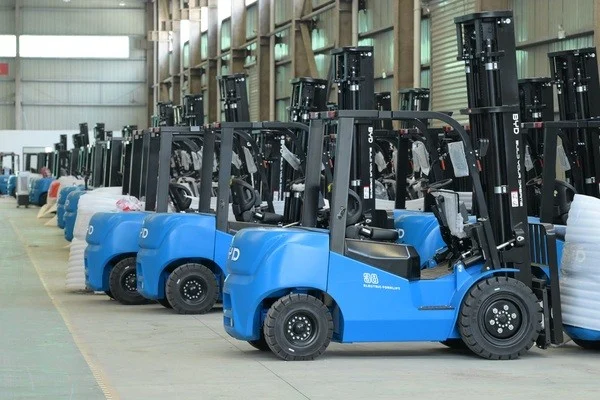
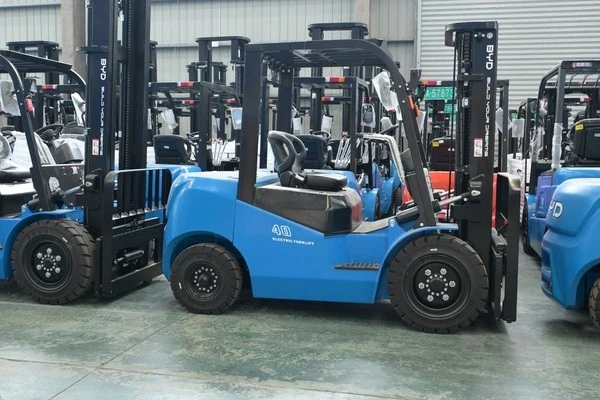
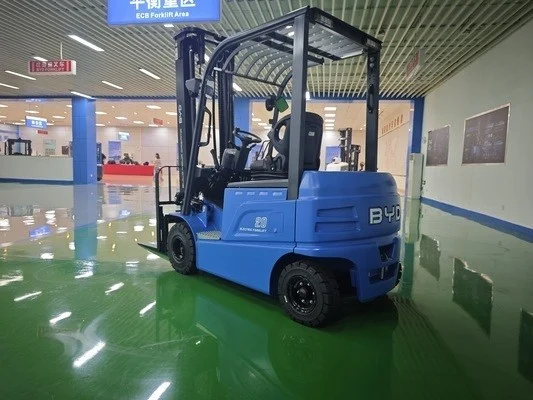
Our sales scope covers BYD four-wheel counterbalance electric forklifts, including lithium battery configurations. Share your load, lift height, aisle and shift details, and we can discuss which configuration matches your handling duty cycle and what information still needs verification.
Frequently Asked Questions
Can I use the advertised capacity as the payload limit?
Only at the load center and lift height stated on the data plate. As load center moves outward or lift height increases, the allowable load generally falls. Check the manufacturer’s load chart against your heaviest load at your highest lift height.
Is a taller mast always the safer choice?
No. A taller mast can reduce forward visibility and may not fit under doorways or overhead structures when collapsed. Choose the mast that meets your required lift height while clearing the travel route, and confirm visibility at working height.
How do I know whether a battery suits a two-shift operation?
Compare the truck’s actual running hours per shift with the battery and charger documentation, and identify when charging can occur. Multi-shift planning depends on the charging profile the manufacturer specifies and the power available at the charging point.
What should I ask about a used electric forklift on sale?
Request the data plate, load chart, battery and charger details, service records and any available inspection report. Confirm the attachment fitted and its effect on capacity, and verify the truck’s condition against the duty cycle you plan to run.