LiFePO4 Forklift Battery Sizing Guide: Estimating Energy Draw Across Four-Wheel Counterbalance Electric Forklift Duty Cycles
News 01/11/2026
Sizing a LiFePO4 forklift battery starts with one question: how much energy does a four-wheel counterbalance electric forklift actually consume during a working shift? Nameplate voltage and amp-hour ratings tell you what a pack can deliver, not what your operation will demand. The practical approach is to build an energy estimate from duty-cycle variables, compare it with usable battery capacity, and then confirm the result against the manufacturer’s published data and a trial under real conditions.
This guide explains how to structure that estimate, which variables matter most, and where the uncertainty lies. It focuses on four-wheel counterbalance electric forklifts, the type this site supplies in BYD lithium configurations. Where a figure depends on a specific truck or charger, treat it as a parameter to verify rather than a fixed number.
Start With the Duty Cycle, Not the Battery Label
A duty cycle describes what the truck does over a shift: how many hours it runs, how much of that time it is lifting, traveling loaded, traveling empty, or idling, and how often it handles a load. Two trucks with identical batteries can have very different energy needs depending on these patterns.
A useful first step is to divide a shift into activity blocks and assign each block a rough share of time. A hypothetical example: a warehouse operation running one eight-hour shift might spend about 30 percent of the time traveling loaded, 30 percent traveling empty, 20 percent lifting and lowering, and 20 percent idling or waiting. These percentages are illustrative only; your own observations should replace them.
Record the following before estimating anything:
- Shift length and number of shifts between charging opportunities
- Average and peak load weight, plus the load center distance
- Lift height and the number of lift cycles per hour
- Travel distance per cycle and average speed
- Floor conditions and any ramps or gradients
- Ambient temperature range in storage and working areas
Each item changes energy draw in a different way, and omitting one usually produces an optimistic estimate.
Estimating Energy Draw From Work Done
Energy consumption has two broad components: the work of moving the truck and load, and the work of lifting. Both are affected by efficiency losses in motors, controllers, hydraulics, and tires. A structured estimate separates them so you can see which part dominates.
Travel energy
Travel energy scales with total moving mass (truck plus load), distance, rolling resistance, and acceleration events. More stop-start cycles raise consumption because each acceleration adds kinetic energy that braking later dissipates. Long, steady runs on smooth concrete are relatively efficient; congested aisles with frequent direction changes are not.
Lift energy
Lift energy depends mainly on load weight, lift height, and the number of lift cycles. A truck lifting moderate loads to low heights many times per hour may consume less than one lifting heavy loads to rack tops less often. Hydraulic system efficiency and any lowering energy recovery features also matter, and these are truck-specific.
Idle and auxiliary loads
Lights, displays, fans, and control electronics draw power even when the truck is not moving. Over a long shift with substantial waiting time, this baseline load is not negligible. Cold storage or high-temperature environments can further change consumption and available capacity.
Because efficiency values vary by model, the honest method is to use the manufacturer’s energy consumption data where available, or to measure amp-hour throughput over a representative shift. Do not substitute generic multipliers you cannot trace to a source.
Matching the Estimate to Usable LiFePO4 Capacity
Once you have an energy estimate, compare it with the usable capacity of the proposed pack. Usable capacity is not the same as nominal capacity: depth of discharge limits, temperature effects, and end-of-shift voltage behavior all reduce what you can safely rely on. A LiFePO4 pack generally holds voltage more steadily across its discharge range than lead-acid, but that does not remove the need to leave margin.
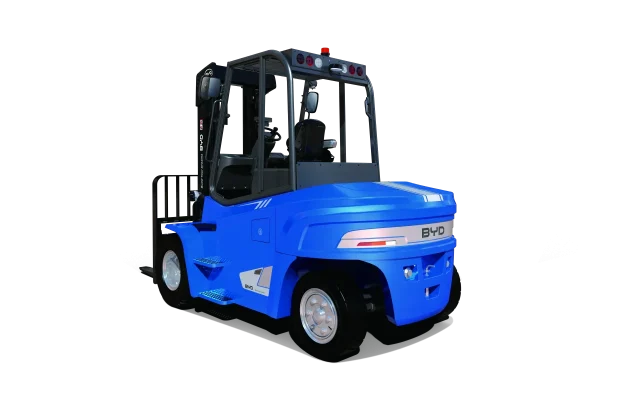
Use a comparison table to organize the decision rather than to imply universal numbers:
| Input | What to Confirm | Why It Matters |
|---|---|---|
| Shift energy estimate | Measured or manufacturer-supplied consumption | Sets the baseline demand |
| Nominal pack capacity | Voltage and amp-hour rating from the datasheet | Defines the energy ceiling |
| Usable capacity | Recommended depth of discharge and temperature limits | Determines realistic runtime |
| Charging window | Break length, charger rating, opportunity charging policy | Decides whether one pack covers the shift |
| Future duty changes | Planned throughput growth or heavier loads | Protects against early undersizing |
A common error is sizing to the average shift and ignoring peak days. Another is assuming a larger pack always solves runtime problems when the real constraint is charging time or truck availability. Keep a margin between estimated demand and usable capacity, and state that margin explicitly in your procurement notes.
Selection Trade-Offs and Common Mistakes
Battery sizing is a balance among runtime, weight, charging infrastructure, and cost. A larger pack extends runtime but adds weight that affects stability and may reduce payload available at a given load center. It also requires a charger and charging area that can handle it within your operating schedule.
Watch these recurring mistakes:
- Using travel distance alone and ignoring lift cycles
- Treating nominal amp-hours as fully available
- Overlooking temperature in cold storage or outdoor docks
- Assuming opportunity charging is possible without confirming charger capacity and break timing
- Sizing from a similar operation’s experience instead of your own duty data
Where the estimate remains uncertain, the practical next step is a structured trial: run the candidate truck through a representative shift and record energy throughput, voltage behavior, and any performance changes near the end of the shift. This converts assumptions into observations specific to your site.
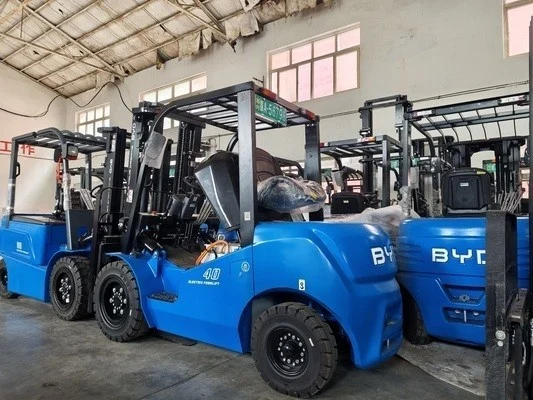
If you are evaluating a BYD four-wheel counterbalance electric forklift, share your actual load weights, lift heights, shift pattern, floor and ramp conditions, and charging windows. Those details let the selection discussion focus on configuration rather than guesswork. Confirm all specifications against current manufacturer technical documentation before committing to a purchase.
Frequently Asked Questions
How do I estimate LiFePO4 forklift battery capacity without measured data?
Build an estimate from duty-cycle blocks: travel time and distance, lift cycles and heights, load weights, and idle time. Apply efficiency assumptions only if they come from the truck manufacturer or a documented source. Then compare the result with usable capacity from the datasheet and keep a margin. Treat the output as a planning range, not a precise prediction.
Does a LiFePO4 battery always allow a full shift on one charge?
No. Runtime depends on the pack size, the duty cycle, temperature, and how deeply the pack is discharged. A light duty cycle with a suitably sized pack may cover a shift, while heavy lifting or long shifts may require opportunity charging or a larger pack. The only reliable answer comes from matching your duty data to the proposed configuration.
Which duty-cycle factor most often causes undersizing?
Lift work is frequently underestimated because it is easy to count travel distance and overlook how many times the truck lifts a load and to what height. Frequent lifting of heavy loads to high rack levels can dominate energy use. Record lift cycles and heights separately from travel data.
Can I compare battery options using only amp-hour ratings?
Amp-hour ratings alone are insufficient. Voltage, usable depth of discharge, temperature limits, charging capability, and physical fit all affect whether a pack suits a given truck and shift. Compare complete configurations against the same duty-cycle estimate.