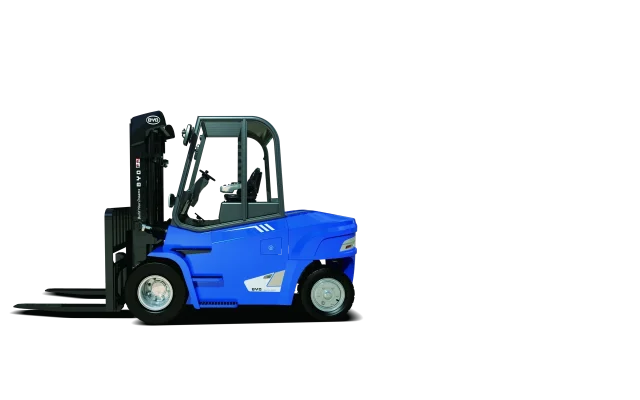
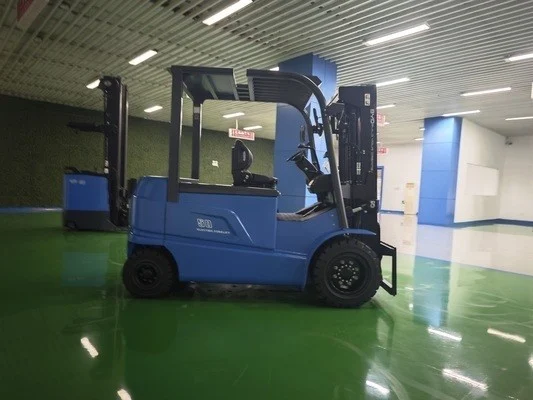
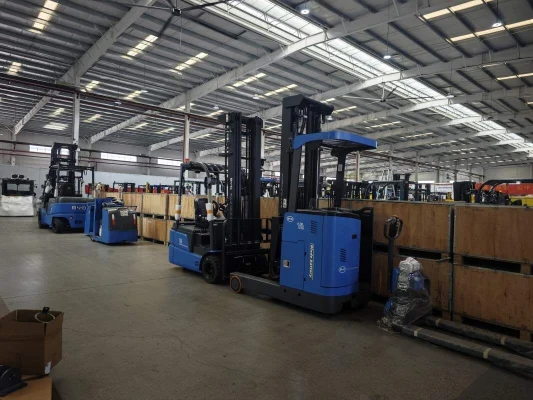
1.5 ton electric forklift: How to Confirm Rated Capacity at Your Actual Load Center Before Ordering a Four-Wheel Counterbalance Truck
News 08/11/2026
A 1.5 ton electric forklift is rated against a specific load center, usually the distance from the front face of the forks to the center of gravity of the load. When your real pallet places the load farther out, the capacity printed on the data plate no longer applies, and the truck may tip or lose hydraulic control well before it reaches 1,500 kg. This article explains how to confirm the rated capacity at your actual load center before you order a four-wheel counterbalance electric forklift, using the load data, attachment details and site dimensions you already have.
Why the Load Center Changes What a 1.5 Ton Rating Means
Forklift capacity ratings are a package: a stated load weight, a stated load center and a stated lift height. The manufacturer’s data plate on a four-wheel counterbalance electric forklift shows the rated capacity at a reference load center, commonly 500 mm or 600 mm, and at a defined lift height. Move the load center outward and the allowable weight falls, because the truck’s stability is governed by the moment of the load, not the weight alone.
Three practical consequences follow:
- Longer pallets and deep loads shift the center of gravity away from the fork face, so a nominal 1.5 ton truck may only be approved to lift a lower weight in that configuration.
- Attachments such as side shifters, fork positioners or clamp frames add their own weight and move the effective load center forward. Their effect must be reflected in the capacity shown on the plate or in a manufacturer-supplied derating chart.
- Lift height matters as well. Many plates state capacity at a reference height, and the residual capacity at full lift can differ. Confirm the capacity at the heights you actually use, not only at floor level.
The rated figure is therefore a starting point, not a guarantee. The useful question is: what weight can this truck handle at my load center, my lift height and my attachment configuration?
How to Confirm Capacity at Your Real Load Center
The method below uses information you can collect without special instruments. It is general selection guidance, not a substitute the manufacturer’s capacity plate and configuration data.
Step 1: Measure the load, not the pallet label
Weigh a representative loaded pallet or stillage. Record the weight and note how the goods sit on the pallet: evenly distributed, offset to one side, or overhanging the fork tips. A load whose center of gravity sits beyond the fork face by more than the reference load center is the case that most often invalidates a 1.5 ton rating.
Step 2: Establish the actual load center
Identify the horizontal distance from the vertical fork face to the center of gravity of the load, including the pallet. If the load is uniform, the center is roughly halfway through its depth; if it is not, treat the measurement as an estimate and confirm it with the supplier. Also note any vertical offset, because a high center of gravity reduces stability independently of the horizontal load center.
Step 3: Add the attachment effect
List every attachment you intend to use. Each has a weight and a forward extension, both of which reduce residual capacity. Ask the supplier to state the capacity at your load center with that attachment fitted, rather than assuming the base truck rating still applies.
Step 4: Match lift height and mast configuration
Record the maximum fork height you need at the rack beam, plus the free lift required to enter the rack. A taller mast or a different mast stage can change the rated capacity. Compare the required height with the capacity stated at that height on the plate or configuration sheet.
Step 5: Check the site envelope
Capacity confirmation is not complete until the truck fits the aisle. Measure aisle width, turning radius requirements and door and rack clearances. If your aisle is too narrow or your lift height too great the four-wheel counterbalance format, a different truck type may be the honest answer, and it is better to learn that before ordering.
Step 6: Document the agreed configuration
Before ordering, put the load weight, load center, lift height, attachment and aisle dimensions in writing and ask the supplier to confirm the rated capacity at that combination. The confirmation should reference the capacity plate or a configuration-specific derating table, not a general brochure figure.
Specification and Configuration Checks by Application
The following table uses a general warehousing and production-logistics context, which is the most common setting where a 1.5 ton electric forklift is considered. Treat the entries as checks to carry out, not as values to assume. Specific figures depend on the manufacturer’s technical data your supplier provides.
| Item | Why it matters at this load center | What to confirm with the supplier | Standard or optional |
|---|---|---|---|
| Rated capacity and load center | Defines the weight allowed at the reference distance; your pallet may exceed it | Capacity plate value, reference load center and capacity at your measured load center | Standard data; configuration-specific derating must be confirmed |
| Lift height and mast stage | Residual capacity can differ at full lift | Capacity at your maximum fork height, free lift and overall lowered height | Mast choice is a configuration item |
| Attachment weight and extension | Shifts the load center forward and adds carried weight | Attachment weight, forward extension and revised capacity | Optional; confirm compatibility and derating |
| Aisle and turning envelope | Determines whether a four-wheel counterbalance truck suits the layout | Turning radius, aisle width requirement and right-angle stacking data | Standard dimensional data |
| Floor and slope conditions | Affects traction, braking and stability with an elevated load | Permitted floor condition, ramp limit and braking information | Confirm against site survey |
| Battery and charging routine | Shift length and charging windows affect availability | Battery capacity options, charging method and time, and required charging space | Configuration item; confirm site power supply |
Two limits deserve emphasis. First, a four-wheel counterbalance electric forklift is a common general-purpose choice warehouse and loading work, but it is not automatically the right truck every aisle or every lift height. Second, no table can replace the manufacturer’s capacity plate: where your supplier has not provided a figure the configuration, the correct action is to request it, not to estimate.
Frequently Asked Questions
Can I simply order a 1.5 ton truck and stay under 1,500 kg?
Only if your load center, lift height and attachment match the conditions on the capacity plate. If your pallet places the load farther out or you add an attachment, the allowable weight at that configuration is lower, and you need the supplier’s derated figure before you commit.
What happens if my actual load center is larger than the reference value?
The truck’s stability margin shrinks. The correct response is to obtain the capacity at your measured load center, consider a larger capacity model, or change the handling method so the load sits closer to the fork face. Operating beyond the rated configuration is a safety issue, not a productivity trade-off.
Does lift height really change capacity on a counterbalance truck?
It can. Capacity is stated at defined conditions, and the residual capacity at full lift may be lower than at the reference height. Confirm the figure at the height you actually use, especially where racking is tall.
How do I compare a quoted capacity with my own measurements?
Ask the supplier to state, in writing, the rated capacity at your load weight, load center, lift height and attachment combination, and to identify the capacity plate or derating table it comes from. Compare that with your measured data rather than with a headline tonnage.
When is a four-wheel counterbalance truck the wrong choice?
If the aisle is too narrow, the required lift height exceeds the model’s approved configuration, or the load center cannot be brought within the rated range, the format may not suit the site. State those constraints to the supplier and ask what configuration, if any, meets them; do not force a truck into a duty it was not rated to perform.
What to Prepare Before You Request a Quote
Bring these items to the conversation with your supplier so the capacity question is answered once, correctly:
- Representative load weight, pallet dimensions and an estimate of the center of gravity position.
- Maximum and typical lift heights, plus free lift needed to enter racking.
- Attachments planned, with their weight and forward extension.
- Aisle width, door and rack clearances, floor condition and any ramps.
- Shift pattern, charging windows and available charging space and power supply.
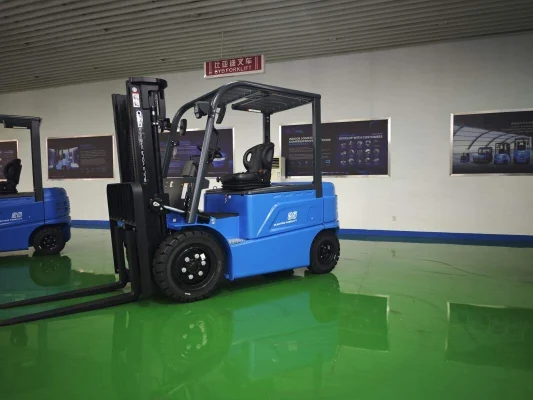
Then ask the supplier to confirm the rated capacity at that exact combination, to identify the source of the figure, and to state which items are standard, optional or subject to factory confirmation. If you are evaluating a four-wheel counterbalance electric forklift, share your load center, load weight and lift height with our team and we will help you check the configuration against the available technical data rather than a headline tonnage.