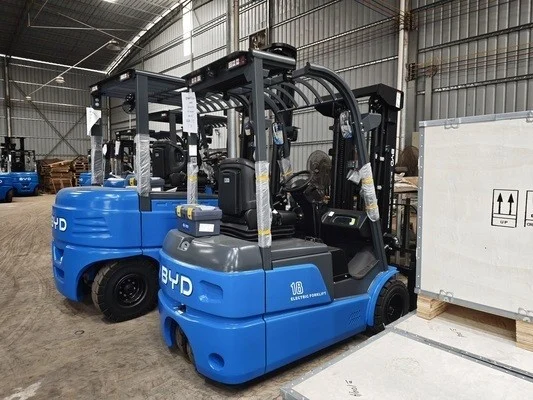
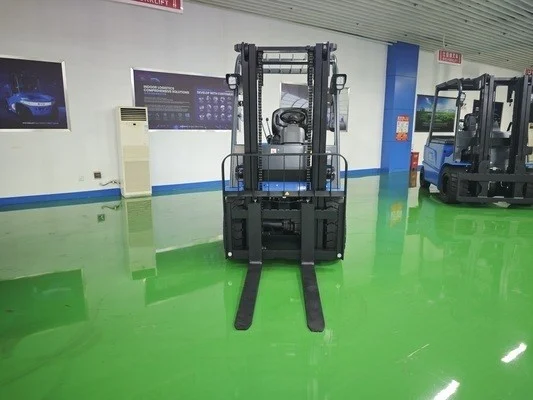
Freezer Aisle Gradient and Door Threshold Surveys: Setting Four-Wheel Counterbalance Electric Forklift Performance Criteria Before Ordering
News 13/11/2026
Ordering an electric forklift for cold storage before anyone has measured the freezer aisle is a common and expensive mistake. Ramps, crowned floors, door thresholds and transitions between warm and cold zones all change what the machine must do, and they change it before the truck ever lifts a pallet. A short, disciplined survey of gradients and thresholds lets you convert those site facts into performance criteria you can put in a specification and discuss with a supplier. This guide explains what to measure, how to record it, and how each measurement translates into a requirement when you are evaluating a four-wheel counterbalance electric forklift.
Why the Survey Comes Before the Specification
Forklift performance figures are always conditional. Rated capacity, gradeability, travel speed and battery endurance depend on load weight, load center, lift height, floor condition and ambient temperature. A freezer aisle adds another layer: the floor may be uneven at doorways, the cold zone may slope toward a drain, and the transition between temperature zones may include a threshold plate or a ramp. If you order against a generic capacity number, you may end up with a truck that is technically compliant but awkward or unsafe in daily use.
The survey exists to replace assumptions with measurements. It gives you a defensible basis to ask specific questions: what gradient must the truck climb while carrying the heaviest expected load, what ground clearance is needed at the threshold, and what happens to hydraulic and electrical behavior when the machine moves between temperature zones. Suppliers can answer those questions only if you provide the numbers.
Measuring Aisle Gradients Accurately
Gradient is usually expressed as a percentage: vertical rise divided by horizontal run, multiplied by 100. A 1 in 50 slope is 2 percent; a 1 in 20 slope is 5 percent. Small-looking slopes matter because a loaded counterbalance truck carries its load ahead of the front axle, and the combination of load, slope and any turning movement affects stability.
What to capture at each location
- Location: aisle number, zone, and the direction of travel.
- Slope percentage: measure the steepest section, not an average across the whole aisle.
- Length of the slope: a short steep ramp and a long gentle ramp are different duty cycles.
- Surface condition: smooth concrete, patched concrete, steel plate, grating, or a transition strip.
- Moisture and ice risk: note drains, door openings, defrost cycles and any history of surface frost.
Use a digital level or an inclinometer placed on a straight edge, and take readings at several points along the travel path. Record the worst case, not the friendliest one. If the aisle slopes in two directions, such as toward a drain and also along the aisle, record both.
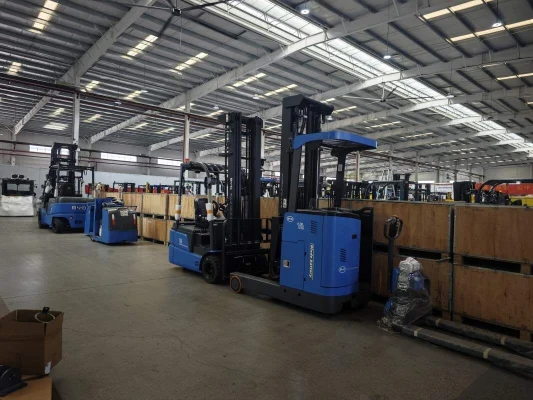
Turning and stopping on a slope
A gradient survey is not only about climbing. A truck may need to stop, start, or turn while on a slope, and these maneuvers are often more demanding than straight travel. Note any place where the operator must turn on a ramp, enter a doorway at an angle, or reverse up a slope. These locations should appear in your criteria as operating conditions, not just as floor data.
Door Thresholds, Transitions and Ground Clearance
Door thresholds are where many cold storage layouts create hidden problems. A threshold may be a raised strip, a recessed channel, a flexible curtain base, or a metal plate bridging two floor levels. Each of these can cause impact, wheel slip, or a jolt that shifts a load.
Threshold checklist
- Height difference between the two floor surfaces, measured at the highest point.
- Width and profile of the threshold: square edge, chamfered, rounded, or a separate ramp.
- Material and condition: steel, aluminum, concrete, worn or loose sections.
- Any gap or recess that a wheel could drop into.
- Door opening width and height, including clearance under a partially raised door.
- Presence of strip curtains, air curtains, or fast-acting doors that affect approach speed and visibility.
Ground clearance, wheel diameter and suspension or chassis design all influence how a truck crosses a threshold. Rather than guessing, give the supplier the measured height difference and the threshold profile, and ask which configuration is appropriate. If the threshold is damaged or loose, repair it before the truck arrives; a new machine will not compensate for a failing floor detail.
Converting Survey Data into Performance Criteria
The output of the survey should be a short list of requirements that a supplier can respond to. The table below shows a practical way to organize it. The values are placeholders; replace them with your own measurements.
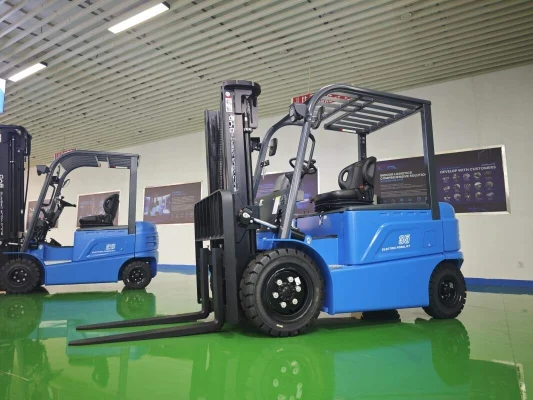
| Site condition | Measured value | Performance criterion to confirm |
|---|---|---|
| Steepest loaded aisle slope | e.g., 4 percent over 15 m | Rated gradeability with the heaviest load at the stated load center |
| Door threshold height difference | e.g., 20 mm step | Ground clearance and wheel size suitable for repeated crossing |
| Cold zone temperature | e.g., −25 °C | Battery, hydraulic fluid and display rating confirmed by the manufacturer |
| Warm-to-cold transition | e.g., two crossings per hour | Condensation and icing management, plus any derating guidance |
| Narrowest aisle | e.g., 3.2 m | Turning radius and right-angle stacking requirement |
| Shift pattern | e.g., 8 hours, two shifts | Battery capacity and charging or opportunity-charging plan |
Keep the criteria factual and testable. Instead of asking whether a truck is “good in cold storage,” ask which components are rated for the measured temperature and what the manufacturer specifies about operation at that temperature. Instead of asking whether it can climb a ramp, state the slope, the load and the load center, and ask for the corresponding rating.
Criteria that are often overlooked
- Load center: the distance from the fork face to the load center affects capacity; confirm the value your loads actually use.
- Attachment weight: any special fork or handling device changes the effective capacity.
- Floor flatness: local depressions can cause rocking and load shift even when the overall gradient is small.
- Operator visibility: thresholds and strip curtains can obstruct the view at the exact moment the truck crosses.
- Charging location: confirm where the truck will be charged and whether that area is inside or outside the cold zone.
Using the Survey in Supplier Discussions
Bring the survey to the first technical conversation. A supplier working with four-wheel counterbalance electric forklifts, including lithium-battery models, can use your measurements to propose a configuration and to identify which parameters still need confirmation from the factory data sheet. Ask for the specific documents that support each claim: capacity charts at the relevant load center and lift height, temperature ratings, and charging guidance.
If your operation involves freezer aisles, thresholds and mixed-temperature zones, share the measured gradients, threshold heights, aisle widths and shift pattern with our team so we can discuss which four-wheel counterbalance electric forklift configuration fits the site. Where a figure is not available in published material, ask the supplier to confirm it in writing rather than accepting an estimate. The goal is a specification that reflects the floor you actually have, not an idealized warehouse.
Frequently Asked Questions
How steep a slope can a four-wheel counterbalance electric forklift handle?
There is no single answer, because gradeability depends on the model, the load, the load center and the surface. Measure your steepest loaded slope and ask the supplier for the rated gradeability under those exact conditions. Do not rely on an unloaded demonstration.
Do door thresholds really affect forklift selection?
They can. Repeated crossing over a raised or recessed threshold places stress on wheels, the chassis and the load. Measure the height difference and describe the profile, then confirm ground clearance and wheel suitability with the supplier.
Should I measure gradients when the freezer is empty or full?
Measure the floor itself, which does not change with load. What changes is the load the truck carries over that floor. Record the floor data separately from the load data, then combine them in the performance criteria.
What if the survey shows a slope steeper than the truck can handle?
Options include rerouting travel, reducing the load per trip, improving the floor, or selecting a different configuration. Discuss the measured slope with the supplier before ordering; do not assume a larger model automatically solves the problem without checking the rating at your load center.