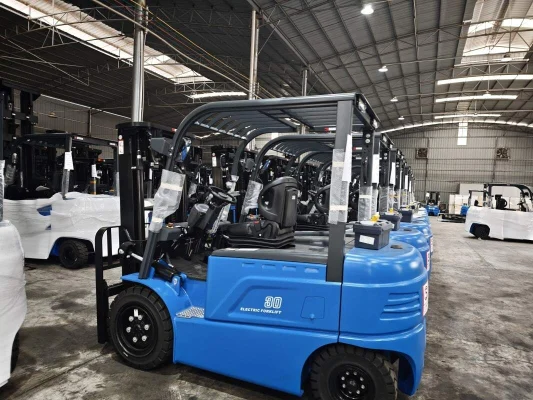
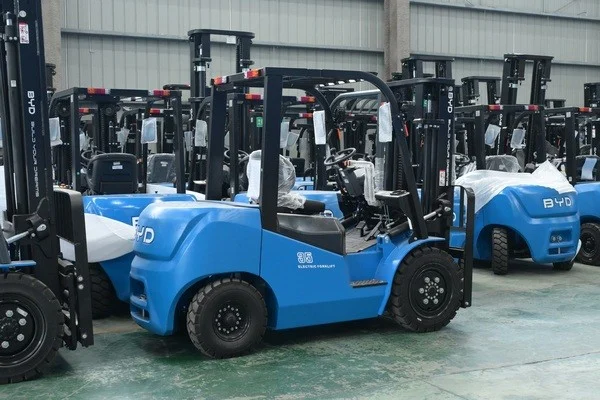
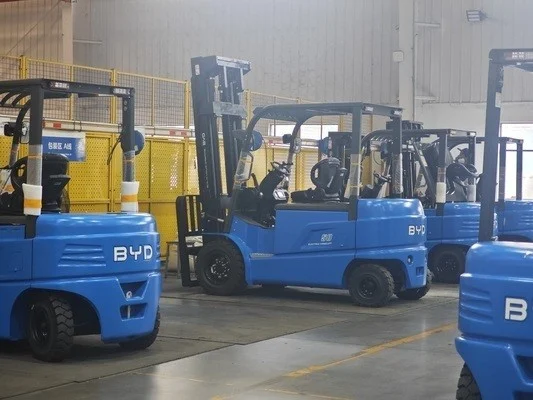
1.5 ton electric forklift: What to Confirm About Overhead Guard Height and Overhead Clearance in Low-Bay Buildings
News 06/11/2026
A 1.5 ton electric forklift can physically fit through a low-bay doorway and still be unsafe or non-compliant once it is inside, because overhead guard height and building clearance are two separate measurements. The overhead guard is the protective structure above the operator; overhead clearance is the lowest obstruction along the travel path, including door headers, sprinkler piping, ductwork, light fixtures, mezzanine edges, and rack beams. Before ordering, confirm both numbers from the manufacturer’s technical data and compare them against a measured site survey, not a drawing. This article explains what to measure, what to ask, and where the limits of a four-wheel counterbalance electric forklift appear in low-bay work.
Why the Guard Height and the Building Clearance Are Different Numbers
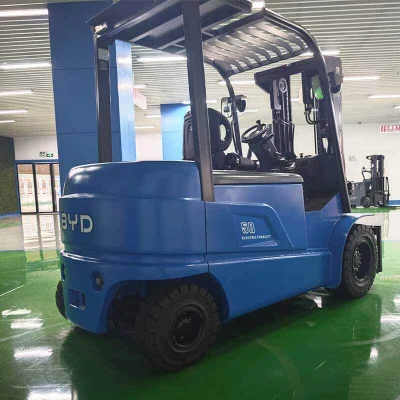
The overhead guard height is a product specification. It is measured from the floor to the highest point of the guard structure, usually with the mast lowered and no load on the forks. The building clearance is a site condition. It is the vertical distance from the floor to the lowest fixed object above the aisle. A machine that clears a door header may still strike a sprinkler head or a cable tray further along the route.
Three practical consequences follow:
- Measure the route, not the doorway. Walk the full travel path at the slowest expected speed and record every obstruction, including those that overhang only part of the aisle.
- Account for the load. A raised mast, a lifted pallet, or an attachment changes the highest point of the machine and load combination. Guard height alone does not describe the working envelope.
- Allow a working margin. Site practice and local rules may require a gap between the highest point of the machine or load and the obstruction. Confirm the applicable requirement with the site safety officer; do not assume a universal figure.
Site Survey Steps Before You Compare Models
A low-bay building rewards a disciplined survey. The goal is a clearance map that any supplier can check against published dimensions.
1. Record the lowest obstruction on each route
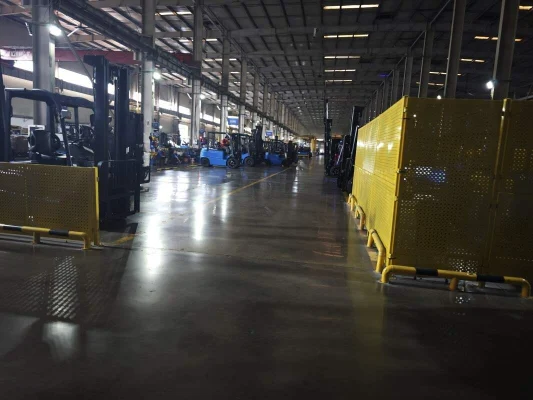
Include door headers, roller shutter housings, fire sprinkler deflectors, heating and ventilation ducts, cable trays, lighting, mezzanine undersides, and the lowest rack beam where the truck must pass beneath. Note the horizontal position of each obstruction, because a pipe near one wall may not reduce clearance across the whole aisle.
2. Measure the floor to obstruction distance at several points
Floors vary. Expansion joints, drainage falls, ramps, and patched concrete change the effective clearance. Take readings where the machine will actually travel and where it will lift, turn, or reverse.
3. Confirm the load and attachment envelope
Ask what the tallest pallet load will be, whether loads will be double-stacked, and whether any attachment will be fitted. Then request the machine height with the mast lowered and the maximum lifted height the site genuinely needs. These are different figures and both belong in the enquiry.
4. Check the door and aisle dimensions together
Door width, aisle width, and turning radius interact. A truck may pass a header but fail to turn inside the aisle without contacting racking. Provide the aisle width, the rack-to-rack distance, and any right-angle turns to the supplier.
Specifications and Configuration Details That Affect Low-Bay Fit
The following table separates what a buyer should verify from what may be optional. Values must come from the manufacturer’s technical data for the specific configuration; where data is not available, treat the item as an open question rather than an assumed number.
| Item to verify | Why it matters in a low-bay building | What to request from the supplier | Standard or optional |
|---|---|---|---|
| Overhead guard height | Sets the minimum vertical space the truck needs before any load is raised | Dimensional drawing with the guard height stated, plus the measurement condition | Confirm per model |
| Mast lowered height and extended height | Determines whether the truck can work under ducts or mezzanine edges and how high it can lift | Mast specification sheet showing both figures | Depends on mast selected |
| Rated capacity and load centre | Capacity at a given load centre may be lower than the nominal rating; attachments further reduce it | Capacity chart showing the effect of load centre and any attachment | Confirm per configuration |
| Overall width, length, and turning radius | Affects whether the truck can turn inside narrow aisles without striking racking | Dimensioned plan view drawing | Confirm per model |
| Battery type and charging arrangement | Charging location and shift pattern influence how many trucks the site needs | Battery and charger data, charging time, and space needed at the charging point | Confirm available options |
| Lights, alarms, and operator aids | Low-clearance areas often need extra warning and visibility aids | List of available lighting and warning options | Often optional |
Two points deserve emphasis. First, the overhead guard height is not a substitute for the full working envelope. Second, a nominal 1.5 ton rating describes capacity under stated conditions; it does not by itself confirm that the truck suits a low-bay aisle. Capacity, load centre, mast, and attachment all interact.
What a four-wheel counterbalance electric forklift suits, and where it does not
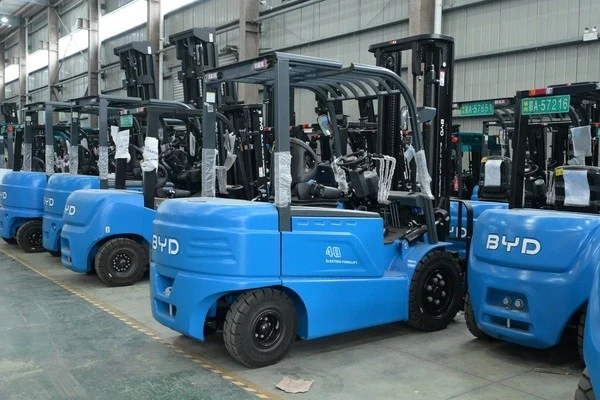
A four-wheel counterbalance electric forklift is a common general-purpose choice for loading, unloading, and horizontal transport in warehouses and factories. In a low-bay building it can be appropriate when the measured clearance exceeds the truck’s highest working point with the required margin, when aisle width allows the turning radius, and when the floor and ramps are within the manufacturer’s stated limits.
It is not automatically the right answer. If the clearance is very tight, if the aisle is narrow relative to the load length, or if the task is mainly moving pallets over short distances at floor level, other equipment categories may fit the space better. Those categories sit outside this site’s sales range, so this article does not recommend them; the honest conclusion is that a site survey may show a counterbalance truck is unsuitable, and that finding should be respected rather than argued away.
Questions to Put to the Supplier, and How to Check the Answers
Use the survey to build a short written enquiry. A useful enquiry includes the lowest measured clearance, the aisle and door dimensions, the heaviest load, the load centre, the required lift height, the floor condition, the shift pattern, and the charging location.
- Ask for a dimensioned drawing, not a headline figure. The drawing should show guard height, mast heights, overall length and width, and turning radius.
- Ask how capacity changes with load centre and attachments. Request the capacity chart, not a single rating.
- Ask which options affect height. Lights, warning beacons, and certain operator aids can add height; confirm whether they change the highest point.
- Ask what the documentation covers. Confirm which documents accompany delivery and what they state about dimensions and capacity.
- Ask about charging. Confirm the charger requirements, the space needed, and whether the proposed charging area suits the building.
Then check the answers against the survey. If a supplier’s figure is close to the measured clearance, ask what margin the site should keep and who is responsible for confirming it. Do not accept a verbal assurance that the truck “will fit” without the drawing and the measurement side by side.
Common errors in low-bay procurement
- Measuring only the main door and ignoring sprinkler heads or ducts deeper inside the building.
- Comparing guard height across models while ignoring mast and load height.
- Ordering on nominal capacity without checking the capacity chart at the real load centre.
- Forgetting that attachments and added lights can change the highest point.
- Assuming a truck that fits today will still fit after racking is moved or a new duct is installed; keep the clearance map updated.
Frequently Asked Questions
Is overhead guard height the same as the forklift’s overall height?
No. Overall height depends on the mast and its position. The guard height describes the protective structure above the operator, while the mast lowered and extended heights describe the lifting assembly. A low-bay check needs all of these figures, plus the height of the load when raised.
How much clearance should I leave above the truck?
There is no single figure that applies everywhere. Site rules, local regulations, and the nature of the obstruction all matter. Ask the site safety officer what margin applies, and ask the supplier to confirm the highest point of the proposed configuration so the two numbers can be compared.
Can a 1.5 ton electric forklift work under a mezzanine?
Only if the measured clearance under the mezzanine exceeds the truck’s highest working point with the required margin, and if the floor, aisle, and turning conditions are suitable. A mezzanine edge often combines a low header with limited turning space, so measure both vertical and horizontal dimensions before deciding.
Does adding lights or a warning beacon change the height?
It can. Accessories mounted on or above the guard may raise the highest point. Ask the supplier whether each option affects the overall height and request the revised figure in writing.
What should I send with my enquiry?
Send the lowest measured clearance on each route, door and aisle dimensions, the heaviest load and its load centre, the required lift height, floor and ramp conditions, shift pattern, and charging location. With those details, a supplier can confirm which configurations of a four-wheel counterbalance electric forklift fit the building and which do not.