Choosing Mast and Overhead Guard Height on a 3 Ton Electric Forklift: Clearing Doorways and Rack Openings
News 31/10/2026
A 3 ton electric forklift only fits a doorway or rack opening when its lowered overhead guard and mast clear the structure with real margin to spare. Buyers often compare rated capacity and forget that the tallest point of the truck, not the load, decides whether it enters the building. This guide explains which heights to measure, how mast type changes the vertical envelope, and where the trade-offs appear when a four-wheel counterbalance electric forklift must work inside an existing building.
Measure the Building Before Comparing Truck Dimensions
Start with the structure, not the spec sheet. Three clear dimensions control access:
- Doorway clear height — the lowest fixed point in the opening, including a partly raised roller shutter, door track, or a cable tray mounted just inside the frame.
- Rack opening height — the distance from the floor to the underside of the lowest beam you must reach, not the beam’s top surface.
- Overhead obstructions along the travel path — sprinkler heads, light fixtures, ventilation ducts, and pipework that hang below the ceiling.
Measure at several points across a wide opening, because floors slope and door frames settle. Record the smallest figure. Also note the floor condition and any ramp at the threshold: a truck that tilts on a slope sweeps its mast and guard through a different arc, and a leaning mast can bind on a tight frame.
A practical habit is to write the three numbers on the same page as the truck’s lowered height and compare them line by line. If the numbers are close, treat the route as restricted and plan a slower, spotter-assisted pass rather than assuming the truck will squeeze through.
How Mast Type Changes the Vertical Envelope
On a four-wheel counterbalance electric forklift, the mast is the tallest and most variable part of the truck. The same 3 ton chassis may be offered with different mast stages, and each stage has its own lowered height, free-lift behaviour, and extended height. The manufacturer’s technical data sheet is the only reliable source of these figures; do not estimate them from photographs.
Lowered height and collapsed mast
Lowered height is measured with the forks fully down and the mast collapsed. This is the figure that matters when the truck passes under a doorway or drives into a low-clearance aisle. A simplex mast usually collapses to a lower profile than a duplex or triplex mast, but it also offers less lift, so the choice is a genuine trade-off rather than a free upgrade.
Free lift and low-clearance entries
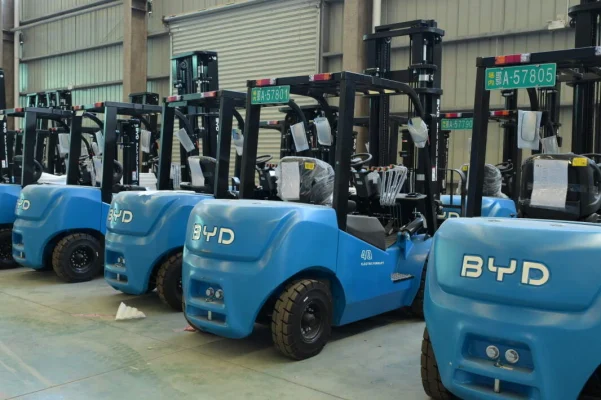
Free lift describes how far the forks can rise before the mast stages begin to extend. Where a truck must lift a pallet inside a container, trailer, or a rack level under a low beam, free lift determines whether the load can be raised without the mast growing taller. Ask the supplier to confirm the free-lift value and the height at which the mast starts to extend, because these two numbers decide whether an indoor lift is possible at all.
Extended height and overhead clearance
At full lift, the mast reaches its highest point. Check this against the ceiling, sprinkler line, and roof structure at the exact place where the highest pick or put-away happens. A truck can clear the doorway and still collide with a sprinkler head two aisles deeper.
Overhead Guard Height and Operator Clearance
The overhead guard protects the operator from falling objects, and its height is fixed by the truck’s design rather than adjusted on site. Two separate clearances matter:
- Guard-to-structure clearance — the gap between the top of the guard and the lowest obstruction above the travel path. This is the number compared with doorway and rack heights.
- Guard-to-seat clearance — the internal space between the guard and the operator’s seating position, which affects comfort and safe entry and exit.
Do not modify, cut, or remove an overhead guard to gain height. Altering the guard changes a safety structure and may void the truck’s conformity. If the standard guard will not clear a fixed obstruction, the correct responses are to change the route, alter the building, or select a truck whose published dimensions suit the site — not to modify the guard.
Operator entry and exit also need headroom outside the aisle. Check the clearance above the seat when the operator steps in, and keep the area above the truck free of hanging cables and loose fixtures.
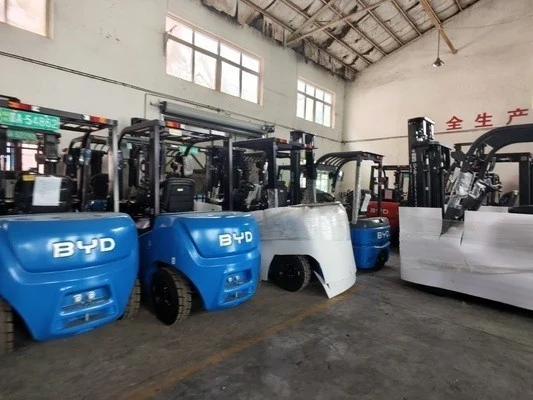
Working Through the Trade-Offs
Height decisions rarely have a single right answer. The table below sets out the common conflicts and the information needed to resolve each one.
| Decision point | What to check | Practical consequence |
|---|---|---|
| Low doorway versus high racking | Lowered height against door clearance; extended height against ceiling | A mast that collapses low enough to enter may still need a ceiling check at full lift |
| Free lift versus lift height | Free-lift value and the height where stages extend | More free lift helps indoor lifting but may limit maximum lift |
| Guard height versus operator comfort | Published guard height and internal clearance | A lower guard helps access but must still meet the manufacturer’s design |
| Tight frame versus load size | Load dimensions, mast width, and turning path | Height clearance alone does not guarantee a clean pass |
Consider a hypothetical application: a 3 ton electric forklift moving palletised goods from an outdoor yard into a warehouse through a roller-shutter door, then lifting to a mid-level rack beam. The buyer would compare the truck’s lowered height with the door’s clear height, the free-lift value with the beam height, and the extended height with the ceiling above the rack. If any one of these fails, the configuration needs revisiting before purchase.
Also account for load height. A pallet stacked above the fork carriage adds to the effective envelope during travel, and a tall load can strike a beam even when the mast clears it. Where loads vary, plan around the tallest routine load rather than the average.
Ground conditions and ramps belong in the same review. A slope changes the angle of the mast and guard relative to a fixed opening, and a soft or uneven surface can cause the truck to pitch. Neither effect is easy to quantify without site measurement, so treat marginal clearances as unsuitable.
Frequently Asked Questions
Does a 3 ton electric forklift fit a standard warehouse door?
There is no universal answer. Door heights vary widely, and lowered height depends on the mast fitted. Compare the published lowered height of the exact configuration with the measured clear height of your door, and keep a working margin rather than planning to the millimetre.
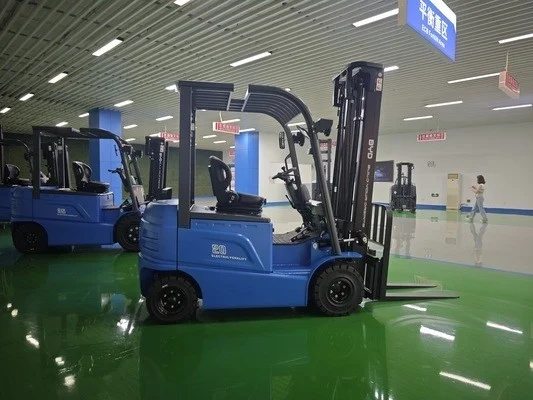
Can the overhead guard be lowered to clear a low beam?
No. The guard is a safety structure sized by the manufacturer. Reducing its height compromises protection and may breach conformity requirements. Change the route or the building instead, or choose a model whose published dimensions suit the site.
What is the difference between lowered height and extended height?
Lowered height is measured with the forks down and the mast collapsed, and it governs doorways and low aisles. Extended height is measured at full lift and governs ceiling, sprinkler, and roof clearance at the highest pick or put-away position. Both figures come from the manufacturer’s data sheet.
Why does free lift matter indoors?
Free lift lets the forks rise before the mast stages extend, which allows lifting under a low beam or inside a trailer without increasing the truck’s overall height. Confirm the free-lift value and the stage-extension height with the supplier before relying on it.
Which measurements should I send when requesting a configuration?
Provide doorway clear height, rack opening heights, the highest lift required, the tallest routine load, aisle width, floor and ramp conditions, and daily shift pattern. These details let a supplier match a four-wheel counterbalance electric forklift and mast to your building rather than guess. Confirm all dimensions against the current technical data sheet before ordering, since published figures can change between models and production batches.