How to Specify a 3 Ton Electric Forklift: Load Center, Lift Height, and Attachment Compatibility
News 30/10/2026
A three-ton rating is a starting point, not a specification. A four-wheel counterbalance electric forklift rated at 3,000 kg at a defined load center can carry considerably less once the load sits farther out, the carriage rises, or an attachment shifts the load forward. Getting the specification right means recording the actual load, its center of gravity, the lift height, the attachment, and the ground and aisle conditions, then matching those figures against the manufacturer’s data sheet. This guide walks through the decisions in the order they usually affect capacity and stability.
Start With the Real Load, Not the Rated Capacity
Rated capacity is normally stated at a specific load center, commonly 500 mm or 600 mm from the fork face, and at a specific lift height. Any load whose center sits beyond that distance reduces the usable capacity. Before comparing models, measure or estimate:
- Maximum load weight, including pallet, packaging, and any residual material.
- Load dimensions and the position of the center of gravity, not just the outer envelope.
- Whether loads are uniform or vary widely across a shift.
- The heaviest load handled at the highest lift, since that combination often governs the choice.
A common error is to specify against the average pallet and then discover that occasional heavier loads exceed the derated capacity at height. If the heaviest load is uncertain, ask the supplier to show the capacity at the actual load center and lift height, not only the headline rating.
Load Center and Lift Height: Where Capacity Changes
Load center and lift height interact. As the load center moves forward, the overturning moment increases; as the carriage rises, stability margins and mast behaviour change. Manufacturers publish capacity charts that show the permitted load at combinations of load center and lift height. These charts, not the nominal figure, are the basis of a safe specification.
Reading a capacity chart
A typical chart lists load center values across the top and lift heights down the side, with permitted load in each cell. Read the cell that matches the worst realistic combination. If the chart does not cover your lift height or load center, request an engineering confirmation rather than extrapolating.
Lift height decisions
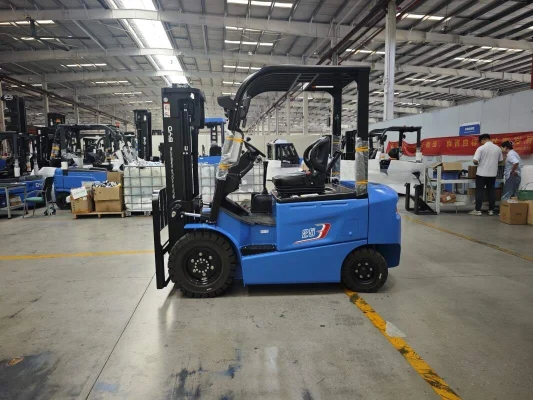
State the required lift height as the height needed to place or retrieve the load, including rack beam height and any clearance. Also note free lift if the forklift must enter a trailer or work under low obstructions, and check whether the mast type you need is available at that height. Do not assume a taller mast is simply a safer choice: it can affect overhead clearance, visibility, and capacity.
Attachments Change the Load Case
Attachments such as side shifters, fork positioners, clamps, or rotators add weight and move the load forward, both of which reduce net capacity. The effect must be calculated, not estimated. Ask for the attachment’s own weight and its load center, then confirm the combined capacity with the forklift supplier.
| Specification item | Why it matters | What to confirm |
|---|---|---|
| Attachment weight | Reduces available payload | Value from the attachment data sheet |
| Attachment load center | Shifts the combined center forward | Distance from fork face |
| Combined capacity | Determines safe working load | Supplier’s derated figure at your lift height |
| Hydraulic demand | Affects function speed and system sizing | Required flow and pressure |
Attachment compatibility also covers mounting, hydraulic circuits, and visibility. A clamp or positioner may need additional hydraulic lines and a different carriage. Confirm these details before ordering, because retrofitting later can be costly.
Site Conditions That Shape the Specification
The surrounding site often decides as much as the load. Check the following before finalising a configuration:
- Aisle width: measure the narrowest aisle and compare it with the truck’s turning radius and dimensions with the chosen attachment.
- Floor and surface: condition, slope, and any thresholds affect traction and stability.
- Duty cycle: shifts per day, hours of operation, and the proportion of lifting versus travel influence battery and charging needs.
- Charging arrangements: available power, charging location, and whether opportunity charging is practical.
- Environment: dust, moisture, cold storage, or outdoor use should be declared so the supplier can advise on suitable configuration.
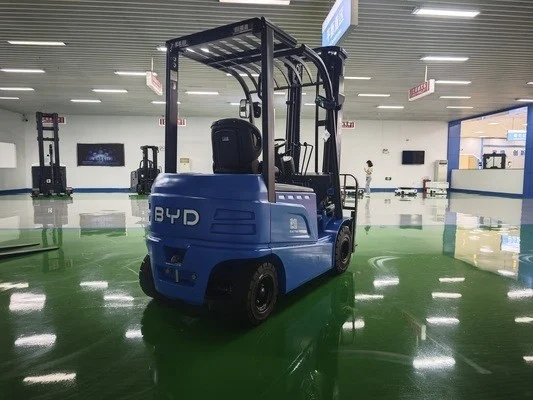
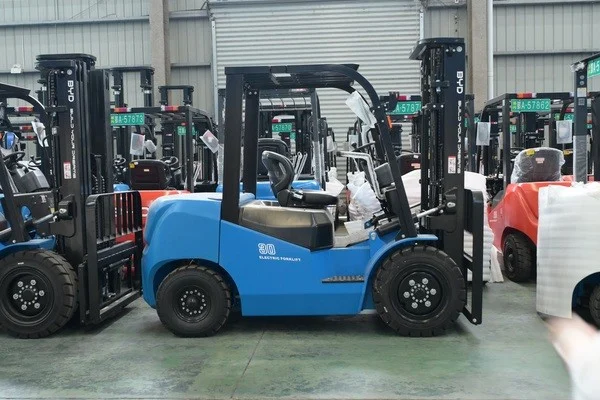
For general factory handling, loading, and warehouse transfer, a four-wheel counterbalance electric forklift is a common choice. Whether it suits a particular site still depends on the figures above; no single configuration fits every operation.
Frequently Asked Questions
Does a 3 ton rating mean it can lift 3,000 kg at any height?
No. The rating applies at a stated load center and lift height. Capacity generally falls as the load center moves forward or the lift height increases, so always read the capacity chart.
How much capacity does an attachment remove?
It depends on the attachment’s weight and load center. The reduction must be calculated from the attachment data and confirmed with the forklift supplier; it should not be estimated from general rules of thumb.
Can I add an attachment after delivery?
Sometimes, but the combined capacity and hydraulic requirements must be rechecked. Adding an attachment without recalculating capacity can leave the truck operating outside its rated conditions.
What information should I give a supplier?
Provide maximum load weight and dimensions, load center, required lift height, attachment type, aisle width, floor and slope conditions, duty cycle, and charging arrangements. These details let the supplier propose a configuration and show the capacity at your actual working conditions.
To move from a general three-ton figure to a workable specification, gather these site and load details first, then ask the supplier to confirm capacity at your load center and lift height. Our team can help match your requirements to a four-wheel counterbalance electric forklift configuration using the technical data available.