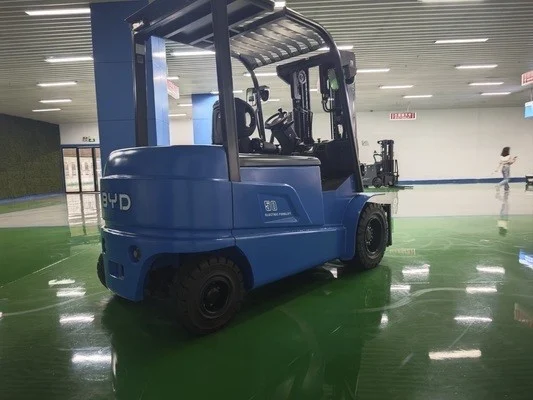
5 Ton Four-Wheel Counterbalance Electric Forklift: Attachment and Load Center Checks Industrial Engineers Should Confirm
News 30/10/2026
A 5 ton forklift rating describes the truck, not the load as it will actually be handled. Once an attachment is fitted, the load center moves forward, the attachment itself adds weight, and the capacity printed on the data plate no longer describes what can be lifted safely. Industrial engineers signing off a specification should confirm three things before approving a configuration: the rated capacity at the actual load center, the derating caused by the attachment, and whether the mast, carriage and hydraulic system are rated to carry the combined load. This article explains how those checks work on a four-wheel counterbalance electric forklift and which figures must come from the manufacturer’s technical data rather than from estimates.
Why the Data Plate Capacity Is Only a Starting Point
Counterbalance forklifts are rated to a stated capacity at a defined load center, normally measured from the vertical face of the forks. A load whose center of gravity sits farther out creates a larger overturning moment around the front axle. The truck’s stability and its hydraulic and structural limits are therefore tied to that geometry, not to weight alone.
Two consequences matter during specification. First, a nominal 5 ton rating applies only at the rated load center. Second, any device added between the carriage and the load changes both the distance and the weight being carried. Engineers should treat the plate value as a baseline and recalculate from there.
Electric trucks add one further consideration: the battery acts as counterweight, so battery mass and position are part of the stability calculation. A replacement battery of different mass or dimensions should be confirmed with the manufacturer before it is treated as equivalent.
Attachment Checks That Change Rated Capacity
Attachments are the most common reason a truck is asked to do more than it is rated to do. The checks below should be completed before a purchase order is raised, not after delivery.
Load center shift
Every attachment pushes the effective load center forward. A fork positioner, a clamp, a rotating device or a slip-on extension all add horizontal distance between the carriage and the load’s center of gravity. The manufacturer’s derating chart normally expresses capacity against load center distance. If the chart is unavailable, request it; do not interpolate from a similar attachment.
Attachment weight
The attachment is carried by the truck at all times, loaded or empty. Its mass must be subtracted from the available capacity, and its own center of gravity affects the calculation. A heavy attachment on a truck specified close to its limit can leave very little residual capacity at the forks.
Carriage, fork and mast compatibility
Confirm the carriage class, fork thickness and fork spread the attachment requires, and whether the mast and hydraulic circuit are rated to operate it. Some attachments need additional hydraulic functions, which affects valve configuration, hose routing and residual capacity. Engineers should ask whether the truck’s lift and tilt circuits can supply the required flow and pressure without compromising lift speed or control.
Visibility and handling
Attachments can obstruct the operator’s view of the load. This is a safety and productivity issue rather than a capacity figure, but it belongs in the specification review. Where visibility is restricted, the layout of the aisle and the handling procedure may need to change.
Residual capacity calculation
The practical output of these checks is a residual capacity figure at the real load center with the real attachment fitted. Ask the manufacturer to state it explicitly. If the answer is a range or a verbal assurance, request the written derating data and the load center on which it is based.
Load Center Checks Before Approving a Configuration
Load center is often treated as a single number, but the engineer needs to confirm several related measurements. The table below lists what to establish and why it matters.
| Check | What to establish | Why it matters |
|---|---|---|
| Rated load center | The distance at which the truck’s capacity is stated | Defines the baseline all other calculations start from |
| Actual load center | Measured horizontal distance from fork face to the combined center of gravity of load plus attachment | Determines the real overturning moment |
| Load dimensions | Length, width and height of the heaviest and the largest loads | Affects both load center and residual capacity at height |
| Load stability | Whether the load is rigid, deformable, or shifts during transport | A shifting load moves the center of gravity while the truck is moving |
| Lift height | Maximum height at which full or reduced capacity is needed | Capacity and stability margins change with lift height and mast type |
| Attachment offset | Added horizontal distance introduced by the device | Directly increases load center and reduces capacity |
Two practical points are frequently missed. First, the heaviest load and the load with the farthest center of gravity are not always the same item; both need checking. Second, a load that is stable on the floor may not be stable at height or during a turn. Engineers should confirm the load handling procedure, not just the static geometry.
Site and Duty Conditions That Affect the Verdict
Capacity checks are necessary but not sufficient. The same truck and attachment combination can be appropriate in one building and unsuitable in another. The following conditions should be recorded as part of the specification file.
- Aisle width and turning radius: a four-wheel counterbalance truck needs more space to turn than a three-wheel design; confirm the actual aisle dimensions against the truck’s turning radius with the attachment fitted.
- Floor condition and gradients: ramps, dock levellers, drains and surface irregularities affect stability and traction. Confirm the maximum gradient the truck is rated to negotiate and whether the route includes it.
- Lift height and mast type: the required free lift and maximum lift height determine the mast specification, which in turn affects capacity and overhead clearance.
- Shift pattern and charging: battery capacity, opportunity charging and any battery exchange arrangement should match the duty cycle. Confirm these with the manufacturer rather than assuming a full shift on one charge.
- Environment: dust, moisture, cold storage or corrosive atmospheres may require specific protection levels. Do not assume a standard truck is suitable without written confirmation.
Where any of these conditions is uncertain, the honest position is that the configuration is unverified. Engineers should record the open item and resolve it before approval rather than accepting a general assurance that the truck will cope.
An illustrative scenario
Consider a hypothetical warehouse that handles coiled material on a 5 ton four-wheel counterbalance electric forklift fitted with a rotating clamp. The coil diameter places the center of gravity well forward of the fork face, and the clamp adds its own mass. A specification based on the plate rating would overstate what can be handled. The correct approach is to obtain the manufacturer’s derating data at the measured load center, add the attachment mass, and confirm the residual capacity against the heaviest coil. If the residual capacity is insufficient, the options are a larger truck, a different handling method, or a changed load presentation. This example is illustrative only; the figures must come from the actual manufacturer’s data.
Frequently Asked Questions
Does a 5 ton rating mean the truck can lift 5 tons with any attachment?
No. The rating applies at a stated load center with no attachment fitted. An attachment shifts the load center forward and adds its own weight, so the safe capacity is lower. The manufacturer should state the derated capacity at the actual load center.
Where can I find the derating data?
Request it from the truck manufacturer together with the attachment supplier’s data. The relevant documents are the capacity chart against load center, the attachment mass and dimensions, and any carriage or hydraulic requirements. If a supplier cannot provide these in writing, the configuration should not be approved.
Is a four-wheel counterbalance electric forklift suitable for both indoor and outdoor work?
It can be, subject to confirmation of floor conditions, gradients, weather protection and tyre specification. Outdoor use on uneven or sloping ground needs specific verification against the truck’s rated capabilities; do not assume indoor performance transfers directly.
Can I change the battery without affecting capacity?
Battery mass and position contribute to counterbalance stability. A replacement battery of different mass or dimensions should be confirmed as suitable by the manufacturer before use. Treating batteries as interchangeable without that confirmation is a common and avoidable error.
What information should I prepare before requesting a configuration review?
Provide the heaviest and largest loads with dimensions and center of gravity, the attachment type, the maximum lift height, aisle and door widths, floor gradients, shift pattern and charging arrangements. With these details, the manufacturer can confirm the appropriate model and derated capacity. Buyers considering a four-wheel counterbalance electric forklift from BYD can share these operating conditions to obtain a configuration recommendation based on published technical data.