5 Ton Forklift Charging Room Design: Electrical Capacity, Ventilation and Charge Scheduling Considerations
News 06/11/2026
A 5 ton forklift charging room is not simply a bay with chargers on the wall. It is a small electrical installation with its own supply capacity, heat load, ventilation path, fire precautions and shift routine. Get those four elements wrong and the result is nuisance tripping, slow charging, overheated batteries or a room that cannot be safely used during peak hours. This article explains the decisions a facility team must make before installing chargers, using a four-wheel counterbalance electric forklift as the reference vehicle. It does not provide model-specific ratings; those must come from the manufacturer’s technical documentation.
What the Charging Room Must Supply
A 5 ton forklift is a heavy-duty truck, and its traction battery is correspondingly large. The charger input power, not the nominal battery voltage alone, determines how much electrical capacity the room needs. Three numbers drive the design:
- Charger output and input power. A high-rate charger draws far more from the building than a conventional overnight unit. The nameplate input current and the supply voltage the charger expects are the starting point.
- Simultaneous charging. The room’s design load is the sum of all chargers running at once, not the average over a week.
- Diversity and duty. If scheduling ensures only part of the fleet charges at any moment, the peak load can be lower. This is a planning decision, not a free assumption.
Ask the charger supplier for the input current at the actual site voltage, the recommended upstream protection, the cable sizing basis and the harmonic or power-factor information relevant to your installation. Then have a qualified electrical engineer confirm the distribution board, cable runs and protective devices. Do not size the room from a generic rule of thumb, and do not assume a charger’s output rating equals its input draw.
One practical point applies to four-wheel counterbalance electric forklifts with lithium batteries: opportunity charging may be acceptable, but only within the battery and charger limits the manufacturer states. Frequent partial charging is a scheduling choice, not a universal right, and it must be confirmed against the battery management system’s requirements.
Ventilation, Heat and Fire Precautions
Ventilation serves two purposes in a charging room: removing heat and, where the battery technology requires it, managing gases released during charging. Lithium batteries do not release the same gases as flooded lead-acid types under normal charging, but they still produce heat, and a fault condition is a different scenario. The safe approach is to design to the manufacturer’s stated requirements rather than to a general assumption.
Heat load
Every charger and every battery loses some energy as heat. The room needs enough air exchange or mechanical cooling to keep temperatures within the range the charger and battery manufacturers specify. In a small room with several high-rate chargers, summer temperatures can rise quickly. Record the expected heat release from each charger and check whether natural ventilation is sufficient or mechanical ventilation is needed.
Airflow path
Air should move from a clean intake across the charging positions and out through an exhaust point that does not recirculate into occupied areas. Avoid dead corners behind chargers. Keep the intake away from vehicle exhaust, dust and any area where fork trucks manoeuvre.
Fire and emergency arrangements
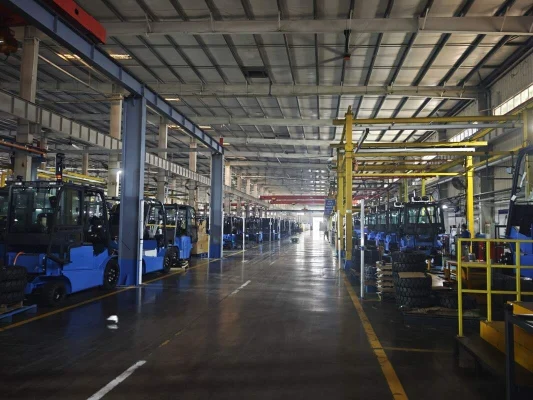
Charging rooms should be treated as a fire-risk area. The exact requirements depend on local codes, the battery chemistry and the building’s fire strategy. Points to confirm with the authority having jurisdiction and the insurer include separation from storage, fire detection, suitable extinguishing media, emergency isolation of the charger supply, and clear egress. Do not rely on a single generic measure; document what was agreed and why.
Layout and access
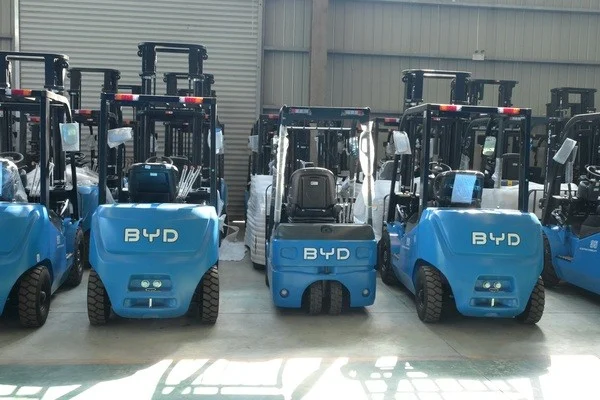
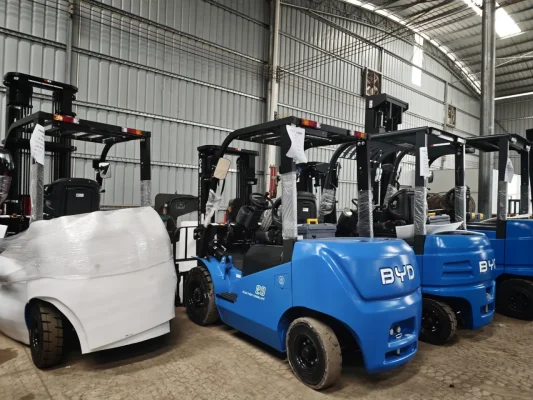
A four-wheel counterbalance truck is long and needs room to enter, align and leave a charging position. Check the turning path, the clearance between parked trucks, and whether the charger cable can reach the battery compartment without strain. Keep the aisle clear of cables, pallets and loose equipment. If the room also stores batteries or spare chargers, separate that area from the vehicle movement path.
Charge Scheduling and Shift Planning
The charging room’s electrical capacity and the fleet’s shift pattern are linked. A schedule that spreads charging across the day can reduce peak demand and avoid a queue at shift change. A schedule that concentrates all charging into one window demands a larger supply.
Questions to settle before choosing a schedule
- How many hours per shift does each truck actually operate, and how many shifts run per day?
- When are trucks available to charge, and how long is each charging window in practice?
- Does the battery manufacturer permit opportunity charging, and under what conditions?
- What is the realistic charger-to-truck ratio, allowing for trucks that return late or need attention?
- Is there a peak-demand charge or supply limit that makes staggered charging worthwhile?
A common mistake is to plan charging around the nominal battery capacity and ignore the time a truck spends waiting, connecting and disconnecting. Another is to assume every truck will be back on schedule. Build in some slack, and decide in advance which trucks get priority when the room is full. Post the schedule at the charging room entrance and make it part of the shift handover.
Connecting charging to battery care
Charge scheduling should respect the battery management system’s limits. Repeated interruption, charging at temperatures outside the permitted range, or leaving a battery at a very low state of charge for long periods can affect life. The manufacturer’s instructions define what is acceptable. If the room is cold in winter or hot in summer, check whether charging must be paused or the room conditioned before charging begins.
Specification and Verification Checklist
The table below summarises the items that most often cause problems. It distinguishes what is normally part of the charger supply, what is a site design decision, and what must be confirmed with the manufacturer.
| Item | Why it matters | How to verify | Typical status |
|---|---|---|---|
| Charger input current and voltage | Sets the supply and protection size | Nameplate and manufacturer data sheet at site voltage | Supplier data |
| Number of simultaneous chargers | Defines peak load | Agreed schedule and layout drawing | Site decision |
| Heat release per charger | Drives ventilation or cooling | Manufacturer’s thermal data | Supplier data |
| Battery charging temperature range | Prevents unsafe or damaging charging | Battery documentation and BMS limits | Confirm with manufacturer |
| Ventilation rate and airflow path | Removes heat and manages gases | Design calculation and commissioning test | Site design |
| Fire detection and isolation | Emergency response | Local code review and insurer agreement | Site design |
| Truck turning and parking clearance | Safe entry and cable reach | Layout drawing checked against truck dimensions | Site design |
| Opportunity charging permission | Affects schedule and battery life | Written statement from battery supplier | Confirm with manufacturer |
Treat any cell marked as needing confirmation as an open item. Do not fill it with an assumed number.
Commissioning checks
Before regular use, confirm that protective devices trip as intended, that ventilation runs and is monitored, that emergency isolation is accessible and labelled, and that the posted schedule matches the actual charger assignment. Record the measured supply voltage and the room temperature under load. These readings become the baseline when something changes later.
Frequently Asked Questions
Can a 5 ton forklift share a charging room with smaller trucks?
It can, provided the supply capacity, charger types, cable reach and layout suit every truck in the room. A heavy truck’s charger may draw more current and release more heat than a small truck’s unit. Check the combined peak load and the ventilation design against the mix, not against one truck alone.
How much space does each charging position need?
There is no single figure. The required space depends on the truck’s dimensions, the charger cable length, the clearance needed to open battery access, and the aisle width needed to reverse out safely. Use the actual truck drawing and a layout plan, and leave room to walk around the vehicle.
Is ventilation always required?
Some form of air exchange is normally needed to control heat, and the manufacturer’s requirements govern gas management. The exact arrangement depends on the battery chemistry, charger type, room size and local rules. Have the design reviewed rather than assuming a fan is enough.
Can charging be scheduled during breaks only?
That depends on the battery capacity, charger output, break length and the number of trucks. Short breaks may support top-up charging if the battery supplier permits it, but they rarely replace a planned charging window. Calculate the energy needed per shift and compare it with what the available windows can deliver.
What should we ask a forklift supplier before building the room?
Ask for the charger input data, ventilation and temperature requirements, permitted charging patterns and the battery documentation. Also ask what information the supplier needs about your loads, lift heights and shift pattern to recommend a suitable configuration. Share your actual operating conditions rather than a generic description, and confirm the figures in writing.
If you are planning a charging area around a four-wheel counterbalance electric forklift, the most useful next step is to list your truck count, shift pattern, available charging windows and site voltage, then request the matching charger and battery data. That information turns the design from guesswork into a documented, verifiable plan.