How to Write Acceptance Test Criteria When Commissioning a Four-Wheel Counterbalance Electric Forklift
News 11/11/2026
Acceptance test criteria turn a vague handover into a documented decision. When you commission a four-wheel counterbalance electric forklift, the criteria should state what you will check, how you will check it, which documents prove the result, and what happens when a result falls outside the agreed limit. The goal is not a long checklist. It is a short, repeatable record that protects both the buyer and the supplier when the truck enters daily service.
This guide is written for warehouse, plant, and logistics teams preparing a handover protocol. It uses the electrical forklift as the working example because battery, charger, and control-system checks are where commissioning documents most often stay vague. Any specific figures — residual capacity, gradeability, aisle width, temperature limits — must come from the supplier’s technical file and the site survey, not from a generic template.
Start With the Duty Cycle, Not the Checklist
Acceptance criteria only make sense against the job the truck will do. Before writing a single line, record the duty cycle in measurable terms: typical and maximum load weight, load centre, lift height required at the rack face, travel distance per trip, number of shifts, floor surface and condition, ramp gradients on the route, and the narrowest aisle the truck must work in.
This matters because a four-wheel counterbalance electric forklift is a general-purpose choice across loading docks, production feeding, and storage transfer, but its suitability depends on those numbers. A truck configured for one duty cycle may be the wrong machine for another. If the site needs very narrow aisles or very high lifts, a counterbalance truck may not be the right platform at all, and the acceptance criteria should not be written to force it into that role.
Translate the duty cycle into testable statements
- Load: state the rated capacity to be verified and the load centre at which it applies.
- Height: state the maximum lift height needed and whether an attachment changes the remaining capacity.
- Route: state gradients, door widths, floor joints, and surfaces the truck will cross.
- Energy: state shift length, charging window, and where charging will take place.
- Environment: state dust, moisture, washdown, or temperature conditions that affect configuration.
Build the Criteria Around Verifiable Evidence
A criterion is only useful if two people can agree whether it passed. Write each item as a check, a method, and an evidence source. Avoid adjectives such as “smooth” or “adequate” unless you define what they mean in the test.
Documents to require at handover
Ask the supplier which documents will be provided and confirm them before delivery. Typical items include the operator manual, the maintenance manual, the battery and charger documentation, the declaration of conformity where applicable, and the configuration sheet listing the delivered options. Do not assume a document exists; list it as a required deliverable and check it on the day.
Functional and safety checks
These checks should follow the manufacturer’s instructions and the site’s own safety rules. A practical sequence is: pre-operation inspection per the manual, brake test on a level surface, steering and horn check, lift and lower through the full range, tilt function, and verification that all labels and warnings are present and legible. Record the result of each as pass, fail, or pass with observation.
Battery, charger, and electrical checks
The electrical system deserves its own section. Confirm the battery type and capacity match the order, confirm the charger is compatible with the battery and the site’s power supply, and verify that the charging area meets the supplier’s stated requirements. Check that the battery monitoring or management system reports normally and that any fault codes are cleared and explained. Where the supplier specifies operating and charging temperature ranges, record them and confirm the site stays inside those ranges.
Key Parameters to Verify, and How to Verify Them
The table below is a starting structure. Fill the right-hand column from the supplier’s technical file and your site survey. Where a value is not available, write “to be confirmed” rather than guessing.
| Parameter or configuration | Why it matters on site | What to confirm with the supplier | Typical evidence |
|---|---|---|---|
| Rated capacity and load centre | Determines whether the truck can handle the heaviest planned load | Capacity at the stated load centre; effect of any attachment | Data plate, configuration sheet, load test record |
| Lift height and mast type | Must match rack height and door clearance | Maximum lift, free lift, overall lowered height | Dimensional drawing, physical measurement |
| Turning radius and aisle requirement | Affects whether the truck can work in existing aisles | Turning radius and recommended aisle width | Drawing, on-site trial in the narrowest aisle |
| Battery and charger specification | Shift coverage and charging schedule | Battery type, charger input requirements, charging time guidance | Battery and charger documents |
| Operating temperature limits | Relevant to cold stores, outdoor docks, or hot areas | Stated operating and charging ranges; any cold-store configuration | Technical file, configuration sheet |
| Brakes, steering, and controls | Core safety functions | Test method recommended in the manual | Completed functional checklist |
| Tyres and floor condition | Affects traction and stopping on wet or smooth floors | Recommended tyre type for the surface | Site survey, supplier recommendation |
Treat the table as a negotiation tool. Each row should end with an agreed acceptance method, not just a specification. If the supplier cannot provide a figure or a test method, that gap belongs in the handover record.
Run the Commissioning Test in a Defined Sequence
A defined sequence keeps the handover short and repeatable. One practical order is: document review, static inspection, functional checks, loaded trial in the real working area, electrical and charging checks, then sign-off with open items listed.
Static inspection and identification
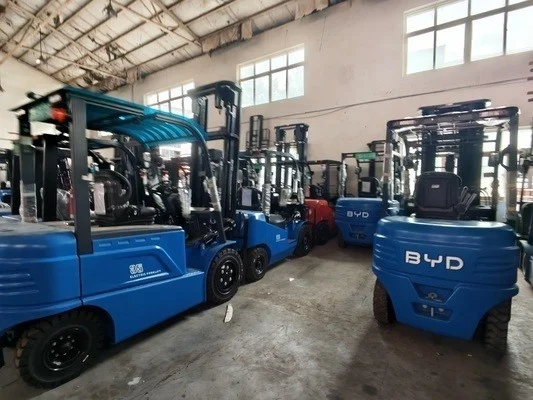
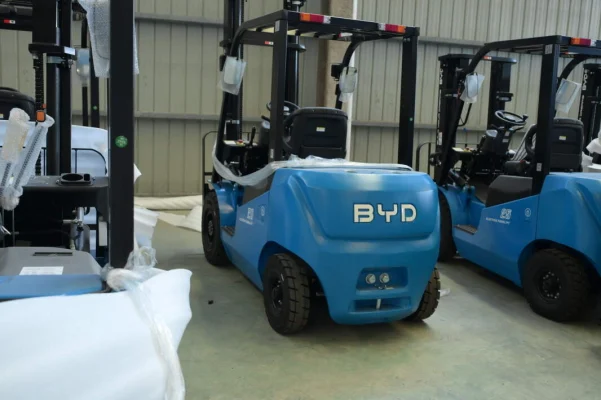
Confirm the serial number, model, and configuration against the order. Check the data plate, labels, and manuals. Photograph the truck and the data plate as part of the record.
Loaded trial in the actual aisle
Where safe and permitted by site rules, run the truck with a representative load through the narrowest aisle, the tightest door, and any ramp on the route. This is where aisle width and turning radius assumptions meet reality. Record any observed difficulty rather than relying on memory.
Charging and shift-change check
Verify the charging procedure with the people who will actually do it. Confirm that the charger, connection, and parking position work in the real layout, and that the shift-change routine fits the charging window. If the site plans opportunity charging, confirm with the supplier that the battery and charger support it.
Sign-off and open items
Close the handover with a signed record that lists passed items, failed items, agreed corrective actions, and dates. Open items should have an owner and a deadline. This record becomes the baseline for future maintenance and warranty discussions.
Frequently Asked Questions
How detailed should acceptance criteria be?
Detailed enough that a second person could repeat the test and reach the same conclusion. Focus on the items that affect safety, load handling, and the daily duty cycle. A short list of well-defined checks is more useful than a long list of vague ones.
What if the supplier’s documents do not include a value I need?
Record the gap and ask the supplier to confirm the value in writing before sign-off. Do not fill the gap with an assumed number. For example, if the operating temperature range is not stated, ask for it and confirm the site stays within it.
Should the acceptance test include a full shift trial?
Not necessarily. A loaded trial through the real route plus a charging check covers the main risks. A longer trial can be useful where the duty cycle is unusual, but agree its scope and duration in advance.
How do I handle a truck that fails one criterion?
Record the failure, agree the corrective action, and set a re-test date. Do not sign off as complete until the item is closed or formally accepted as an open item with a plan.
Data to Collect Before You Ask for a Quotation
A clear data pack shortens the whole process. Before contacting a supplier about a four-wheel counterbalance electric forklift, assemble the following: maximum and typical load weight, load centre, required lift height, narrowest aisle and door width, ramp gradients, floor surface and condition, number of shifts and charging window, charging location and power supply, and any environmental conditions such as cold, dust, or washdown.
Then prepare questions that turn those numbers into a configuration: which capacity and mast suit the load and height, what aisle width the truck needs, which battery and charger match the shift pattern, and which options address the environment. Ask the supplier to state the basis for each recommendation in writing. Where the site conditions fall outside the truck’s suitable range, ask directly whether a counterbalance truck is the right choice, and record the answer. That honest boundary check is the most valuable part of commissioning, because it prevents a mismatch that no checklist can fix later.