Planning Battery Swap and Opportunity Charging Routines Across Multi-Shift 2 Ton Electric Forklift Operations
News 10/11/2026
A 2 ton electric forklift working across two or three shifts rarely runs out of power in the middle of a task. The problem usually appears earlier: charge time no longer fits inside breaks, and one battery pack cannot cover a full shift once loads, lift heights, and travel distances add up. The practical answer is a written routine that combines opportunity charging during idle windows with a planned battery swap at a fixed point in the shift pattern. This article explains how to build that routine around a four-wheel counterbalance electric forklift, what data you need before committing to a plan, and where the approach stops working.
Match the Charging Plan to Shift Length and Duty Cycle
Charging decisions start with the duty cycle, not the calendar. Two sites running the same truck model can need very different routines if one moves pallets 20 meters and the other moves them 120 meters with repeated lifts to racking.
Collect these inputs before choosing a routine:
- Actual powered hours per shift, separated from idle time
- Average and peak load weight, plus the load center at which they are handled
- Lift heights and how often the mast reaches them
- Travel distance and floor conditions, including ramps or dock plates
- Break structure: fixed meal breaks, staggered relief, and any unpaid gaps
- Available charging positions and the electrical capacity feeding them
These inputs determine energy use per shift. A truck that spends most of its time idling between lifts recovers quickly during short charging windows. A truck in near-continuous lifting and shuttling has little idle time to exploit, so the routine must lean more heavily on a battery swap.
Why the 2 Ton Class Deserves Its Own Calculation
A 2 ton electric forklift sits in a range where both opportunity charging and battery swapping are realistic. The pack is large enough that a full recharge takes hours, yet the truck is often deployed on work that cannot pause. Treat the 2 ton class as its own case rather than scaling numbers down from a 3 or 4 ton plan; load weight, mast height, and hydraulic demand change the energy picture.
Designing the Swap and Opportunity Charging Routine
A workable routine has three layers: short charging events inside the shift, one or more battery swaps at predictable moments, and a charging schedule that keeps spare packs ready.
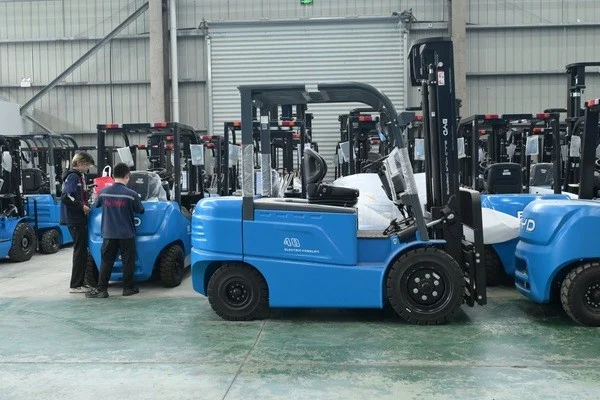
Step 1: Map the Real Idle Windows
Walk the shift with the operators and note every stop longer than a few minutes. Typical windows include shift handover, meal breaks, trailer changes, and waiting at a dock door. Opportunity charging works best when the truck returns to a fixed charging point during these windows. If the truck parks far from that point, the connection time may exceed the charging benefit.
Step 2: Decide the Swap Point
Choose a swap moment that repeats every shift, such as the end of the second break or the start of the third shift. A fixed point makes training and staffing simpler than reacting to a low state of charge. Confirm that the swap area has clear access, overhead clearance, and a safe method for moving the pack, following the battery handling instructions supplied with the truck.
Step 3: Build a Charging Calendar
List every pack and every charger, then assign charging slots so that at least one pack is always ready. The calendar should show which pack is on the truck, which is charging, and which is available. This is the part most sites skip, and it is the reason swap routines fail after a few weeks.
Step 4: Set Rules Operators Can Follow
Keep the rules short and visible at the charging point:
- Plug in whenever the truck is parked at the charger and no task is pending
- Report a state of charge below the agreed threshold before the end of the shift
- Never skip a scheduled swap to finish a task
- Record swap and charging events so the plan can be reviewed
Step 5: Review Against Actual Data
After a few weeks, compare planned and actual state of charge at swap time. A consistent shortfall means the duty cycle is heavier than assumed, the charging windows are shorter than planned, or the pack is being asked to do more than the routine allows. Adjust the swap point or add a charging window rather than pushing operators to skip breaks.
Limits, Trade-offs, and What to Confirm Before Buying
Opportunity charging and battery swapping are not free. Each has costs that should be weighed before the routine is fixed.
| Approach | Main benefit | Main constraint |
|---|---|---|
| Opportunity charging | Uses existing breaks; no extra pack handling | Requires charger access near the work area and disciplined plug-in habits |
| Scheduled battery swap | Keeps the truck working through long shifts | Needs a spare pack, safe handling method, and trained staff |
| Combined routine | Covers heavy duty cycles with predictable uptime | More planning and record keeping |
Several details must come from the manufacturer’s technical documentation rather than general assumptions: the recommended charging profile, the acceptable depth of discharge, the pack weight and lifting points, and the charger rating. Without those documents, treat any specific number as unconfirmed. Battery chemistry and charger design also affect how often short charging events are sensible, so confirm the guidance that applies to your exact configuration.
Some operations are poor fits. A single-shift site with generous breaks may need only a simple charging habit. A site with no space for a spare pack or no safe handling equipment should not plan around swaps. And a routine cannot compensate for a truck that is undersized for the loads and lift heights it faces; in that case the selection itself needs review.
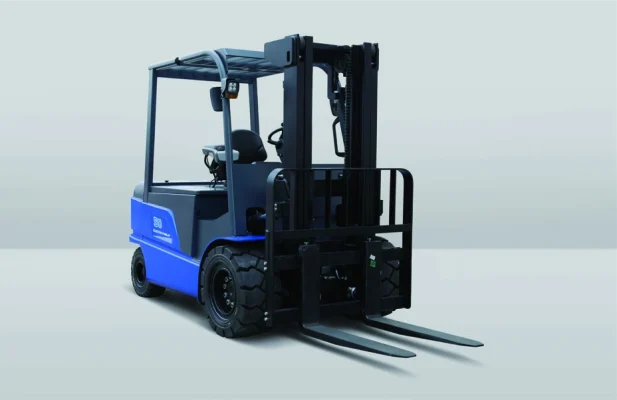
If you are specifying a four-wheel counterbalance electric forklift, share your shift pattern, measured duty cycle, lift heights, and charging layout with the supplier so the battery and charger configuration can be checked against the routine you intend to run. Ask which parameters the supplier can confirm in writing, and keep those documents with the charging plan.
Frequently Asked Questions
Can a 2 ton electric forklift run three shifts on one battery?
Sometimes, but it depends on the duty cycle. A truck with long idle periods and access to a charger during breaks may complete three shifts on one pack. Continuous lifting and shuttling usually requires a swap or a larger battery configuration. Measure powered hours and energy use before assuming one pack is enough.
How long should each opportunity charging window be?
There is no universal duration. The useful window depends on charger rating, pack capacity, state of charge, and the manufacturer’s charging guidance. What matters is that the window is long enough to add meaningful energy and that the truck reliably returns to the charger during it.
What should a battery swap area include?
Clear access, adequate overhead clearance, a safe method for moving the pack, and a place to store the spare pack. Follow the handling instructions supplied with the truck and battery. The area should also allow the depleted pack to begin charging immediately so the calendar stays on track.
What is the most common planning mistake?
Assuming the truck can charge whenever it is parked. In practice, the truck is often parked away from the charger, or the break is too short to connect and disconnect. Mapping real idle windows and charger locations before fixing the routine prevents most of these failures.