BYD ECB Forklift Battery Charging Room Planning: Ventilation, Power Supply, and Opportunity Charging Checkpoints
News 01/11/2026
A charging room serving a BYD ECB forklift fleet is a small industrial facility with its own electrical, thermal, and logistics rules. Poor planning shows up as overheated chargers, nuisance breaker trips, long queue times between shifts, or batteries that never get a full charge. This guide walks through the ventilation, power supply, and opportunity charging decisions that matter most when you plan a room around four-wheel counterbalance electric forklifts, and it flags the parameters you should confirm with your dealer and your electrical contractor before construction begins.
Start With the Fleet and Shift Pattern, Not the Room
Room size, charger count, and electrical capacity all follow from how the trucks are used. Before drawing walls, collect the following:
- Number of four-wheel counterbalance electric forklifts and their battery voltage and capacity, taken from the nameplate or the manufacturer’s technical data.
- Shift pattern: single shift, two shifts, or continuous operation with driver rotation.
- Whether batteries are swapped between shifts or charged in place.
- Typical energy use per shift, which your dealer can estimate from duty cycle and battery capacity.
- Available space adjacent to the charging positions, including clearance around charger cabinets and battery compartments.
These inputs determine whether you need a few overnight chargers or a larger opportunity charging layout. They also determine whether the room is a dedicated enclosure or a designated zone inside an existing warehouse. Confirm the exact charger models and their input requirements against the current BYD documentation; charger families and ratings vary by market and model year.
Ventilation: Managing Heat and Gases
Ventilation serves two purposes: removing heat generated by chargers and, where applicable, managing gases released during charging. The correct design depends on battery chemistry and charger type, so treat the following as planning principles rather than a fixed specification.
Heat Load
Chargers convert a portion of input power into heat. The room needs enough air exchange or mechanical cooling to keep charger and battery temperatures within the limits stated in the manufacturer’s documentation. Useful steps include:
- Obtain the heat loss figures for the specific charger models from the supplier.
- Size general ventilation or cooling to the combined charger load, not to a single unit.
- Keep chargers spaced as the installation manual requires, and avoid stacking them tightly against walls.
- Place temperature sensors where they read the air around the chargers, not near doors or outside walls.
Gases and Air Quality
Lithium-ion batteries used in BYD electric forklifts do not produce the same charging gases as flooded lead-acid batteries, but charging areas still need appropriate air quality management, and local codes may impose specific requirements. Ask the battery and charger supplier which emissions, if any, apply to the exact chemistry you are buying, and have your designer check applicable workplace and fire regulations. Do not assume a ventilation design copied from a lead-acid room will satisfy a lithium-ion installation, or the reverse.
Practical Layout Points
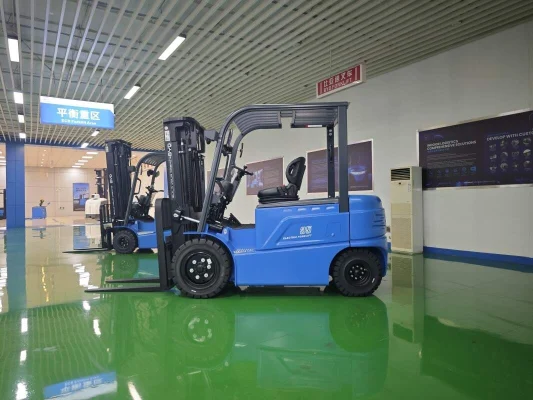
Keep the charging zone away from combustible storage, provide clear access to emergency equipment, and post charging instructions where drivers can see them. If the room shares space with other operations, separate the charging positions with barriers or marked floor zones so that trucks and pedestrians do not cross charging cables.
Power Supply and Electrical Distribution
Electrical capacity is the most common bottleneck in retrofitted charging rooms. Plan the supply around the connected load of all chargers running at once, plus a margin your electrical engineer considers appropriate.
What to Confirm With the Supplier
- Input voltage, phase, and frequency accepted by the charger models you are considering.
- Maximum input current and recommended circuit protection per charger.
- Whether chargers can be staggered or load-managed to reduce peak demand.
- Connector type and cable length, which affect where trucks can park while charging.
Distribution Design
Dedicated circuits per charger simplify fault finding and maintenance. Position distribution boards and isolators so that a charger can be locked off without cutting power to the rest of the room. Route cables overhead or in protected floor ducts where trucks maneuver, and keep charging leads off the floor when not in use. If the building supply is limited, discuss charging schedules with operations before adding chargers, because simultaneous charging of several trucks can exceed the existing service capacity.
| Planning item | Information to gather | Who confirms it |
|---|---|---|
| Charger input rating | Voltage, phase, maximum current | Forklift dealer or charger supplier |
| Heat output | Heat loss per charger at rated load | Charger supplier |
| Ventilation requirement | Air changes or cooling capacity | Mechanical designer, supplier data |
| Circuit protection | Breaker and cable sizing | Electrical contractor |
| Battery charging profile | Recommended charge windows | Battery and forklift supplier |
Opportunity Charging Checkpoints
Opportunity charging means topping up during breaks and idle periods rather than waiting for a full discharge. It can reduce the need for battery swaps, but it only works when the battery, charger, and work pattern support it. Use these checkpoints before committing:
- Battery suitability: Confirm with the supplier that the battery chemistry and battery management system in your BYD ECB trucks accept frequent partial charging.
- Break length: Map driver breaks, lunch periods, and shift changes against the time needed to add useful energy. Short, frequent top-ups require chargers positioned close to work areas.
- Charger placement: Opportunity charging points should sit where trucks naturally pause, without blocking aisles or fire exits.
- State of charge discipline: Set a minimum state of charge at which a truck must be plugged in, and record it so drivers follow the same rule.
- Temperature: Charging in very cold or very hot areas can affect charging behavior; check the operating limits in the supplier documentation.
- Record keeping: Track charging events and any interruptions so that problems can be traced to a charger, a battery, or a work pattern.
Opportunity charging is not automatically better than scheduled overnight charging. It suits operations with predictable short breaks and enough charging positions near the work area. Where trucks run long, uninterrupted shifts, a conventional charging schedule or a battery exchange plan may be simpler to manage.
Commissioning and Common Planning Errors
Before the room goes into service, test each charger on its own circuit, check that ventilation runs whenever chargers are active, and confirm that emergency stops and isolators are reachable. Brief drivers on connector handling, cable storage, and the rule for when a truck must be charged.
Recurring mistakes include sizing the electrical supply to the number of trucks rather than the number of chargers running simultaneously, ignoring charger heat in a small enclosed room, placing charging positions where they block traffic, and assuming that a ventilation design from another battery type will transfer unchanged. Each of these is cheaper to correct on paper than after installation.
If you are planning a charging area around BYD four-wheel counterbalance electric forklifts, share your shift pattern, truck count, battery details, and available floor space with the supplier early. They can confirm the charger models, input requirements, and installation conditions that apply to your fleet, and your electrical and mechanical designers can then size the room to match.

Frequently Asked Questions
Can a BYD ECB forklift charge in a general warehouse area?
That depends on local regulations, the battery chemistry, and the charger installation requirements. Some operations designate a charging zone inside the warehouse rather than building a separate room. Confirm the applicable fire, electrical, and workplace rules with your designer and the equipment supplier before deciding.
How many chargers does a small fleet need?
There is no universal ratio. The number depends on shift length, battery capacity, break patterns, and whether trucks charge in place or exchange batteries. Start with the energy each truck consumes per shift and the charging rate of the candidate charger, then add positions so that trucks are not waiting during peak breaks.
Does opportunity charging shorten battery life?
Frequent partial charging is a normal operating mode for many lithium-ion systems, but the acceptable pattern is defined by the battery manufacturer and its management system. Ask the supplier to confirm the recommended charging windows and limits for the exact battery in your trucks rather than relying on general statements.
What ventilation data should I request from the supplier?
Request the heat loss figures and any emissions information that applies to the charger and battery combination you are buying, together with the installation manual’s clearance requirements. Give these documents to your mechanical designer so that ventilation is sized to real data rather than assumptions.