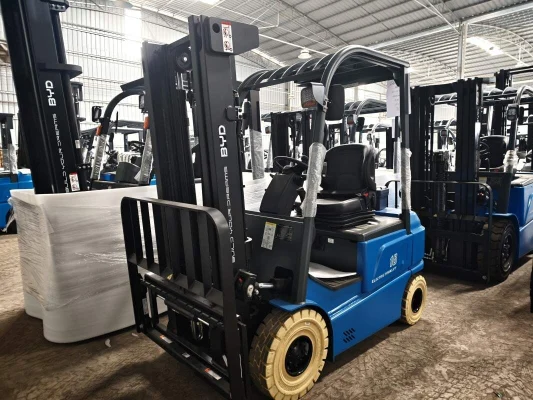
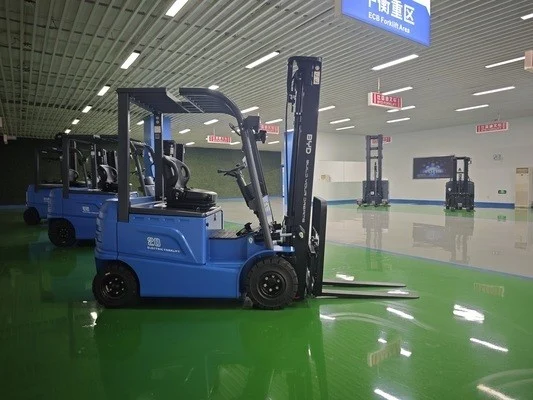
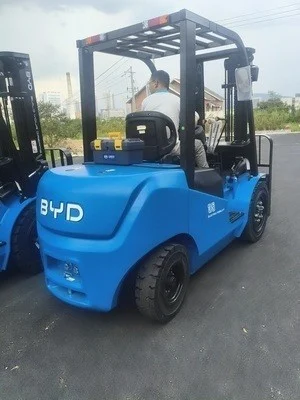
BYD ECB35 Four-Wheel Counterbalance Electric Forklift: Questions to Resolve on Floor Conditions, Aisle Width, and Turning Radius
News 12/11/2026
The BYD ECB35 is a four-wheel counterbalance electric forklift, and most buying mistakes around it happen before anyone discusses battery chemistry. They happen when the floor, the aisle, and the turning radius are treated as afterthoughts. Those three conditions decide whether a truck can work in your building at all, so they deserve answers before a quote is finalized. This article walks through the questions worth resolving, the measurements you need to collect, and where honest uncertainty remains until the manufacturer’s data sheet and an on-site check settle the numbers.
Start With the Floor, Not the Load Chart
A counterbalance truck carries its load cantilevered ahead of the front wheels, so the floor carries more than the rated capacity suggests. Two questions matter more than a single load figure.
What does the surface actually look like?
Sealed concrete, worn concrete with joints and patches, asphalt, epoxy coating, and outdoor yard surfaces behave differently. Small wheel diameters and hard tires transmit shock into the mast and the operator. Expansion joints, drains, dock levelers, and threshold plates create repeated impact points that a smooth showroom floor never reveals. Walk the route and note every transition, slope, and defect rather than judging the building as a whole.
How much load does the floor see?
Point loading under the front wheels is the number a structural engineer needs, not the gross vehicle weight alone. The truck’s own weight, the load, the load center, and the lift height all shift the distribution. Ask the manufacturer’s technical documentation what the axle loads are at your intended capacity and load center, and have the building owner confirm the slab can accept them. No article can supply that figure; only the data sheet and a site assessment can.
Does the route include ramps or dock plates?
Gradients change both traction and stability. Confirm the maximum slope on the route, whether it is traveled loaded or empty, and whether the surface is dry. Wet or contaminated ramps reduce grip regardless of tire type. If the route leaves the building, check whether the truck is specified to operate outdoors and in what weather.
Aisle Width: Separate the Numbers People Confuse
Aisle questions usually fail because three different widths get mixed together. Keep them apart.
- Rack-to-rack distance: the clear space between stored loads or uprights.
- Travel aisle: the clear path the truck needs to move straight through without turning into a position.
- Right-angle stacking aisle: the clear width needed to turn 90 degrees and place or pick a load.
The stacking aisle is almost always the controlling dimension, and it depends on the load length, the truck’s overall width, and the turning geometry. Measure the narrowest point on the real route, not a nominal drawing dimension. Include pallet overhang, protruding rack components, columns, doors, and safety barriers. A clear width that looks generous on a plan can shrink once a pallet is slightly overloaded in length or a guardrail is added.
Where does the BYD ECB35 fit?
Whether this model suits a given aisle cannot be answered from the model name alone. The required stacking aisle is a function of the truck’s dimensions and turning characteristics as published in the manufacturer’s specification, combined with your load size. Request the turning radius and aisle-width figures from the supplier, then compare them with your measured clear width and add an operating margin. If the margin is thin, the honest answer may be that a different handling approach fits better than forcing a four-wheel counterbalance truck into a tight layout.
What about pedestrian and rack clearance?
Aisle width is not only about the truck turning. Confirm that pedestrians are separated from truck routes, that rack uprights are protected, and that the remaining clearance allows safe sightlines at corners and doorways. A layout that technically permits a turn but leaves no room to see around a corner is a layout problem, not a truck problem.
Turning Radius and the Questions It Raises
Turning radius describes how much space the truck sweeps as it turns. It is a starting point, not a complete answer, because the load and the mast also sweep through space.
Which radius is being quoted?
Ask whether a quoted figure refers to the outside of the truck body, the outside of the load, or a specific reference point, and at what steering angle. Figures quoted without these definitions are not comparable. Also ask how the figure changes with attachments, longer forks, or a different mast, since each can alter the effective envelope.
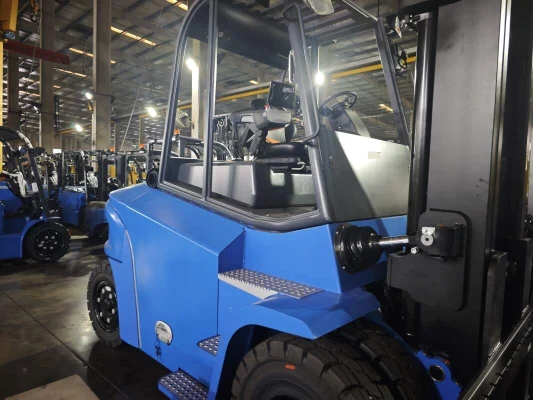
How does the radius interact with the load?
A long load extends the swept path well beyond the truck’s own footprint. In a hypothetical layout with 1,200 mm pallets in a narrow rack bay, the load corners, not the counterweight, often set the limit. Sketch the turn with the load included, or ask the supplier to help model it against your actual pallet dimensions.
What else limits maneuverability?
Steering type, tire size, and the position of the operator all influence how confidently a truck turns in a tight space. So does floor condition: a smooth, sealed floor allows more predictable turning than a patched one with joints that upset the wheels mid-turn. Speed limits, mirrors, and traffic rules inside the building affect real cycle time as much as the radius itself.
A practical checklist before you commit
- Measure the narrowest clear width on the real route, including all obstructions.
- Record the longest and widest loads, including overhang.
- Identify every slope, dock plate, joint, and surface transition.
- Obtain the manufacturer’s turning radius and aisle figures, with definitions.
- Confirm floor load capacity with the building owner and the supplier’s axle-load data.
- Run a demonstration on your own floor and in your own aisle before ordering.
The demonstration step resolves more doubt than any specification table. A short trial in the actual building shows whether the turning envelope, the floor, and the operator’s sightlines work together.
Frequently Asked Questions
Can the BYD ECB35 work in a narrow aisle?
It depends on the measured clear width, the load dimensions, and the truck’s published turning and aisle figures. A four-wheel counterbalance design generally needs more stacking space than a purpose-built narrow-aisle truck. Collect the numbers and compare them with a margin rather than assuming a fit.
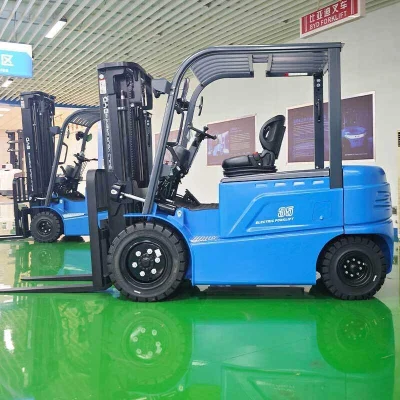
Does a smooth floor mean the floor is suitable?
Not necessarily. A smooth surface can still be thin, poorly supported, or unable to accept the point loads under the front wheels. Surface condition and structural capacity are separate questions, and both need answers.
How do I know if my aisle is wide enough?
Measure the clear width at the tightest point, add the load overhang, and compare that with the right-angle stacking aisle the supplier specifies. If the difference is small, plan a demonstration rather than relying on the drawing.
What should I send when requesting a configuration?
Share your loads, required lift height, load center, measured aisle widths, floor type and condition, slopes, shift pattern, and charging arrangements. Those details let the supplier match a four-wheel counterbalance electric forklift configuration to your operation instead of guessing.
Floor condition, aisle width, and turning radius are linked decisions. Resolve them with measured data, the manufacturer’s published figures, and a trial in the real building; the model name alone cannot settle them.