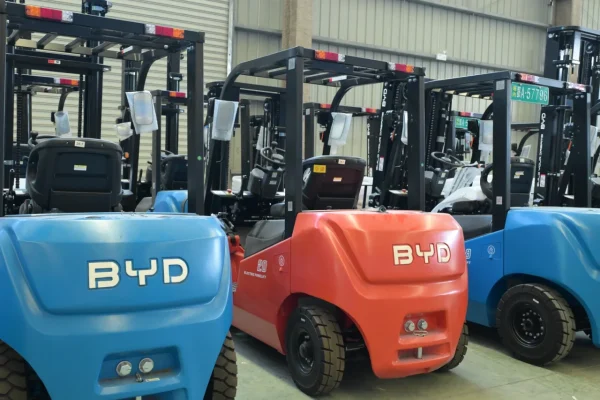
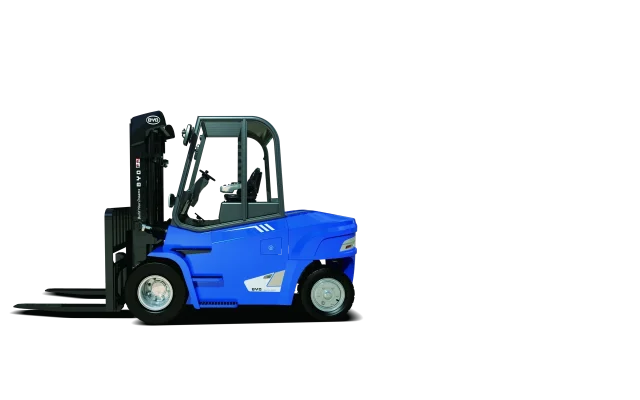
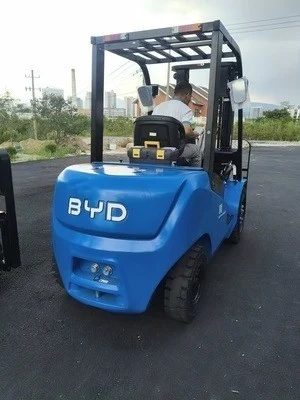
Choosing BYD forklift Load Capacity and Lift Height: A Four-Wheel Counterbalance Electric Forklift Sizing Guide
News 30/10/2026
Sizing a BYD forklift starts with two numbers that are easy to state and easy to misread: rated load capacity and lift height. Neither number stands alone. A four-wheel counterbalance electric forklift rated at a given load can only carry that load at a defined load center, and its lift height interacts with residual capacity, mast type, and overhead clearance. Buyers who compare headline figures across models often end up with a machine that is either oversized and expensive or marginal on the heaviest pallet. This guide explains how the two figures work together, which site conditions change the answer, and what to confirm with the supplier before ordering.
How Rated Capacity and Load Center Interact
Forklift capacity is not a single fixed weight. Manufacturers publish a rated capacity tied to a load center, usually measured from the vertical face of the forks to the center of gravity of the load. When the load center moves forward, the safe capacity drops. This is why a machine that handles a compact pallet comfortably may be marginal when the same weight sits farther out on longer forks or a bulkier load.
A practical way to read a capacity chart is to treat it as a curve rather than a ceiling. Ask the supplier for the capacity at the load center your loads actually produce, not only the headline rating. If your pallets vary in depth, size the truck against the worst realistic combination of weight and load center, not the average.
Estimating Your Real Load Center
Load center depends on pallet depth and how the goods sit on it. A load that overhangs the pallet, or a pallet that is deeper than standard, pushes the center of gravity forward. Where loads are irregular, the honest answer is that the load center must be measured or conservatively estimated, and the capacity chart checked against that estimate. Do not assume the rated capacity applies to every pallet in the warehouse.
Attachments Change the Numbers
Any attachment added to the carriage — a side shifter, clamp, or positioning device — adds weight and usually moves the load forward. Both effects reduce usable capacity. Capacity figures published for a bare carriage do not automatically apply once an attachment is fitted, so the attachment and its effect on residual capacity must be confirmed with the supplier.
Lift Height, Mast Choice, and Residual Capacity
Lift height determines which mast configuration suits the building, and it also affects how much the truck can safely carry at height. Higher lift typically means a taller, heavier mast, and capacity at full height may be lower than capacity at ground level. The capacity plate usually states values at more than one height, and the lowest figure is the one that governs the worst case.
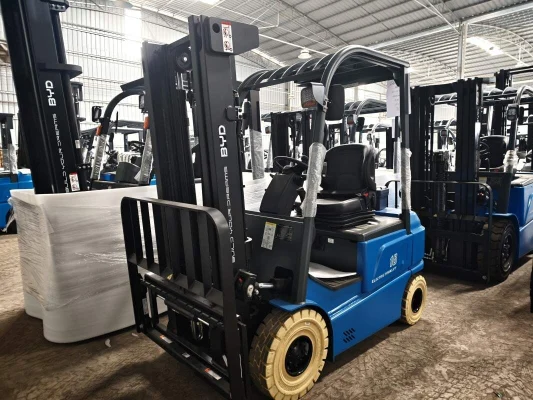
Three mast types cover most four-wheel counterbalance electric forklift applications:
- Two-stage (duplex) mast: a common choice where lift heights are moderate and overhead clearance is not a constraint. It generally offers good forward visibility and a simpler structure.
- Three-stage (triplex) mast: uses nested rails to reach higher lift heights while keeping the collapsed height lower, which matters when the truck must pass under doorways or into containers.
- Four-stage or specialist masts: relevant to very high or very low collapsed-height requirements; availability and specifications must be confirmed rather than assumed.
The key question is not only the maximum lift height but the collapsed height and the free lift. Free lift is the amount the forks can rise before the mast extends. In buildings with low door frames or mezzanine openings, insufficient free lift can block access even when the maximum lift height is adequate.
Overhead Clearance and the Building
Measure the lowest obstruction on the travel route, not just the racking. Sprinkler heads, lighting, door headers, and cable trays all set limits. The truck’s extended mast height plus the load plus a safety margin must fit beneath the lowest point on the route. This is a site measurement task, and no catalogue figure can replace it.
Capacity at Height
If your heaviest loads are stored on the top beam, check the capacity at that height rather than at ground level. Where the capacity at height is close to the load weight, consider a larger model or a different racking arrangement. The decision belongs with the capacity chart and the actual duty, not with a rule of thumb.
Site Conditions That Reshape the Sizing Decision
Capacity and lift height set the frame, but several site factors can override a neat calculation. The table below lists the conditions worth checking before a model is selected.
| Condition | Why It Matters | What to Confirm |
|---|---|---|
| Aisle width | Affects whether a four-wheel counterbalance truck can turn and stack efficiently | Measured aisle width and required right-angle stacking clearance |
| Floor condition | Affects ride, tyre choice, and stability | Floor flatness, joints, and any ramps or dock levellers |
| Gradients | Slopes change the safe load and travel practice | Ramp percentage and length, plus the supplier’s guidance on gradeability |
| Shift pattern | Sets daily energy demand and charging windows | Hours per shift, breaks, and available charging time |
| Charging infrastructure | Determines whether opportunity charging fits the operation | Power supply, charger location, and battery configuration |
A four-wheel counterbalance electric forklift is a common general-purpose choice in factories, loading bays, and warehouse transfer work. That does not make it the right answer everywhere. Very narrow aisles, for example, may call for a different truck category, and a counterbalance machine should not be presented as a substitute where the aisle geometry does not allow it. Where the building is tight, the honest step is to measure and then discuss options rather than force the truck into a layout it cannot serve.
Energy and Shift Demand
Lithium battery configurations change how charging fits a working day, but the right battery and charger depend on measured energy use, not on a guess. Record hours per shift, the proportion of time lifting versus travelling, and the breaks available. Those figures let the supplier size the battery and confirm whether the charging pattern is realistic.
Tyres and Floor Interface
Tyre type affects traction, floor loading, and ride quality. The correct choice depends on indoor or outdoor use, floor surface, and whether the truck crosses thresholds or dock plates. This is a configuration decision to settle with the supplier using the actual site description.
Frequently Asked Questions
Can I use the rated capacity as the maximum weight on every pallet?
No. Rated capacity applies at a specified load center. Larger load centers, longer forks, and attachments reduce the usable capacity, so the capacity chart must be read against your actual loads.
Does a higher lift height reduce how much I can carry?
It can. Capacity at full height may be lower than at ground level, and the capacity plate normally states values at more than one height. Size against the capacity at the height where the heaviest loads are handled.
How do I choose between a two-stage and a three-stage mast?
Compare the required lift height with the collapsed height and free lift the building allows. A three-stage mast helps where overhead clearance on the travel route is tight; a two-stage mast may suit moderate heights. Confirm both figures with the supplier.
What information should I send when requesting a BYD forklift quotation?
Provide the heaviest load and its load center, the required lift height, the lowest overhead obstruction, aisle width, floor and ramp conditions, shift hours, and charging arrangements. These details let the supplier propose a four-wheel counterbalance electric forklift configuration that matches the duty instead of a headline rating.
Before ordering, verify the capacity chart at your real load center and lift height, confirm the collapsed height and free lift against the building, and check that the battery and charging plan match the shift pattern. Where any of these figures is uncertain, measure it or ask the supplier to confirm it in writing. A sizing decision built on verified site data is far more reliable than one built on a single capacity number.