BYD ECB35 Four-Wheel Counterbalance Electric Forklift: Operator Training and Daily Inspection Points Buyers Overlook
News 05/11/2026
Buyers comparing the BYD ECB35 often focus on load capacity, battery configuration and price, then treat operator training and daily inspection as details to settle after delivery. That sequence creates avoidable risk. The four-wheel counterbalance electric forklift is a working machine with a battery pack, hydraulic system, steering and brake components, and a mast that lifts loads above people. The checks and habits established in the first weeks of ownership determine whether the truck stays productive and whether operators spot problems before they become downtime. This guide covers the training topics and inspection points that procurement teams frequently leave out of the specification and handover plan.
Why Training and Inspection Belong in the Procurement Specification
Procurement documents usually list the truck, charger, battery type and delivery date. They rarely state who trains the operators, what the training covers, or which inspection record the site will use. Those gaps surface later as inconsistent operating habits, missed defects and disputes about responsibility.
Treat training and inspection as deliverable items. Ask the supplier what operator familiarization accompanies the truck, what documentation is provided, and which maintenance intervals the manufacturer specifies. Confirm the answers in writing before the purchase order is issued. The goal is not to shift responsibility onto the supplier; it is to make sure the site knows what it must organize itself.
Three questions are worth settling early:
- Who is authorized to operate the truck, and how is that authorization recorded?
- Which daily and pre-shift checks apply to this configuration, including battery type and charging method?
- Who reviews completed checklists, and what triggers a truck being taken out of service?
For a BYD ECB35 inquiry, also confirm the exact battery and charging arrangement offered, because the daily routine differs between battery types. Do not assume a specification from another model or another site applies.
Operator Training Topics Buyers Commonly Omit
Load Handling at the Actual Load Center
Operators learn rated capacity, but they often do not learn that capacity depends on load center and lift height. A load whose center of gravity sits farther from the fork face reduces the safe capacity, and the effect grows as the mast is raised. Training should use the truck’s own capacity plate and the loads the site actually handles. Buyers should confirm the load center and lift height they need when requesting a configuration, and should not assume the nominal rating applies to every load.
Stability and Travel Habits
Counterbalance trucks carry the load ahead of the front wheels, so stability depends on speed, steering angle, load height and floor condition. Training should cover traveling with the load low, reducing speed before turns, and avoiding sharp steering inputs. Ramps and dock edges deserve specific attention: confirm with the supplier what gradients the truck is rated to handle and under what load conditions, rather than relying on general practice.
Battery and Charging Routine
Charging behavior affects both uptime and battery life. Operators need clear rules on when to charge, where charging takes place, ventilation and electrical safety, and who is permitted to connect the charger. If the site plans opportunity charging, confirm with the supplier that the battery and charger configuration supports the intended pattern. Do not extend charging practices from a different battery technology to the new truck without confirmation.
Pedestrian and Traffic Awareness
Electric trucks are quiet, which makes them harder to notice in busy areas. Training should address speed limits, horn use at blind corners, pedestrian exclusion zones and the site’s traffic plan. These are site-specific rules, so the buyer must supply them; the supplier cannot.
Emergency and Shutdown Procedure
Operators should know how to stop the truck safely, lower the forks, isolate power and report a fault. Confirm the correct shutdown sequence in the operator manual supplied with the truck, and do not rely on memory from a previous machine.
Daily Inspection Points That Get Skipped
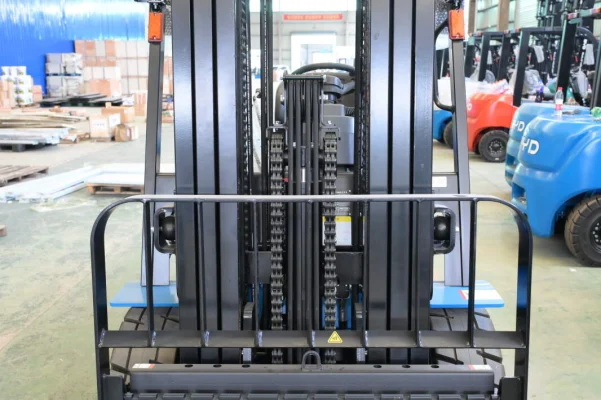
A pre-shift walk-around takes minutes and catches many developing faults. The checklist below is a general structure; adapt it to the operator manual and the site’s risk assessment, and confirm any item the supplier specifies differently.
| Area | What to Check | Why It Matters |
|---|---|---|
| Forks and carriage | Cracks, bends, wear at the heel, security of the fork locking pins | Damaged forks or unsecured carriages affect load control |
| Mast and chains | Chain tension and condition, visible damage, smooth lift and lower | Mast faults affect stability and lift performance |
| Hydraulics | Leaks, hose condition, fluid level where a gauge or sight glass permits | Leaks can lead to sudden loss of lift or slipping loads |
| Tyres and wheels | Wear, cuts, embedded debris, loose wheel nuts | Tyres affect braking, steering and stability |
| Brakes and steering | Service brake response, parking brake hold, steering play | These are primary safety functions |
| Battery and charger | Connector condition, cable damage, charge level, ventilation | Poor connections and damaged cables create electrical and fire risk |
| Safety devices | Horn, lights, seat switch, restraint, warning devices | These protect the operator and nearby pedestrians |
| Leaks and cleanliness | Fluid spots under the truck, accumulated debris | Early leak detection prevents larger repairs |
Two habits make the checklist effective. First, the operator signs and dates it, and a supervisor reviews it. Second, any defect is reported immediately, with a clear rule on which defects stop operation. A checklist that is completed from memory without walking around the truck provides little protection.
What to Confirm with the Supplier Before Ordering
Use the inquiry stage to close the information gaps that training and inspection depend on. Provide your actual duty cycle: loads and load centers, lift heights, aisle widths, floor surface, ramps, shift pattern and charging windows. Ask the supplier to confirm which configuration suits those conditions and to state any limits.
Request the operator manual, the capacity plate details, the specified inspection and maintenance intervals, and the recommended daily check items the manufacturer publishes. Ask what operator familiarization is available and whether it covers the battery and charging routine. Where a figure is not available in the documents provided, record it as an open item rather than accepting an estimate.
Finally, plan the handover. Nominate a person responsible for operator authorization, a person responsible for reviewing checklists, and a route for reporting faults. These roles cost nothing to assign and prevent the most common failure: a truck in use with a known defect and no one accountable.
Frequently Asked Questions
How often should a four-wheel counterbalance electric forklift be inspected?
Most sites run a pre-shift visual and functional check, plus periodic inspections at intervals the manufacturer specifies. The correct interval depends on duty cycle and site conditions, so confirm it in the maintenance documentation supplied with the truck rather than adopting another site’s schedule.
Does the battery type change the daily inspection?
Yes. Connector condition, cable damage, charge level and ventilation apply to any battery, but the charging routine and the checks around it depend on the battery and charger configuration. Confirm the specific procedure with the supplier when the truck is specified.
Can operators be trained without a formal program?
Familiarization with the truck is not the same as a complete operator training program. Many jurisdictions require formal training and authorization, and requirements vary. The buyer should confirm local obligations and combine them with product-specific familiarization from the supplier.
What should be included in a BYD ECB35 inquiry?
Include loads and load centers, required lift height, aisle and door dimensions, floor and ramp conditions, shift pattern, charging arrangements and any site-specific safety rules. Ask for the capacity plate details, manual, maintenance intervals and available operator familiarization so training and inspection planning can start before delivery.