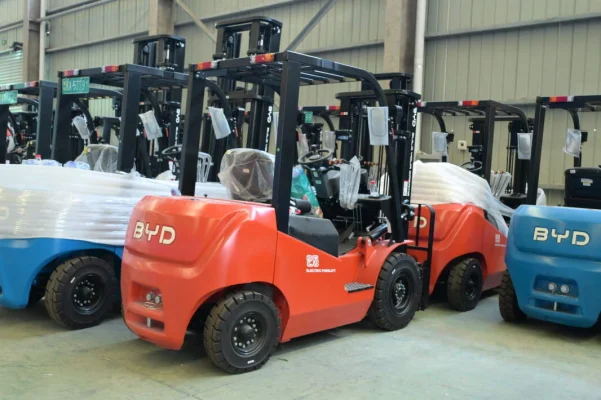
BYD ECB35 Four-Wheel Counterbalance Electric Forklift: Site Conditions and Duty Cycle Details Buyers Should Verify
News 01/11/2026
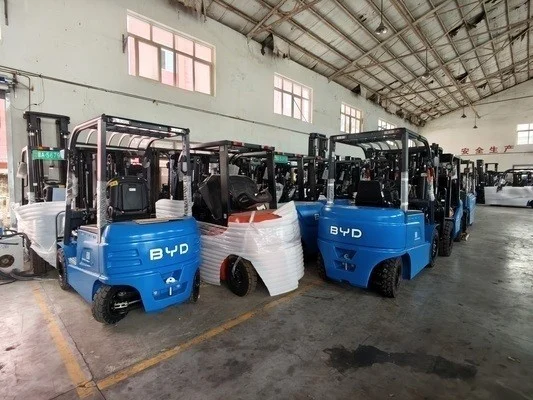
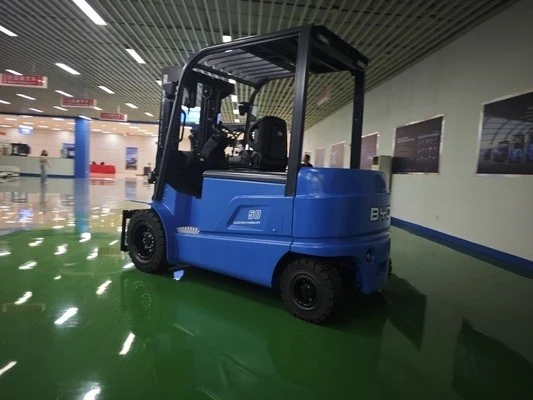
Buying a BYD ECB35 four-wheel counterbalance electric forklift is less about picking a model number and more about confirming that your site and your work pattern match the truck’s configuration. The ECB35 sits in the 3.5-tonne nominal capacity class, but that figure depends on load centre, lift height, attachment weight and battery state. Before you request a quotation, gather the site conditions and duty cycle information a supplier needs to configure the truck correctly and to avoid a machine that is overloaded, underpowered or unsuited to your aisles.
Start With the Load, Not the Model Name
The nominal capacity on any counterbalance truck is tied to a defined load centre and lift height. Ask yourself three questions before discussing the ECB35:
- What is the heaviest load, including pallet and attachment weight? A 3,000 kg load on a 500 mm load centre is a different duty from the same mass at a longer load centre.
- How high must the forks lift? Capacity typically reduces as lift height increases, so the required lift height and the heaviest load must be checked together.
- Will you use clamps, rotators or other attachments? Attachments add weight and move the load centre forward, which affects the usable capacity.
Provide the supplier with the heaviest load, the load centre and the maximum lift height. They can then confirm whether the ECB35 configuration suits your duty or whether a different capacity class is needed. Do not assume the nominal rating applies at every height and load centre.
Site Conditions That Change the Specification
Four-wheel counterbalance electric forklifts are a common general-purpose choice in factories, loading bays and warehouses, but the site details determine whether a standard configuration works. Walk your site and record the following.
Aisle Width and Turning
Measure the narrowest aisle and the space available at turns and rack ends. A four-wheel counterbalance truck needs more room to turn than a three-wheel or reach truck, so confirm the actual aisle width against the truck’s dimensions and turning radius. If your aisles are tight, say so early; the answer may be a different truck type rather than a larger aisle.
Floor Surface and Condition
Note the floor material, joints, drains, ramps and any damaged areas. Uneven surfaces and slope affect stability, tyre choice and operator comfort. Describe gradients as a percentage and length, not as “a small ramp”.
Indoor, Outdoor and Doorways
State whether the truck works indoors, outdoors or both, and whether it passes through doorways or into containers. Overhead obstructions, door heights and weather exposure all influence the configuration and the attachments you may need.
Charging and Power Availability
Confirm the available power supply, the distance from the charging position to the work area, and whether charging can happen during breaks or only between shifts. Lithium-ion trucks such as the BYD range allow opportunity charging, but the practical schedule still depends on your electrical capacity and the charger specification. Ask the supplier to confirm the charger requirements and the charging time from your actual state of charge.
Duty Cycle Details Buyers Often Leave Out
Duty cycle is the single most useful input a buyer can provide, yet it is often reduced to “eight hours a day”. A more useful description covers:
- Shift pattern: hours per shift, shifts per day, days per week.
- Operating time: how much of the shift the truck is actually moving or lifting, versus waiting.
- Travel distance: average and maximum distance per trip, and total distance per shift.
- Lift frequency: lifts per hour and typical lift height per cycle.
- Load profile: average load weight and the proportion of trips at maximum load.
- Environment: temperature range, dust, moisture or corrosive atmosphere.
These details let the supplier judge battery capacity, charger size and whether one truck can cover the work or whether a second unit or a battery change is needed. They also reveal whether the ECB35 is being asked to do work better suited to a different capacity or truck type.
Technical Data and Acceptance Points to Confirm
Once the site and duty cycle are clear, ask for the manufacturer’s technical data sheet and check the following before you accept a quotation. Do not rely on verbal summaries.
| Item | What to Confirm |
|---|---|
| Rated capacity | Capacity at the stated load centre and lift height |
| Lift height | Maximum and required lift height, plus free lift if needed |
| Dimensions | Overall width, length, height and turning radius against your aisles |
| Battery and charger | Battery voltage and capacity, charger model, charging time and power supply |
| Tyres | Tyre type matched to indoor, outdoor or mixed use |
| Attachments | Any attachment and its effect on rated capacity |
| Documentation | Operator manual, maintenance schedule and warranty terms |
At acceptance, check the delivered configuration against the agreed specification, confirm the battery and charger match the quotation, and record the serial numbers. Ask what training and spare parts support are included. None of these points should be assumed; they belong in the written offer.
Frequently Asked Questions
Is the BYD ECB35 suitable as a general warehouse truck?
It can be, provided the aisle width, load weight, lift height and duty cycle are confirmed against the manufacturer’s data. Four-wheel counterbalance trucks are common in general handling, but tight aisles or very high lifts may point to a different configuration or truck type.
Can I estimate runtime from the battery capacity alone?
Not reliably. Runtime depends on travel distance, lift frequency, load weight, temperature and the charger schedule. Give the supplier your duty cycle details and ask for a runtime estimate based on the manufacturer’s data, then verify it during a trial if one is available.
What should I send with my quotation request?
Send the heaviest load and load centre, required lift height, aisle widths, floor and slope details, indoor or outdoor use, shift pattern, lifts per hour, charging power available and any attachment requirements. This lets the supplier configure the truck and quote accurately.
Do I need to check capacity at full lift height?
Yes. Rated capacity is linked to load centre and lift height, so confirm the capacity at the height you will actually use, not only at ground level. If in doubt, ask the supplier to state the capacity at your maximum lift height in writing.