What Lift Height and Mast Configuration Choices Do to BYD Forklift Price on Four-Wheel Counterbalance Electric Models
News 31/10/2026
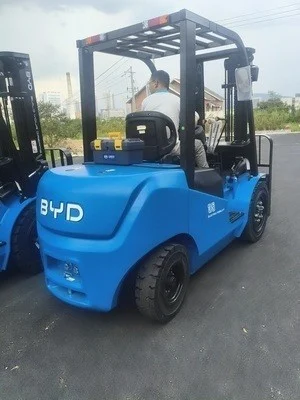
Lift height and mast configuration often change a quoted BYD forklift price more than any other specification on a four-wheel counterbalance electric truck. The reason is structural: a taller mast needs longer, heavier rails and a different chain and hydraulic arrangement, and every added stage changes how the carriage, cylinders and overhead guard work together. Buyers who fix the lift height and mast type early get comparable quotes; buyers who leave them open tend to receive prices that differ by thousands and cannot be compared line by line. This article explains which mast and height choices move cost, which ones mostly move capability, and what to confirm before requesting a configuration.
Why Mast Height and Type Drive Cost on a Counterbalance Truck
A counterbalance forklift carries the load outside the wheelbase, so the mast is not a simple vertical guide. It is a load-bearing structure that must resist bending moments as the carriage rises and as the load center moves forward. That is why lift height and mast design are priced together rather than as independent options.
Three cost drivers matter most:
- Mast stages and closed height. A simplex (single-stage) mast is the simplest and least expensive arrangement, but it gives limited free lift. Duplex and triplex masts add stages, more rail sections and more chain runs, which raises material and assembly cost. A triplex mast usually costs more than a duplex of the same lift height because it packs more structure into a shorter collapsed profile.
- Free lift and overhead clearance. If a truck must enter a container, a trailer or a low-clearance building with the mast collapsed, full free lift becomes a requirement. Full free lift is a design feature of the mast, not an accessory, and it carries a price premium.
- Structural capacity at height. Rated capacity is normally stated at a defined load center and a defined lift height. As lift height increases, remaining capacity at the same load center generally decreases, and the manufacturer may require a heavier mast, different chains or a different carriage to keep the truck stable. Those changes are reflected in price.
Hydraulic cylinder length, hose routing, chain count and the overhead guard all scale with the mast. A taller mast also affects transport: collapsed height, overall weight and shipping dimensions can change, and those affect delivery cost as well as the equipment price.
Matching Lift Height and Mast Type to Real Working Conditions
Price only makes sense against a duty. The useful approach is to start from the highest point the forks must reach in normal operation, then work backward to the mast that delivers it with acceptable clearance and capacity.
Start with the true required lift height
Measure the height the fork carriage must reach to place or retrieve a load, not the height of the rack beam alone. Add clearance to lift a pallet off a beam and to clear the top of the load. If the truck works at several heights, use the highest routine requirement rather than an occasional exception. Overstating lift height is a common cause of overpaying; understating it can make the truck unusable at the top rack level.
Decide whether free lift is needed
Free lift is the height the forks can rise before the mast sections begin to extend. It matters when the truck must travel with a load through a low opening, such as a container door or a mezzanine access. If every lift happens in open warehouse space with high ceilings, a mast without full free lift may be adequate and less expensive. Confirm the actual opening height and the load height together, not separately.
Check capacity at the working height and load center
A truck rated at a given capacity at a standard load center does not necessarily handle the same load at maximum lift height. Ask the supplier to confirm rated capacity at the load center and lift height you actually use. If the load is long or offset, the effective load center is greater than the nominal figure, and the allowable capacity drops further. This is a safety issue before it is a price issue.
Account the aisle, floor and overhead constraints
Mast type affects visibility and collapsed height, and the truck’s overall dimensions affect aisle width. Floor condition and ramps matter too: a four-wheel counterbalance electric forklift is a general-purpose choice in many factories and warehouses, but gradients, dock plates and uneven surfaces should be described honestly so the supplier can check suitability. None of these factors should be guessed from a catalog page.
Compare configurations on the same basis
When quotes arrive, compare them against a short specification sheet rather than a total price. A useful comparison table looks like this:
| Item to confirm | Why it affects price |
|---|---|
| Required lift height and load height | Sets mast length and stage count |
| Mast type and free lift | Changes structure, chains and cylinders |
| Rated capacity at working load center | May require a heavier mast or carriage |
| Collapsed height and overhead clearance | Constrains mast choice and transport |
| Battery and charger configuration | Affects shift coverage and total cost |
| Attachment or fork dimensions | Changes carriage and residual capacity |
Two quotes that look far apart often differ on one of these lines. A lower price may reflect a shorter mast, less free lift or a lower capacity rating at height, none of which is visible in the headline number.
What to Confirm Before Accepting a BYD Forklift Price
Mast and lift height are only part of the configuration, but they are the part most often left vague. Before treating a figure as final, confirm the following with the supplier.
Ask what the quoted lift height actually means
Clarify whether the stated height is the maximum fork height, the mast extended height or the lift height at rated capacity. These are different figures. Ask also whether the quoted capacity applies at that height or only at a lower one.
Request the specification sheet, not just a price
A written configuration should list mast type, number of stages, free lift, rated capacity and load center, fork length, battery type and charger. Where a figure is not available, ask the supplier to confirm it rather than assuming a typical value. Published specifications should come from the manufacturer’s technical documentation; this article does not substitute for that documentation.
Describe the duty cycle and charging conditions
Shift length, number of lifts per shift, travel distance and available charging time influence battery and charger selection, which in turn affects total cost. A single-shift operation with a long charging window has different needs from multi-shift work. State these conditions plainly so the configuration can be checked against them.
Confirm delivery and site constraints
Taller masts can change shipping dimensions and may require specific handling on arrival. Check door heights, yard access and unloading arrangements before the order is placed. These are practical details that are easy to overlook when the discussion focuses on price.
If you are comparing options, send the actual working conditions, load weight, load center, required lift height and any low-clearance access to the supplier and ask which four-wheel counterbalance electric configuration fits. That request produces a more useful answer than a general price question.
Frequently Asked Questions
Does a taller mast always cost more?
Usually yes, because taller masts need longer rails, more chain and different hydraulic components, and may require a heavier structure to maintain capacity at height. The size of the difference depends on the stage count, free lift requirement and capacity rating. Ask the supplier to quote the specific configuration rather than extrapolating from a base model.
Is a triplex mast worth the extra cost?
A triplex mast is useful when collapsed height must stay low while lift height remains high, such as working inside containers or under low doorways. If the truck operates in open space with adequate overhead clearance and does not need to travel with a raised load under a low opening, a simpler mast may meet the duty at lower cost. The decision should follow the measured clearance, not a preference.
Can I add lift height later?
Mast changes are structural, not cosmetic. Increasing lift height after delivery typically means replacing major mast components, and it may also change the truck’s rated capacity and stability characteristics. It is generally more practical to specify the required height correctly at the outset. Confirm any modification proposal in writing with the manufacturer’s technical data.
Why do two quotes with the same lift height differ so much?
Check free lift, stage count, capacity at the working load center, fork length, battery and charger, and delivery terms. A price difference often reflects a different configuration rather than a different quality level. Comparing line by line against a written specification sheet is the reliable way to see what is actually being offered.
Does lift height affect battery choice?
Lift height itself does not determine battery capacity, but the work cycle does. More lifts, longer travel and multi-shift use increase energy demand. Provide shift length and charging windows so the battery and charger can be matched to the duty, and treat that part of the configuration as part of the total cost.