Indoor Electric Forklift Load Charts: How Mast Height and Attachment Weight Change Real Capacity on Four-Wheel Counterbalance Trucks
News 02/11/2026
An indoor electric forklift’s rated capacity is not a single fixed number. It is a baseline that changes once you add mast height and an attachment. A four-wheel counterbalance electric forklift rated at 2,000 kg at a 500 mm load center may handle significantly less when the mast is raised or a side-shifter is fitted. This article explains how to read a load chart, why mast height and attachment weight reduce real capacity, and what to check before you buy or rent.
Reading a Load Chart: The Baseline and the Variables
Every counterbalance forklift has a data plate showing its rated capacity at a specified load center and lift height. That rating assumes a standard mast, no attachment, and a horizontal load. The load chart—sometimes called a capacity chart—extends this by showing how capacity decreases as load center moves forward or as lift height increases.
Load center is the horizontal distance from the vertical face of the forks to the center of gravity of the load. Most charts use 500 mm or 600 mm as the standard load center. When you handle a load whose center is farther out—such as a double-deep pallet or a wide crate—capacity drops.
Mast height affects capacity because a taller mast adds weight and raises the load higher. The higher the load, the less stable the truck becomes, so the manufacturer derates capacity at increased lift heights. Attachments add weight and shift the load center forward, further reducing net capacity.
To read a chart correctly, follow these steps:
- Identify the load center of your actual load. If it is greater than the chart’s baseline, find the corresponding capacity reduction.
- Determine the maximum lift height you need. Check the chart for capacity at that height.
- Subtract the attachment weight from the chart capacity. The result is the net capacity you can safely handle.
- Confirm that the remaining capacity exceeds the weight of your heaviest load plus any pallet or packaging.
If any step yields a capacity lower than your load weight, you need a different truck configuration or a larger model. Never rely on the headline capacity alone.
How Mast Height and Attachments Reduce Real Capacity
Mast height and attachments each take a bite out of capacity, and their effects compound. Understanding both helps you avoid overload and choose the right configuration.
Mast Height: The Stability Trade-off
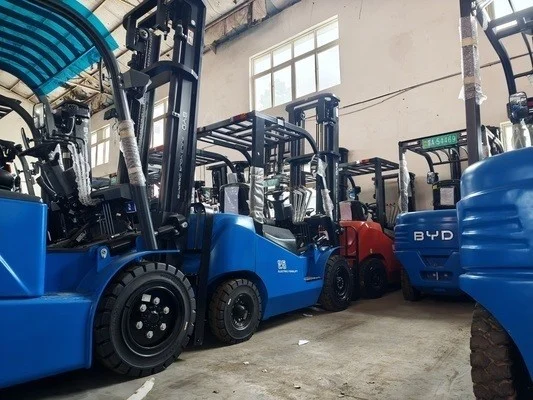
A taller mast is heavier and raises the load’s center of gravity. Both factors reduce stability, so manufacturers derate capacity at higher lift heights. The derating is not linear; it depends on the mast type (duplex, triplex, etc.) and the truck’s design. For indoor electric forklifts, triplex masts are common because they offer high lift with a low collapsed height, but they may have lower capacity at full height than a duplex mast of the same rating.
When selecting a mast, consider the maximum height you will actually use, not just the building’s ceiling. If you only occasionally lift to 6 meters, a mast rated for that height may still be necessary, but you should check the capacity at that height. Also note that free lift (the height the forks can rise before the mast extends) matters in low-clearance areas such as trailers or mezzanines.
Attachments: Weight and Load Center Shift
Attachments such as side-shifters, fork positioners, clamps, and rotators add weight to the carriage and move the load center forward. The added weight reduces net capacity directly, and the forward shift reduces it further because the load’s center of gravity is now farther from the mast.
For example, a side-shifter might weigh 100 kg and shift the load center forward by 50 mm. On a truck rated 2,000 kg at 500 mm, the net capacity after accounting for both effects could be significantly lower. The exact reduction depends on the attachment and the truck’s chart; you must use the manufacturer’s derating information.
Some attachments are integrated at the factory and their effect is already included in the chart. Others are added later, and the chart may not reflect them. Always ask the supplier whether the load chart you are using includes the specific attachment.
Combined Effects
When you use both a tall mast and an attachment, the capacity reductions multiply. A load that is safe at ground level with no attachment may be unsafe at height with a side-shifter. Always calculate net capacity using both factors.
Applying Load Charts in Indoor Operations
Indoor operations often involve high racking, narrow aisles, and attachments for specialized handling. Here is how to apply load charts in practice.
Step-by-Step Capacity Check
Follow this sequence before you commit to a truck or a load:
- Define the task: Record the heaviest load, its dimensions, and its load center. Include pallet weight.
- Determine lift height: Measure the highest shelf you need to reach. Add clearance for the pallet and forks.
- Select attachment: Decide whether you need a side-shifter, clamp, or other attachment. Note its weight and load center shift from the supplier’s data.
- Obtain the correct load chart: Ask the manufacturer or dealer for the chart that matches your mast, attachment, and load center. Do not use a generic chart.
- Calculate net capacity: Start with the rated capacity at your load center, then apply the mast height derating and subtract the attachment weight. The result is your net capacity.
- Compare and decide: If net capacity is less than your load weight, consider a larger truck, a different mast, or a lighter attachment.
Common Mistakes
Even experienced operators and buyers make these errors:
- Using the headline capacity without checking load center or lift height.
- Forgetting to subtract attachment weight.
- Assuming a load chart applies to all attachments; it may only cover the standard carriage.
- Ignoring dynamic effects such as load sway or uneven ground, which can reduce stability further.
- Overlooking the weight of pallets, packaging, or residual material.
Table: Key Parameters and Verification Points
| Parameter | Why It Matters | What to Confirm with Supplier | Typical Options |
|---|---|---|---|
| Rated capacity | Baseline capacity at standard load center | Capacity at your actual load center | Varies by model |
| Load center | Affects stability and capacity | Chart values at different load centers | 500 mm, 600 mm, or custom |
| Mast height | Derates capacity as height increases | Capacity at your maximum lift height | Duplex, triplex, etc. |
| Attachment weight | Reduces net capacity | Weight and load center shift of attachment | Side-shifter, clamp, positioner |
| Net capacity | Actual safe load | Calculation method and verification | Derived from above |
Note: The table lists general parameters. Specific values depend on the truck model and configuration. Always request the manufacturer’s load chart for your exact setup.
When to Consult the Manufacturer
If your load center exceeds the chart’s maximum, or if you plan to use a non-standard attachment, consult the manufacturer. They can provide a custom load chart or recommend a different configuration. Do not guess.
Frequently Asked Questions
Can I use the rated capacity if I never lift to full height?
No. The rated capacity is typically stated at a specific load center and may assume a standard mast. Even if you lift only to a lower height, the load center and attachment still affect capacity. Always use the load chart that corresponds to your mast and attachment, and check capacity at your actual lift height.
How do I find the load center of my load?
The load center is half the depth of a uniformly stacked load, measured from the vertical face of the forks. For irregular loads, it is the horizontal distance from the fork face to the center of gravity. If you are unsure, consult a qualified person or use a conservative estimate.
Does a side-shifter always reduce capacity?
Yes, because it adds weight and moves the load center forward. The amount of reduction depends on the side-shifter’s weight and the truck’s design. Some side-shifters are integrated and their effect is included in the published capacity; others are add-on and require derating. Always confirm with the supplier.
What if my load chart does not list my attachment?
Do not assume capacity. Contact the manufacturer or dealer with the attachment model and weight. They can provide a revised capacity calculation or recommend a different attachment. Using an unlisted attachment without derating could lead to overload and tip-over.
By understanding load charts and the effects of mast height and attachments, you can select a four-wheel counterbalance electric forklift that safely meets your indoor handling needs. Always verify capacity with the manufacturer’s data for your specific configuration.