Cold Storage Electric Forklift Battery Thermal Management: Charging Room Placement and Shift Scheduling Questions Buyers Should Settle Early
News 06/11/2026
Buying an electric forklift for cold storage involves more than comparing lift capacity and price. Battery thermal management, charging room location, and shift scheduling are three interconnected decisions that determine whether a four-wheel counterbalance electric forklift can work reliably across freezer and ambient zones. Settling these questions before you request a quotation prevents costly layout changes and operational surprises later.
Why Battery Temperature Drives the Charging Room Decision
Lithium-ion batteries used in electric forklifts deliver rated capacity within a specified temperature window. Below that window, internal resistance rises, available capacity falls, and charging can become restricted or unsafe. The exact limits vary by battery manufacturer and must be confirmed from the technical datasheet. Without that data, treat any temperature figure as unverified.
This matters because a forklift that shuttles between a freezer at minus 25°C and a loading dock at 10°C experiences repeated thermal cycling. The battery does not need to be kept warm during every task, but it does need a charging location where temperature stays within the manufacturer’s allowed range. Placing chargers inside the freezer is rarely practical; placing them in an unheated annex can expose the battery to temperatures outside the charging window. The charging room placement question therefore starts with the battery’s specified charging temperature range, not with convenience.
When you request a quotation, ask the supplier to state the battery’s charging and discharging temperature limits and whether any pre-conditioning is required before charging. If the supplier cannot provide those figures, the design is not ready to approve.
Charging Room Placement: Questions to Settle Before Layout Approval
A charging room serves several functions: it houses chargers, provides ventilation, and keeps batteries within a workable temperature band. Its location relative to the freezer, dock, and battery storage area affects travel time and battery exchange logistics. Use the following checklist to structure the decision.
- Temperature range at the proposed location: Record the minimum and maximum air temperature the room will see across the year. Compare these with the battery manufacturer’s charging temperature limits.
- Ventilation and gas detection: Charging can release gases. Confirm ventilation rates and any detection requirements with the battery and charger suppliers, and check local building codes.
- Distance to the coldest work zone: A longer indoor travel distance reduces the battery’s exposure to deep cold but adds cycle time. Measure the actual route.
- Floor space and access: Ensure the room allows safe maneuvering of the forklift and any battery handling equipment. Confirm door widths and floor loading.
- Fire protection and separation: Follow local fire regulations and insurer requirements. The battery supplier should provide relevant safety data.
- Power supply and charging profile: Confirm available voltage, current, and whether fast or opportunity charging is planned. Match these to the charger and battery specifications.
If the only available space is inside the cold zone, discuss with the battery supplier whether a heated charging cabinet or a temperature-controlled enclosure is acceptable. Do not assume that a standard charger will operate reliably in sub-zero air without written confirmation.
Shift Scheduling and Battery Capacity: Matching Work Patterns to Charging Windows
Shift patterns determine how much battery capacity is consumed between charging opportunities. A single-shift operation may return the forklift to the charging room with ample time to recharge. A multi-shift operation with limited breaks may need either larger battery capacity, opportunity charging during breaks, or a battery exchange routine. The right choice depends on measured energy consumption, not on a rule of thumb.
To estimate energy demand, gather the following from the operation:
- Actual hours the forklift is powered on per shift, including idle time.
- Load weight and lift height profile during a typical shift.
- Travel distance and surface conditions.
- Ambient temperature the battery experiences during work.
These inputs let the supplier calculate a realistic amp-hour consumption figure. Without them, any runtime claim is a guess. Once you have the consumption estimate, compare it with the proposed battery’s usable capacity at the expected operating temperature. Remember that usable capacity at low temperature may be lower than the nominal rating; confirm the derating curve from the battery datasheet.
Shift scheduling also affects charging room throughput. If several forklifts need charging at shift change, the number of chargers and their output must match the queue. A single charger may become a bottleneck even if each battery could recharge in time. List the planned charging windows and the number of vehicles requiring charge in each window.
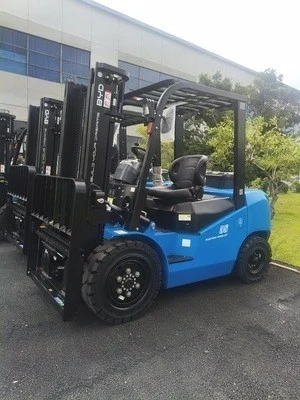
Procurement Details to Confirm in the Quotation
When you approach a supplier for a four-wheel counterbalance electric forklift intended for cold storage, provide the following information in your inquiry. This reduces back-and-forth and makes quotations comparable.
| Item | What to Provide or Confirm |
|---|---|
| Operating temperature range | Minimum and maximum air temperature in each zone the forklift will enter. |
| Battery chemistry and temperature limits | Request the battery datasheet showing charging and discharging temperature windows. |
| Charging room conditions | Proposed location, seasonal temperature range, ventilation, and power supply. |
| Shift pattern and energy use | Hours per shift, load profile, and any measured amp-hour consumption. |
| Charging strategy | Conventional, opportunity, or battery exchange; number of chargers needed. |
| Safety and compliance | Local fire codes, insurer requirements, and any specific cold-store regulations. |
Also ask the supplier to clarify what is included in the delivery: battery, charger, any thermal management accessories, and commissioning support. Confirm warranty terms that relate specifically to cold-store operation, since standard warranties may exclude damage from operating outside specified temperature limits.
Finally, request a factory acceptance test or pre-delivery checklist that includes a charging test at the lowest expected ambient temperature. If the supplier cannot perform such a test, ask for a written statement of the battery’s verified performance at that temperature, or plan to conduct a supervised trial on site before accepting the unit.
Frequently Asked Questions
Can a standard lithium-ion forklift battery be charged inside a freezer?
Charging inside a freezer is generally not recommended unless the battery and charger manufacturers explicitly approve it. Low temperatures can reduce charging efficiency and may fall outside the allowed charging window. The safe approach is to confirm the battery’s charging temperature range and provide a charging location that stays within it.
How do I decide between opportunity charging and battery exchange?
Compare the measured energy consumption per shift with the usable capacity at operating temperature. If breaks provide enough time to add sufficient charge without exceeding the battery’s recommended depth of discharge, opportunity charging may work. If not, battery exchange or a larger battery may be needed. The decision requires actual consumption data, not assumptions.
What information should I give a supplier to get an accurate quotation?
Provide the operating temperature range, shift pattern, load weight and lift height, travel distance, charging room conditions, and any local safety requirements. Also state whether you plan conventional charging, opportunity charging, or battery exchange. Without these details, the supplier can only offer a generic specification.
Does cold storage operation void the battery warranty?
Warranty terms vary by supplier. Some warranties exclude damage caused by operating or charging outside specified temperature limits. Ask the supplier to provide the warranty document and confirm in writing that the intended use falls within the covered conditions. Do not rely on verbal assurances.