Cold Storage Electric Forklift Operator Training: Four-Wheel Counterbalance Controls and Safety Practices in Freezer Environments
News 07/11/2026
Operating a four-wheel counterbalance electric forklift in a freezer is not simply a matter of wearing a warmer jacket. Cold air, ice, condensation, and reduced visibility change how the machine responds, how long a battery lasts, and how quickly an operator can react. This article explains the control and safety practices that matter when training operators on this equipment, and it notes where a site-specific assessment should replace general guidance. It addresses an electric forklift in cold storage as a training subject, not as a claim that any particular model suits every freezer layout.
What Makes Freezer Operation Different
Cold storage exposes the truck and the operator to conditions that rarely appear together in an ambient warehouse. The following factors deserve attention during training design.
- Traction: Ice, frost, and tracked-in snow reduce grip on floors, ramps, and dock plates. Steering and braking inputs that feel normal on dry concrete can cause a slide.
- Visibility: Condensation on the mast, overhead guard, and windows, plus fog when doors open, can hide pedestrians and rack legs.
- Battery behavior: Lithium-ion packs generally tolerate cold better than older lead-acid designs, but usable capacity and charging behavior still depend on the manufacturer’s temperature limits. Treat cold-weather performance as a specification to confirm, not an assumption.
- Operator fatigue: Insulated clothing restricts movement and adds bulk, which affects pedal feel and reach to controls.
- Hydraulics and seals: Cold thickens hydraulic oil and stiffens seals. Lift and tilt response can differ from warm-weather operation until the system reaches its working temperature.
These are general material and equipment behaviors. The specific limits of any truck come from the manufacturer’s technical documentation, which should be consulted before training begins.
Controls and Operating Practices on a Four-Wheel Counterbalance Truck
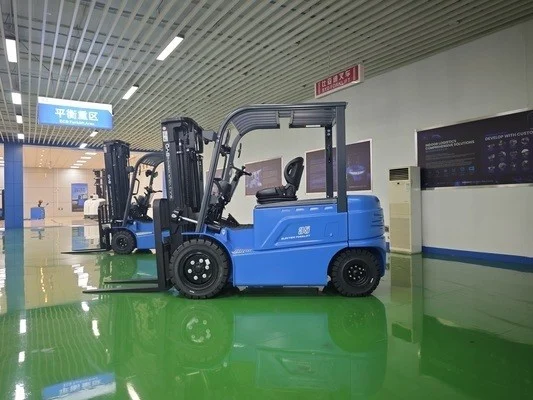
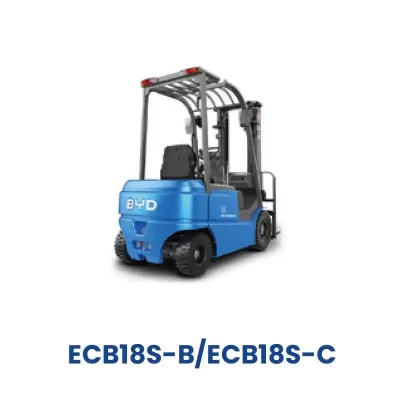
A four-wheel counterbalance electric forklift steers with the rear axle and carries the load ahead of the front wheels. That layout gives stability with heavy loads but means the rear swing is wide during turns. In a freezer aisle, this geometry interacts with ice and narrow clearances.
Pre-Use Walkaround in Cold Conditions
Trainers should build a cold-weather walkaround into the start of every shift. Check tires and wheels for ice buildup and flat spots; inspect the mast, chains, and hoses for frost or cracking; confirm the overhead guard and load backrest are clear of ice; test the horn, lights, and any blue or red warning lights; and verify the battery state of charge and the charger connection. Record anything that looks unusual rather than assuming it is normal cold-weather behavior.
Starting, Steering, and Braking
Operators should start slowly, allow the hydraulic system to warm through gentle movements, and test braking in an open area before entering racking. Steering should be deliberate, with turns made wide enough to account for rear-end swing. Because regenerative braking on electric trucks can feel different from friction brakes, operators should understand how the truck decelerates when the travel pedal is released, especially on a slight slope or a wet floor.
Load Handling and Travel
Keep the load low and the mast tilted back during travel. Approach racking squarely and lift only when the truck is stopped. In freezers, the load center and rated capacity must be respected exactly as stated on the data plate; cold does not increase capacity, and attachments or ice on the fork carriage can reduce it. Where floors are icy, reduce travel speed and increase following distance from pedestrians and other trucks.
Charging and Battery Care
Charging practice should follow the battery supplier’s instructions and the site’s electrical safety rules. Operators should know where charging takes place, whether it occurs inside the freezer or in a warmer area, and what ventilation and fire precautions apply. Avoid assuming that a lithium-ion pack can be charged at any temperature; confirm the permitted range and any warm-up or cool-down requirements with the manufacturer’s documentation.
Building a Training Routine That Holds Up in the Cold
Training should combine classroom explanation with supervised practice in the actual freezer environment. A practical sequence includes:
- Explain the truck’s data plate, stability limits, and the specific hazards of the site layout.
- Demonstrate the cold-weather walkaround and have each operator perform it.
- Supervise practice on ice-free floor first, then on the site’s actual surfaces under controlled conditions.
- Assess each operator on load handling, pedestrian awareness, parking, and shutdown procedures.
- Refresh training after layout changes, new attachments, or incidents, and keep records of who was trained and when.
Trainers should also cover emergency actions: what to do if the truck loses traction, if a load shifts, if visibility drops suddenly, or if the battery alarms. Local regulations and the site’s own safety management system set the legal minimum; this article does not replace them.
When a site is choosing or configuring a four-wheel counterbalance electric forklift, the practical inputs are load weight, load center, lift height, aisle width, floor condition and slope, shift pattern, and charging arrangements. Sharing these details with the supplier allows the selection and configuration to be matched to the freezer rather than guessed. Specifications, options, and pricing should come from current manufacturer documentation.
Frequently Asked Questions
Can a standard electric forklift be used in a freezer?
Not automatically. Cold storage use depends on the truck’s rated temperature range, battery and charger suitability, lubricants, seals, and the site’s safety procedures. Confirm these points with the manufacturer’s technical data before deploying any truck in a freezer.
How does ice on the floor change operator technique?
It reduces traction, so operators should travel more slowly, steer and brake gently, and allow longer stopping distances. Training should include supervised practice on the surfaces the operator will actually meet, with the understanding that no technique eliminates the risk of sliding on ice.
What should operators check on the battery in cold conditions?
They should check state of charge, charger connections, and any alarms or warnings, and follow the battery supplier’s temperature limits charging and discharging. Because cold affects usable capacity, shift planning should account the possibility of reduced runtime rather than assuming warm-weather performance.
Is refresher training needed after a layout change?
Yes. New racking, changed aisle widths, altered door positions, or different floor surfaces can invalidate assumptions operators learned earlier. A short refresher and supervised practice help keep habits aligned with the current environment.