Cold Store Forklift Hydraulic and Lubricant Choices: Protecting Four-Wheel Counterbalance Electric Trucks in Subzero Operation
News 13/11/2026
A cold store forklift works in conditions that punish every fluid on board: sustained subzero air, rapid temperature swings at the dock, and condensation that appears each time the truck leaves the freezer. Hydraulic oil thickens, grease stiffens, and seals that behave well at room temperature may weep or harden. This article focuses on one practical question: how to choose hydraulic fluid, lubricants, and related cold-store configuration details when the truck is a four-wheel counterbalance electric forklift, the type this site supplies as BYD lithium models. It does not replace the manufacturer’s data. Treat every temperature, viscosity, and service interval below as a checklist item to confirm with the supplier and the fluid maker, not as a fixed specification.
Why Cold-Store Hydraulic and Lubricant Choices Differ From Ambient Warehousing
Most warehouse trucks operate in air that stays within a comfortable band. A freezer or chiller changes the physics of every lubrication point. Three effects matter most.
First, viscosity rises as temperature falls. Hydraulic oil that flows freely at 20 °C may become noticeably thicker at −25 °C, which raises pressure drop through filters and valves and can slow lift and tilt response until the oil warms. Second, water enters. Condensation forms on cold metal when humid dock air touches it, and moisture in hydraulic oil or grease reduces film strength and promotes corrosion. Third, elastomers and greases stiffen. Seals, hoses, and pivot-point grease that are acceptable in a dry ambient warehouse may lose flexibility or channeling ability in repeated freeze–thaw cycles.
The correct response is not a single “cold-weather oil” label. It is a matched set of decisions: fluid grade, grease type, seal and hose compatibility, condensation control, and a maintenance routine that accounts the truck actually works in. A four-wheel counterbalance electric forklift used mainly inside one freezer has different needs from one that crosses a warm dock every few minutes.
Chiller, freezer, and cross-temperature duty are not the same
Clarify the duty pattern before selecting fluids. A truck that stays in a chilled room near 0 °C faces mild thickening and moderate condensation. A truck parked continuously in a deep freezer faces the lowest temperatures and the longest cold soaks. A truck that moves between freezer and ambient dock several times per shift faces the most aggressive condensation and the widest viscosity swing. Each pattern shifts the priority: continuous deep-freeze duty stresses cold flow and battery behavior, while cross-temperature duty stresses moisture control, seal cycling, and defogging.
Matching Hydraulic Fluid, Grease, and Cold-Store Configuration to the Truck
The following sections separate what generally applies to cold-store hydraulic and lubrication practice from what must be verified on the specific BYD four-wheel counterbalance electric forklift configuration. Do not assume any option is standard. Ask the supplier to confirm each item against the actual model, battery, and attachment.
Hydraulic oil: grade, viscosity, and moisture
Hydraulic fluid choice should follow the manufacturer’s approved viscosity range at the lowest expected operating temperature, not a generic recommendation. Ask the supplier which fluid grades are approved, what the minimum cold-start temperature is, and whether the hydraulic system has any cold-weather limitations. Confirm the viscosity index and pour point from the fluid maker’s data sheet rather than relying on marketing labels. Also ask about water tolerance and whether the system includes a breather or filter that needs cold-duty attention.
Practical checks: sample the oil after the first cold season and test water content; watch for sluggish lift or tilt at shift start; inspect filter bypass indicators; and confirm that any top-up oil matches the installed grade. Mixing incompatible fluids can change viscosity and seal behavior, so record the installed product and keep top-ups consistent.
Grease and pivot-point lubrication
Grease at mast, carriage, steer axle, and linkage points must remain pumpable and stay in place at low temperature. Ask which grease class the manufacturer approves, whether low-temperature grease is required, and how often relubrication is expected in cold duty. Confirm compatibility between the existing grease and any low-temperature product before switching; some thickeners do not mix well.
Inspect grease condition rather than only counting intervals. Stiff, channeled, or watery grease at a cold pivot point signals that the current product or schedule is not working. Clean and repack according to the supplier’s guidance rather than simply adding more grease.
Seals, hoses, and condensation protection
Cold and moisture attack elastomers and electrical connections. Ask the supplier which seals and hoses are specified cold-store duty, whether the truck has condensation protection for controllers, displays, sensors, and wiring, and what inspection points are recommended. Confirm whether heaters, enclosures, or desiccant measures are available and whether they are standard or optional. Do not assume that a general warehouse truck has these features.
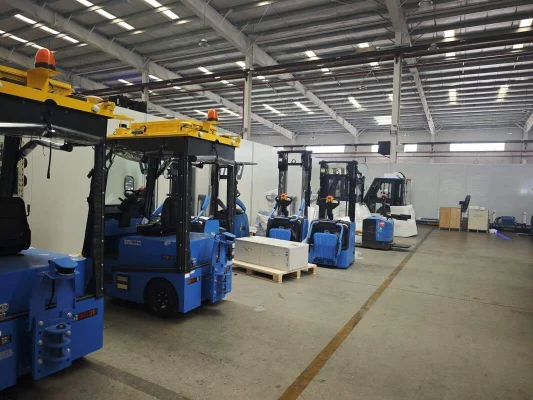
For food, seafood, and meat cold stores, also confirm washdown and corrosion expectations with the supplier. Cleaning chemicals and moisture can affect seals, paint, and connectors, so the cleaning method should be part of the configuration discussion.
Battery, charging, and cold-temperature limits
Lithium batteries have temperature-dependent behavior. Ask the supplier to confirm the approved operating, storage, and charging temperature ranges, how the battery management system limits charge or discharge at low temperature, whether battery heating is available, and where charging should take place. Charging a cold battery may be restricted, and moving the truck to a warmer charging area may be necessary. None of these values should be assumed; they must come from the manufacturer’s documentation.
Load, height, and aisle fit
Cold-store racking and aisles are often tight, and attachments change capacity. Confirm rated load at the actual load center, residual capacity with any attachment, required lift height, mast closed height, turning radius, and aisle width. If the aisle or lift height does not suit a four-wheel counterbalance truck, say so honestly and review the layout before committing. Tires, floor condition, slope, and wet or icy surfaces also affect safe operation and should be checked on site.
| Item to verify | Why it matters in a cold store | What to ask the supplier | Standard or optional |
|---|---|---|---|
| Hydraulic fluid grade | Cold thickening affects lift response and filter pressure | Approved grades, minimum cold-start temperature, water tolerance | Confirm per model |
| Low-temperature grease | Stiff grease starves pivot points | Approved grease class and relubrication interval | Confirm per model |
| Seals and hose material | Freeze–thaw cycling and moisture shorten life | Cold-duty specification and inspection points | Confirm per model |
| Condensation protection | Moisture affects controllers, displays, and connectors | Enclosures, heaters, desiccant, cold-store package | Often optional; verify |
| Battery temperature limits | Charge and discharge may be restricted when cold | Operating, storage, and charging ranges; heating; BMS limits | Confirm per battery |
| Capacity at load center | Attachments and height reduce usable load | Rated load, residual capacity, lift height, aisle width | Data sheet item |
A hypothetical cross-dock scenario
Consider a hypothetical frozen-food distributor whose four-wheel counterbalance electric forklift spends two hours in a −18 °C freezer, then repeatedly crosses a humid 10 °C dock to load trailers. The likely priorities are moisture control in the hydraulic system, low-temperature grease at the mast and steer axle, condensation protection on displays and connectors, and a charging plan that keeps the battery within its approved temperature range. The exact fluid grade, grease class, and temperature limits still must come from the truck and fluid manufacturers. This scenario illustrates the reasoning; it is not a tested case.
Cold-Store Forklift FAQ and Pre-Purchase Checklist
Can I use ordinary hydraulic oil in a freezer truck?
Only if the manufacturer approves that grade at the lowest temperature the truck will see. Ordinary oil may thicken enough to slow response or stress the system. Confirm the approved grade and minimum cold-start temperature before use, and do not substitute based on a generic label.
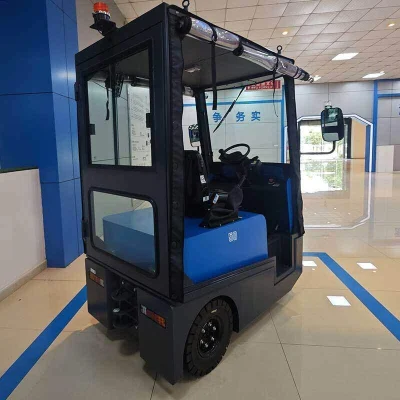
How often should cold-store hydraulic oil be checked?
The interval depends on duty, moisture ingress, and the manufacturer’s guidance. A practical starting point is to inspect oil condition and water content after the first cold season, then adjust based on sample results and observed performance. Record findings rather than relying on a fixed calendar alone.
Is a cold-store package necessary on a four-wheel counterbalance electric forklift?
It depends on the duty pattern and the supplier’s configuration. Ask which cold-store features are available, which are standard, and which are optional. Confirm condensation protection, seal and hose specification, battery heating, and display or sensor protection against the actual model.
What data should I gather before requesting a quote?
Collect the lowest operating and storage temperatures, charging location and temperature, duty pattern (continuous freezer or cross-temperature), required load and load center, lift height, aisle width, floor condition and slope, attachments, shift length, and cleaning method. Also note food-safety or cleaning requirements. With these details, the supplier can confirm the suitable BYD four-wheel counterbalance electric forklift configuration and identify which specifications still need verification.
Before purchase, ask the supplier to confirm in writing: approved hydraulic fluid and grease, minimum operating temperature, battery charge and discharge limits, condensation protection, seal and hose specification, residual capacity with attachments, aisle and lift-height fit, and the recommended inspection schedule. If any answer is missing, treat it as an open item rather than filling the gap with assumptions.