Assessing Compatibility of Factory Electric Forklifts With Diverse Industrial Manufacturing Floor Layouts
News 04/10/2026
Modern manufacturing facilities operate with wildly different floor layouts, driven by production flow, storage needs and available space. Choosing correct material handling equipment directly impacts operational efficiency, worker safety and overall output. Factory electric forklifts bring multiple benefits including lower emissions, reduced noise and lower long-term operating costs, but only work well when their design matches your facility layout. This guide breaks down key assessment criteria, matches common layout types to appropriate forklift designs and provides actionable steps you can apply to your own facility.
Key Layout Factors Impacting Compatibility
Aisle Width Dimensions
Aisle width is the most common constraint when evaluating forklift fit. Wide aisles built before modern equipment often accommodate standard counterbalance electric forklifts with no modifications. Facilities built with space efficiency in mind, especially those built after 2000, often use narrower aisles to maximize storage and production space. Standard counterbalance forklifts require aisles at least 10 to 12 feet wide to operate safely. Narrower aisles need specialized forklift designs with smaller footprints and modified turning capabilities.
Turning Radius Requirements
Turning radius directly relates to aisle width, but also impacts movement around production cells, loading docks and workstations. Facilities with multiple fixed production machines scattered across the floor require tighter turning capabilities to avoid collisions with equipment or work areas. Tight turning radius designs allow forklift operators to maneuver in small spaces without repeated reverse adjustments, which cuts down on handling time and reduces accident risk.
Floor Load Capacity Constraints
Older manufacturing facilities often have older concrete floors not rated to support heavy moving loads from large forklifts and their carried materials. Electric forklift weights vary by lift capacity and battery size; heavy duty units can add thousands of pounds of concentrated load to floor sections. Facilities with mezzanines or elevated storage levels also face stricter floor load limits. You must verify both your floor’s static and dynamic load ratings before selecting a forklift to avoid structural damage or safety hazards.
Matching Forklift Types to Common Layout Configurations
Narrow Aisle Manufacturing Layouts
Narrow aisle layouts prioritize maximum storage and production space within a limited footprint. These layouts work best with reach trucks or very narrow aisle (VNA) turret trucks, both powered by electricity. These designs feature reduced turning radii and can operate in aisles as narrow as 6 to 8 feet, depending on model and load size. They allow you to maintain high production output without expanding your facility’s physical footprint.
Open Bulk Storage & Production Layouts
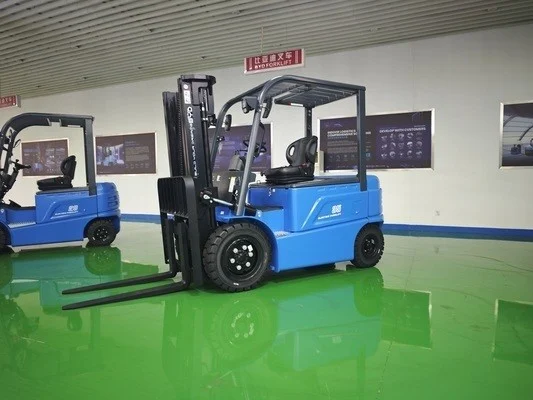
Open layouts with large unobstructed floor space common in heavy manufacturing or bulk material production work well with standard counterbalance factory electric forklifts. These units offer higher lift capacities and faster travel speeds over long distances, making them ideal moving large loads between shipping areas and production zones. Their simpler design also lowers maintenance costs for facilities that have enough space to accommodate their wider turning requirements.
Mixed-Mode Production Layouts
Most modern manufacturing facilities use mixed layouts that combine narrow aisle storage, discrete production cells and open assembly areas. Three-wheel electric forklifts often work best in this environment, as they combine tight turning capabilities with enough lift capacity to handle most common factory loads. They can maneuver through narrow aisles to retrieve stored components, then travel to production cells without difficulty. This versatility makes them a top choice for facilities that need one forklift fleet to serve multiple layout zones.
Practical Step-by-Step Compatibility Assessment
- Map all critical navigation paths: Measure aisle widths, turning clearance around fixed obstacles and door opening dimensions across all areas your forklift will travel. Document any low overhead clearances that impact lift height as well.
- Verify floor load ratings: Check original building blueprints to confirm static and dynamic load ratings for all floor sections, including any elevated areas. If blueprints are unavailable, consult a structural engineer to complete on-site testing before purchasing new equipment.
- Test maneuverability with a demo unit: Most equipment suppliers allow you to test a demonstration unit in your actual facility layout. Have your most experienced operator test navigation through all tight spots and common routes to identify any unforeseen issues.
- Account for future layout changes: If you plan to adjust your production layout within the next three to five years, select a forklift that can accommodate common changes, such as narrower aisles or new production cell placements, to extend your equipment service life.
Frequently Asked Questions
Can all factory electric forklifts work on sloped manufacturing floors?
Most standard electric forklifts handle small grades up to 5-7 percent without issues. Steeper slopes require specialized units with higher torque and adjusted center of gravity designs. Always check the manufacturer specification for grade capability before operating any forklift on sloped floors.
Do I need specialized floor coatings to use electric forklifts?
Electric forklifts do not require specialized coatings for normal operation, but high-quality durable floor coatings reduce wear on both floor surfaces and forklift tires. Coating also makes cleaning easier, which benefits facilities that handle food, pharmaceutical or other clean production materials.
How does pallet size impact layout compatibility?
Larger or non-standard pallet sizes increase the overall turning clearance a forklift needs, even if the forklift itself has a small footprint. Always factor in your load size and dimensions when calculating required aisle width and turning clearance, not just the forklift base dimensions.
What is the most common mistake facilities make during assessment?
The most common mistake involves only measuring clear aisle width, failing to account for additional clearance needed when turning into or out of the aisle near intersections or loading docks. This leads to forklifts that can travel down straight aisles but cannot maneuver at the ends, creating operational bottlenecks.
Assessing compatibility between factory electric forklifts and your manufacturing layout requires careful measurement of your facility’s unique constraints, and matching those constraints to appropriate forklift design. Taking the time to complete on-site measurement and testing before purchasing reduces the risk of costly mistakes, improves operational efficiency and keeps your workers safe. Prioritize flexibility if you expect layout changes in coming years, to get maximum value from your equipment investment.