Choosing Counterbalance Electric Forklift Capacity and Lift Height When Retrofitting Existing Warehouse Racking
News 01/11/2026
Retrofitting racking rarely leaves the floor layout untouched, and the forklift that worked in the old aisle may no longer fit the new one. When you specify a four-wheel counterbalance electric forklift alongside a racking change, two numbers drive most of the decisions: rated capacity and lift height. Both are linked to the load center, the mast type, and the clear height above the racking. Getting them wrong is expensive, because a truck that is too tall cannot enter the aisle, and a truck that is too short cannot reach the top beam safely.
This guide explains how to read those numbers against your rack layout, which site measurements to collect before you request a quote, and where the trade-offs appear. It applies to four-wheel counterbalance electric forklifts, including lithium-battery models. Other truck types serve different roles and are outside the scope here.
Match Rated Capacity to the Load at the Actual Load Center
Rated capacity is not a single fixed figure. A manufacturer states capacity at a specific load center, commonly 500 mm or 600 mm, and the allowable load falls as the load center moves outward. Long pallets, deep racking, or attachments such as a push-pull or clamp can shift the effective load center well beyond the nominal value. The capacity plate on the truck shows the derating curve, and that curve is the document to check, not the headline number in a brochure.
Work through the load side first:
- Heaviest unit load: weigh a loaded pallet rather than trusting the label. Pallet weight, packaging, and uneven stacking all add up.
- Effective load center: measure from the vertical face of the fork carriage to the center of gravity of the load. Overhanging loads and non-standard pallets increase this distance.
- Attachment allowance: any attachment adds weight and moves the load forward. Ask the supplier how the attachment affects the capacity curve.
- Reserve margin: a small margin above the heaviest routine load leaves room handling variation and future packaging changes. The size of that margin is a site decision, not a fixed rule.
Once you know the load and the load center, compare them with the derated capacity at the lift height you need, not only at ground level. A truck rated at a given capacity with the mast lowered may have a lower allowable load at full height, because the mast and carriage geometry change the stability envelope. Ask the supplier to confirm the capacity at your maximum lift height and load center together.
Racking beam loads and truck capacity are different questions
The racking beam capacity tells you what the structure can hold. The forklift capacity tells you what the truck can lift and place safely. Both must be satisfied, and neither substitutes the other. If the beam capacity is generous but the truck derates heavily at height, the limiting factor is the truck. If the truck is capable but the beam is lightly rated, the racking governs.
Set Lift Height from Rack Clear Height and Mast Geometry
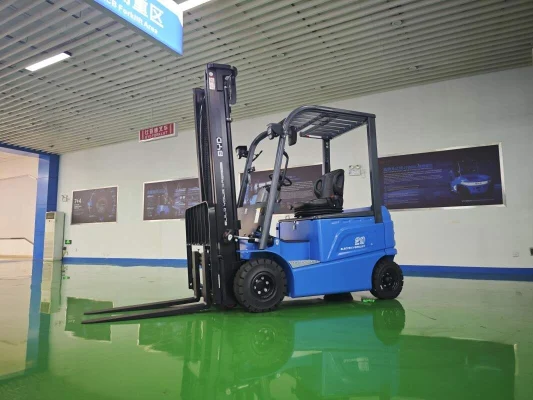
Lift height is usually described in two ways: the maximum fork height and the overall lowered height, which includes the mast and any overhead guard. The second number matters as much as the first when the truck must pass under sprinkler lines, door headers, or low roof trusses. A mast tall enough to reach the top beam can still be too tall to travel through the building.
Collect these measurements before choosing a mast:
- Top beam height: the height of the beam you must place loads on, measured from the floor.
- Required free lift: the fork height you need before the mast sections begin to extend. This matters when entering a rack bay under a low beam or when double-stacking.
- Overhead obstructions: sprinklers, lights, ductwork, and door openings along the travel path.
- Floor level variation: slopes, dock levellers, and transitions change the effective clearance as the truck moves.
As a general principle, the maximum fork height should exceed the top beam height by enough to lift the pallet clear and set it down without scraping. The exact allowance depends on pallet design and how the load is picked, so confirm it with the supplier rather than assuming a fixed figure. Also check the lowered height against every point on the travel route, not just the racking aisle.
Mast types change both height and visibility
Two-stage, three-stage, and four-stage masts offer different combinations of lowered height, free lift, and extended height. A mast with more stages can reach higher while keeping the lowered profile shorter, which helps in buildings with low doorways. The trade-off is often reduced forward visibility through the mast channels and more moving parts to maintain. The right choice depends on which constraint is tighter on your site: the top beam height or the overhead clearance on the travel path.
Check Aisle Width, Floor, and Charging Before You Commit
Capacity and lift height are the headline figures, but a retrofit often fails on the surrounding conditions. Aisle width, floor condition, and charging arrangements can rule out a configuration that looks correct on paper.
| Site factor | What to measure or confirm | Why it affects the choice |
|---|---|---|
| Aisle width | Clear width between rack uprights and any obstructions | Determines the minimum right-angle stacking aisle the truck needs; a larger truck may not turn |
| Floor condition | Flatness, joints, slopes, and load-bearing capacity | Affects stability, tyre choice, and safe travel speed with a raised load |
| Door and lift openings | Height and width at every transition | Constrains the mast’s lowered height and the truck’s overall dimensions |
| Charging location | Distance from the work area and available power | Influences battery capacity and shift planning, especially with lithium options |
| Work cycle | Lifts per shift, travel distance, and dwell time | Helps confirm whether the chosen capacity and battery suit the duty cycle |
For aisle width, ask the supplier for the right-angle stacking aisle dimension of the specific model, measured with the relevant load length. Do not estimate it from the truck’s overall width alone. If the new racking narrows the aisle below that figure, you may need a different model, a different rack layout, or a different handling approach.
Floor condition deserves attention during a retrofit because new racking often changes traffic patterns. A truck carrying a heavy load at height is more sensitive to floor transitions and slopes than one travelling empty. Confirm that the route is suitable and that the tyres match the floor surface.
Charging arrangements affect uptime rather than lifting ability, but they belong in the same decision. Lithium-battery models can offer different charging routines from lead-acid, and the practical question is whether the available charging window and location support your shift pattern. Confirm the details with the supplier against your actual schedule.
Bring the right information to the selection conversation
A supplier can only recommend a configuration when the site data is specific. A useful enquiry includes the heaviest unit load and its dimensions, the effective load center, the top beam height and required free lift, the narrowest aisle on the route, the lowest overhead clearance, floor slopes, and the number of shifts and charging windows. With those figures, the discussion about capacity and lift height becomes a comparison of real options rather than guesswork. If your project involves a four-wheel counterbalance electric forklift from our range, share these details and we can discuss which configurations fit the measurements you provide.
Frequently Asked Questions
Can I use the headline capacity printed on the truck?
Only at the load center stated on the capacity plate. Once the load center moves outward, the allowable load is lower. Check the derating curve at your actual load center and maximum lift height.
How much extra lift height should I allow above the top beam?
Enough to lift the pallet clear and place it without contact. The exact allowance depends on pallet design and handling method, so confirm it with the supplier instead of applying a fixed number.
Does a taller mast always mean a taller truck?
Not necessarily. Multi-stage masts can reach higher while keeping the lowered height shorter, which helps with low doorways. The trade-off is usually reduced visibility and more maintenance points, so weigh both constraints.
What if the new aisle is narrower than the truck needs?
Compare the required right-angle stacking aisle with the clear width between rack uprights. If the aisle is too narrow, review the rack layout or the truck model rather than assuming the existing truck will still fit.