Electric Forklift 5 Ton Price In India: How Duty Cycle and Shift Patterns Shape Battery Capacity and Four-Wheel Counterbalance Costs
News 30/10/2026
Quotes on a 5-ton electric forklift in India vary widely because the battery is not a fixed accessory—it is sized to the work. Two buyers asking about the same lift capacity can receive very different numbers once duty cycle, shift length, and charging windows are factored in. This article explains how those variables change battery capacity and, in turn, the cost of a four-wheel counterbalance electric forklift, and it outlines what to measure before requesting a configuration.
Why Two 5-Ton Quotes Can Differ So Much
A 5-ton rating describes lifting capability, not energy demand. The battery must supply power across a full working period, and that period looks different in a busy steel yard than in a warehouse handling finished goods. The main cost drivers are battery capacity (kWh), charger type and rating, and any options tied to the operating environment.
Published prices are rarely comparable because Indian listings may quote the truck alone, the truck with one battery, or a package including chargers and spares. Import duties, local assembly, warranty terms, and service coverage also move the final figure. Rather than treating any single number as a benchmark, buyers should compare like-for-like scopes and confirm what each quote includes.
Duty Cycle and Shift Patterns: The Real Battery Sizing Inputs
Battery capacity is usually estimated from energy consumed per hour multiplied by the hours the truck must run between charges, plus a safety margin. The hard part is estimating consumption honestly.
What a duty cycle includes
- Share of time spent lifting loaded versus traveling empty
- Average and maximum lift height, and load weight relative to rated capacity
- Travel distance per cycle and floor conditions
- Number of starts, stops, and hydraulic movements per hour
- Ramps or inclines on the route
Heavy loads lifted high, long travel distances, and frequent hydraulic action all raise energy use. A truck that handles a few pallets per hour at low height has very different needs from one cycling continuously at full rated load.
Shift patterns and charging windows
Single-shift operation with an overnight charge usually allows a smaller battery than multi-shift work. Where the truck must run through two or three shifts, options include a larger battery, battery swapping, or opportunity charging during breaks—each with trade-offs in cost, space, and workflow. The charging window available at your site, and the charger capacity your electrical supply supports, are as important as the battery itself.
Matching Four-Wheel Counterbalance Configuration to the Job
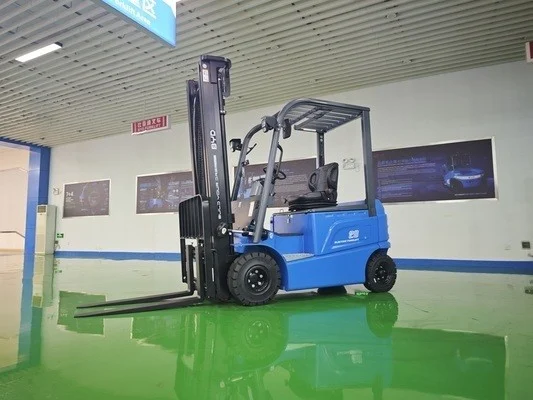
A four-wheel counterbalance electric forklift is a common general-purpose choice in Indian factories, warehouses, and loading yards. It suits many pallet-handling and truck-loading tasks, but the fit depends on aisle width, floor surface, lift height, and load center—not on the label alone.
Specifications that change the price
Battery capacity and chemistry. Lithium-ion packs are available in the models this site supplies; capacity in kWh should be confirmed against your calculated energy demand, not guessed from truck size. Ask the supplier to show how the recommended capacity was derived from your duty cycle.
Mast and lift height. Higher lifts require heavier masts and reduce remaining capacity at the load center. Confirm rated capacity at your actual lift height and load center, especially if attachments are used.
Attachments and remaining capacity. Clamps, rotators, or special forks add weight and shift the load center, which lowers the usable load. Ask the supplier to state the remaining capacity with the attachment fitted.
Tyres, braking, and floor conditions. Wet or uneven surfaces affect traction and stopping distance. Tyre type and brake specification should match the yard or shed floor.
Charging infrastructure. Charger rating, connector type, and the electrical capacity at the charging point must be verified. A larger battery without a suitable charger may not deliver the availability you expect.
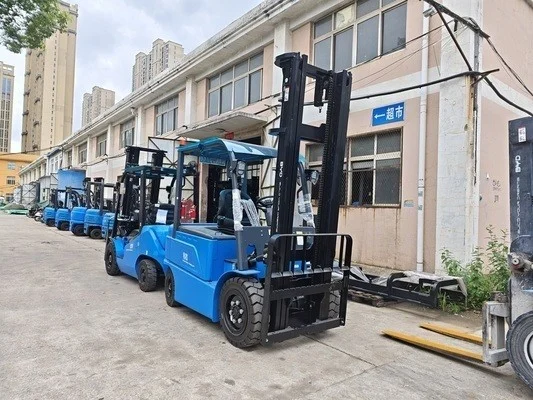
Comparison Table: Parameters, Risks, and What to Confirm
| Parameter | Why it matters in Indian operations | What to confirm with the supplier | Standard or option |
|---|---|---|---|
| Battery capacity (kWh) | Determines run time between charges | Calculation basis from your duty cycle; operating temperature range | Capacity selected to application |
| Shift pattern | Multi-shift work needs more energy or swapping | Whether swapping or opportunity charging is supported | Configuration-dependent |
| Rated capacity at load center | Attachments and high lifts reduce usable load | Remaining capacity at your lift height and load center | Confirm from technical data |
| Mast height and type | Affects aisle and door clearance | Overall lowered height and free lift | Selected to site |
| Charger rating and supply | Charging window and electrical capacity | Charger input requirements and connector type | Matched to battery |
| Tyres and brakes | Floor condition and safety | Recommended type for your surface | Selected to site |
The table lists items to verify rather than fixed values. Specific capacities, dimensions, and charging data should come from the manufacturer’s technical documentation for the model offered.
Building a Reliable Price Comparison
To compare quotes, list the truck model, battery capacity and chemistry, charger, warranty, service coverage, and delivery terms. Ask each supplier to state the assumptions behind the battery recommendation. A lower headline price may reflect a smaller battery that cannot complete your shift, or a scope that excludes the charger.
Also confirm the operating environment: ambient temperature, dust, moisture, and floor gradients all affect component choice. Where conditions are extreme, the supplier should confirm the applicable limits rather than assume standard ratings apply.
As a hypothetical example, a mid-sized warehouse running one shift with moderate loads and an overnight charging window may need a smaller battery than a three-shift operation handling heavy loads at height. The difference in battery and charger specification, not the truck’s lift rating, often explains most of the price gap.
Before requesting a quote, gather: load weights and dimensions, lift heights, aisle widths, floor type, shift schedule, charging window, electrical supply details, and any attachments planned. Share these with the supplier so the four-wheel counterbalance configuration can be matched to the actual job. To discuss selection and configuration of BYD four-wheel counterbalance electric forklifts, provide your working conditions, load, and lift height.
Frequently Asked Questions
Does a 5-ton rating mean the truck can lift 5 tons at any height?
No. Rated capacity applies at a specified load center and lift height. Higher lifts and attachments reduce the usable load, so confirm remaining capacity for your actual conditions.
Can I use one battery across multiple shifts?
It depends on energy demand and charging time. Multi-shift work may require a larger battery, a swap arrangement, or opportunity charging. The supplier should confirm what the recommended configuration supports.
Why do quotes from different suppliers vary so much?
Scopes differ: battery capacity, charger inclusion, warranty, and service coverage. Compare item by item and ask how each battery recommendation was calculated.
What information do I need before asking for a price?
Load weight and size, lift height, aisle width, floor condition, shift pattern, charging window, and electrical supply. These determine the battery and configuration that fit your operation.