Electric Forklift Battery Runtime Planning: Aligning Usable Capacity With Multi-Shift Four-Wheel Counterbalance Workloads
News 05/11/2026
Runtime planning starts with one correction: the nameplate kilowatt-hour rating of an electric forklift battery is not the energy you can plan around. Usable capacity is smaller, and it shrinks further as the pack ages, cools down, or works near its discharge limit. A four-wheel counterbalance electric forklift on a multi-shift schedule needs a plan built on usable energy per shift, not on a single headline number. This article explains how to connect the two, which measurements to collect, and where the plan usually breaks down.
Why nameplate capacity overstates shift runtime
Battery labels typically state nominal voltage and rated capacity. A battery management system reserves part of that capacity to protect the pack and to keep the truck from cutting out under load. Depth-of-discharge limits, temperature, age, and the way the truck is driven all reduce what remains available to the motor and hydraulics.
Treat usable capacity as an estimate that must be confirmed against the manufacturer’s technical data and the truck’s own energy display. If that documentation is not available, write down the parameter you need and request it rather than assuming a percentage.
Three factors usually explain the gap between expectation and reality:
- Reserve and cutoff settings. The pack stops delivering power before it is truly empty, and that margin is not available to the shift.
- Temperature. Cold conditions reduce the energy a lithium pack can deliver and accept; very hot conditions can push the system toward derating.
- Age and duty cycle. Capacity fades gradually, so a plan that works on day one may not work in year three.
Estimating energy demand across multiple shifts
Rather than guessing hours of runtime, estimate how much energy one shift consumes, then compare that figure with usable capacity. The method below uses measurements you can collect on site. It is a planning framework, not a guarantee.
Step 1: Describe the duty cycle in numbers
Record shift length, the share of time the truck is actually moving or lifting, average load weight, lift height, travel distance, and floor and ramp conditions. A truck that lifts near its rated load all shift draws far more energy than one handling light loads with long idle periods. Load centre matters too: a load carried far from the fork face increases the load moment and the hydraulic and traction effort.
Step 2: Convert work into an energy estimate
Ask the supplier whether an energy-consumption figure per hour is available for a comparable duty cycle, and under what test conditions it was measured. If no figure exists, use the truck’s own energy meter or battery state-of-charge readings at the start and end of a shift. Repeat the measurement on several shifts, including a busy one, and use the highest figure as your planning value.
Step 3: Compare demand with usable capacity
Divide usable capacity by the measured energy per shift. The result is the number of shifts one pack covers before recharging, minus a safety margin. Keep the margin explicit: it absorbs cold mornings, heavier-than-usual loads, and capacity fade. Avoid planning to the last kilowatt-hour.
| Planning input | How to obtain it | Why it changes the answer |
|---|---|---|
| Rated capacity and voltage | Battery label and manufacturer data sheet | Sets the upper bound only |
| Usable capacity | Supplier documentation, BMS settings | Defines realistic energy per charge |
| Energy per shift | On-truck meter or state-of-charge readings | Captures real duty cycle |
| Charging window | Shift pattern and break schedule | Determines whether opportunity charging fits |
| Ambient conditions | Seasonal site records | Affects available energy and charge acceptance |
Charging strategy, operating limits, and common planning errors
Multi-shift operation rarely depends on one long overnight charge. The practical question is whether the schedule offers enough charging time, and whether the charger and site power supply support it. Opportunity charging during breaks and shift changes can keep a pack in a comfortable state of charge, but it requires the right charger and a battery management system that permits partial charging without harm. Confirm both points with the supplier.
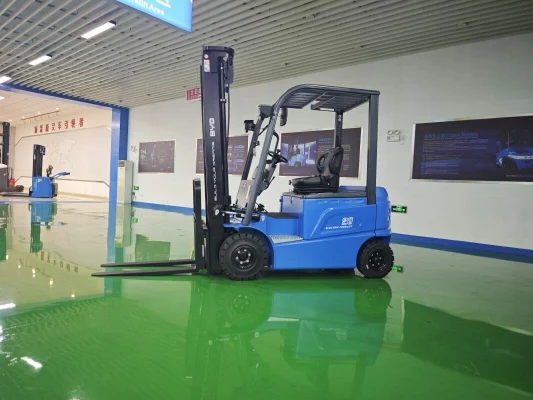
Site conditions also set limits. Narrow aisles, steep ramps, and uneven floors affect energy use and may rule out certain configurations. A four-wheel counterbalance electric forklift is a common general-purpose choice in factories, loading bays, and warehouse transfers, but suitability still depends on load, lift height, load centre, aisle width, floor surface, gradient, shift pattern, and charging infrastructure. No single model fits every site.
Frequent planning mistakes include:
- Using nominal capacity as if it were available energy.
- Measuring only a quiet shift and ignoring peak demand.
- Ignoring seasonal temperature swings and battery ageing.
- Assuming a charging window exists without checking the electrical supply and charger rating.
- Treating a specification sheet as a promise under all duty cycles.
If you are evaluating a purchase, share your actual duty cycle, load weight, lift height, and charging windows with the supplier so the configuration can be matched to the work. A written list of measured inputs is more useful than a broad request.
Frequently asked questions
How many hours can one battery charge last?
There is no universal number. Runtime depends on usable capacity and on how much energy the truck consumes per hour, which varies with load, lift height, travel, floor conditions, and driving style. Measure energy use on your own shifts and compare it with documented usable capacity.

Is opportunity charging safe during breaks?
It can be, provided the charger, battery management system, and connector are designed to support it. Confirm the approved charging profile and any limits on partial charging with the battery and truck supplier before changing your routine.
How much capacity should I reserve?
Reserve enough to cover cold conditions, heavier loads, and gradual capacity fade. The right margin depends on your duty cycle and how much variation you observe. Base it on measured data rather than a rule of thumb.
Does a larger battery always solve runtime problems?
Not always. A larger pack can help, but if the real cause is a charging window that is too short, a mismatched charger, or a duty cycle that exceeds the truck’s design, adding capacity may not fix it. Diagnose the constraint first.