How Many Types of Forklift Are There: Reconciling Lift Height and Overhead Guard Height with Four-Wheel Counterbalance Electric Truck Selection
News 12/11/2026
Forklift classifications vary by power source, chassis layout and mast design, so the count depends on which dimension you use. What matters more during a purchase decision is a narrower question: when does a four-wheel counterbalance electric forklift fit a task, and when does lift height or overhead guard height rule it out? These two dimensions are easy to confuse because both appear on a specification sheet, yet only one describes the load and the other describes the operator and the building.
Lift Height and Overhead Guard Height Describe Different Things
Lift height, usually stated as maximum fork height, tells you how high the forks can raise a load. It belongs to the mast assembly and the load path. Overhead guard height describes the top of the protective structure above the operator compartment. It belongs to the truck body and the operator envelope. A truck can lift a pallet to a high rack beam and still be unable to enter the aisle or doorway that leads to that beam.
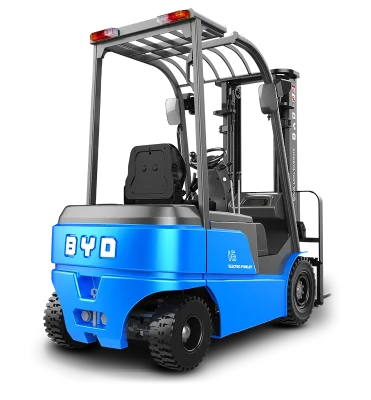
This distinction matters most in buildings with low doorways, mezzanine openings, sprinkler lines, lighting, ventilation ducts or older roof structures. A four-wheel counterbalance electric forklift is a common general-purpose choice in factories, loading areas and warehouse transfer work, but its overhead guard is a fixed structure on most models. The guard does not fold down the way a mast retracts. If the guard cannot pass under a fixed obstruction, the truck cannot serve that route no matter how much capacity it has.
What the two numbers should be compared against
- Lift height: the highest rack beam, shelf or truck bed the load must reach, plus clearance to lift the pallet off and set it down safely.
- Overhead guard height: the lowest fixed obstruction along the entire travel path, including door lintels, mezzanine beams, pipework and light fittings.
- Free lift: how far the forks rise before the mast stages extend, which affects operation under low ceilings and inside containers or trailers.
- Collapsed mast height: the truck’s height with the mast fully lowered, a separate figure from both numbers above.
Each of these should be read from the manufacturer’s technical data sheet rather than estimated from a similar-looking truck. Mast options and guard designs change the figures, and a specification valid on one model does not transfer to another.
Reading the Overhead Guard Figure Against Your Building
Measure the lowest obstruction on the actual travel route, not just the main aisle. Doorways, fire shutters, mezzanine edges and temporary structures such as scaffold or stored goods all reduce the available height. Add a working margin rather than planning to the millimetre, because floor unevenness, tyre condition and load deflection all change the real clearance.
Also confirm the guard’s rated capacity. An overhead guard is a protective structure with a defined load limit, and the rating is not the same as the truck’s lifting capacity. If the application involves falling objects, the guard specification and any additional protection should be checked against the manufacturer’s documentation and the site’s safety assessment.
When the guard height becomes the deciding constraint
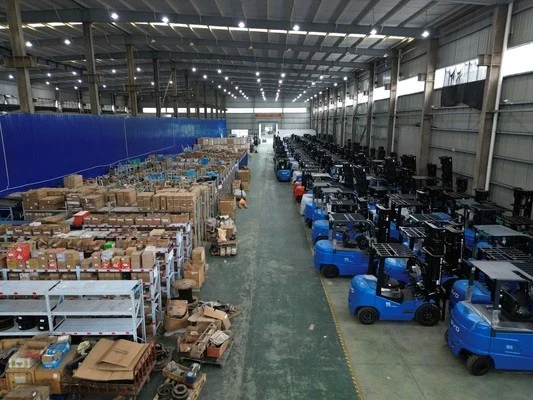
Consider a hypothetical application: a four-wheel counterbalance electric forklift is proposed to move pallets from a yard into a low-clearance storage area through a doorway with a shallow lintel. The lift height needed inside is modest, but the guard cannot pass the lintel. In this situation the honest answer is that the truck is unsuitable for that route unless the building is altered or the load is transferred at the doorway. Do not assume a smaller truck solves the problem automatically; check the actual guard height of every candidate model. Other truck types exist with different structures, but they should be evaluated on their own specifications and suitability, not treated as a substitute that inherits the counterbalance truck’s capabilities.
Reconciling Lift Height, Capacity and Load Centre
Lift height does not stand alone. Rated capacity is normally stated at a defined load centre, and the capacity available at height is typically lower than the capacity at ground level. A truck that handles a load at floor level may not handle the same load at full lift. The manufacturer’s load chart is the only reliable source here; do not extrapolate from a single capacity figure.
Use the following sequence when a high rack or stacked storage area is involved:
- Record the highest lift height the task requires and the load weight at that height.
- Confirm the load centre the rating is based on, and compare it with the actual pallet and load dimensions.
- Check the residual capacity at the required height using the manufacturer’s load chart.
- Confirm free lift and collapsed mast height if the truck must work under low ceilings or inside trailers.
- Confirm overhead guard height against the lowest obstruction on every route.
If any of these figures is unavailable, treat the selection as incomplete rather than assuming a typical value.
A simple comparison of constraints
| Constraint | What it controls | Typical failure if ignored |
|---|---|---|
| Lift height | Reach to the highest storage level | Load cannot be placed or retrieved safely |
| Residual capacity at height | Load weight the truck can handle at that level | Instability or overloading at height |
| Overhead guard height | Passage under fixed obstructions | Route is blocked despite adequate lift |
| Free lift and collapsed height | Operation under low ceilings and in trailers | Mast cannot enter the space |
Site Conditions That Change the Selection
Height figures are only part of the decision. Aisle width, floor surface and condition, ramps and gradients, shift pattern and charging arrangements all influence whether a four-wheel counterbalance electric forklift is the right fit. Four-wheel trucks generally suit applications needing stability and higher lift, while their turning envelope is larger than some other layouts. Confirm the aisle width and turning radius from the technical data, and check that the floor can carry the truck and load together.
Battery and charging arrangements also need early confirmation. Lithium battery options change charging routines and may allow opportunity charging, but the practical schedule depends on the actual charger, shift length and site electrical supply. State the working pattern to the supplier rather than assuming a charging model will fit.
Information to gather before requesting a quotation
- Maximum load weight and the height at which it must be handled.
- Pallet and load dimensions, including load centre.
- Highest storage level and lowest fixed obstruction on every route.
- Aisle widths, floor type and any ramps or gradients.
- Shift length, charging windows and available power supply.
- Any need to work inside containers or trailers, which affects free lift.
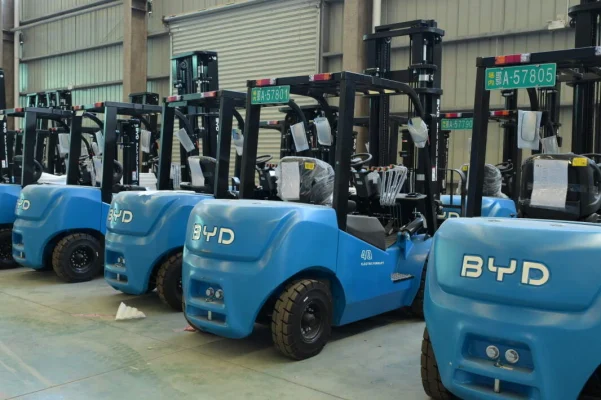
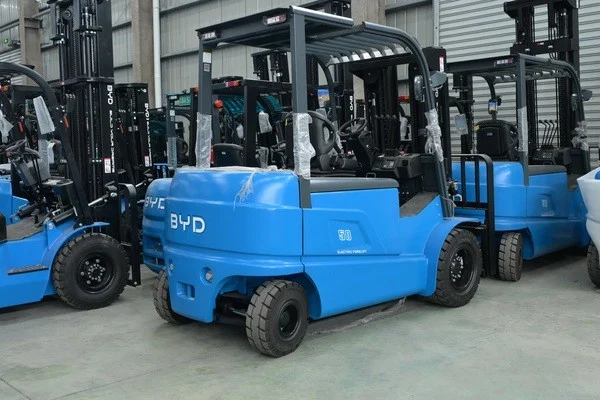
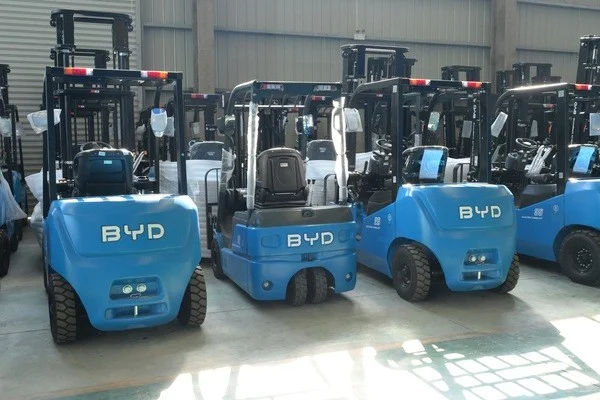
Sharing these details lets a supplier propose a configuration within its actual product range and verified specifications, rather than a generic recommendation. Our sales scope covers BYD four-wheel counterbalance electric forklifts, including lithium battery models, and configuration should be confirmed against the technical data available at the time of enquiry.
Frequently Asked Questions
Does a higher lift height always mean a better truck?
No. Higher lift usually reduces the capacity available at that height and may require a taller mast that affects collapsed height and visibility. Choose the lift height the task needs, then check residual capacity and mast dimensions against the site.
Can the overhead guard be removed to pass a low doorway?
No. The overhead guard is a protective structure and should not be removed or modified to gain clearance. If the guard cannot pass an obstruction, the route or the truck choice must change, and any modification should only follow the manufacturer’s guidance and a site safety assessment.
How is overhead guard height different from overall height?
Overall height is normally quoted with the mast lowered and describes the truck’s highest point in that state. Overhead guard height describes the protective structure above the operator. Both should be checked, along with collapsed mast height, because the tallest point can change with mast position.
Is a four-wheel counterbalance electric forklift suitable for very narrow aisles?
It may not be. Four-wheel trucks generally need more turning space than some other layouts. Confirm the aisle width and turning radius from the manufacturer’s data and compare them with the actual aisle, allowing a margin for operator error and load overhang.
Before committing, reconcile the two figures that started this discussion: the lift height the load requires and the overhead guard height the building allows. If both fit, confirm capacity at height, aisle dimensions and charging arrangements. If either fails, the selection needs revision, not a workaround.