Electric Forklift for Sale Near Me: Tire, Floor Surface and Turning Radius Checks Before You Choose a Four-Wheel Counterbalance Unit
News 02/11/2026
Searching an electric forklift near me usually returns a long list of dealers and a short list of questions you can actually answer before you call. Tire type, floor surface and turning radius are three of those questions. They decide whether a four-wheel counterbalance electric forklift can enter your building, carry your loads and turn inside your aisles without damaging the floor or the racking. Get them wrong and the machine may run well on the showroom floor but fail on your dock. This guide explains what to check, how the numbers relate, and which details to confirm with the dealer before you commit.
Start With the Floor, Not the Price
The floor surface defines the tire requirement, and the tire requirement affects traction, ride comfort and how much load the machine can move safely. A four-wheel counterbalance electric forklift carries most of its weight on the front wheels, so the front tire is the one doing the hard work under load.
Common floor surfaces and what they demand
- Sealed concrete indoors: the most forgiving surface. Smooth or cushion tires are typical, and the main checks are flatness, joint condition and floor loading limits.
- Rough or cracked concrete, expansion joints, potholes: harsh on small wheels. Confirm tire size and compound with the supplier, and expect slower travel speeds over damaged sections.
- Asphalt yards and ramps: softer than concrete and more sensitive to heat. Traction and tire wear deserve attention, especially on slopes.
- Epoxy or coated floors: some coatings mark easily under sharp turns. Ask about tire compound and turning behavior, and check the coating supplier’s guidance.
- Wet, oily or food-processing floors: traction becomes the limiting factor. Cleaning routines, drainage and any floor treatment matter as much as the tire itself.
None of these surfaces automatically rules a counterbalance truck in or out. The point is to describe the floor honestly, including the worst section, and let the dealer match tire type and compound to it. Floor loading is a separate question: point loads under a loaded forklift can be high, so check the building’s structural limits, particularly on upper floors or mezzanines.
Indoor and outdoor use in the same shift
Many sites move between a sealed indoor floor and a rougher yard. A four-wheel counterbalance electric forklift can work both, but the tire choice becomes a compromise. A tire that protects a coated indoor floor may wear faster outdoors. A tire built for rough ground may ride harder and mark delicate surfaces. State both environments when you request a quote so the configuration reflects the real duty cycle rather than one half of it.
Tire Type, Load and the Checks That Follow
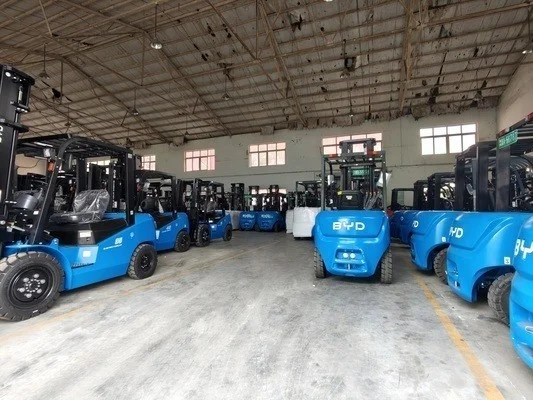
Tire choice is not a cosmetic upgrade. It interacts with load capacity, stability and the space the machine needs to turn. The figures that matter come from the manufacturer’s data plate and technical documentation, not from general assumptions.
What to confirm about tires
- Recommended tire type and compound for your floor and duty cycle.
- Wheel diameter and overall machine dimensions with that tire fitted.
- Any change in rated capacity or lift height caused by the tire and mast combination.
- Whether the quoted configuration is the standard build or a special order.
Ask the dealer to show the capacity plate values that apply to the exact configuration offered. A forklift’s rated capacity depends on load center and lift height, so a number quoted without those conditions is incomplete. If a specification is not in the documentation, treat it as unconfirmed rather than filling the gap with an estimate.
Load center and why it changes the answer
Load center is the horizontal distance from the vertical face of the forks to the center of gravity of the load. The further out the load sits, the lower the safe capacity. Long loads, wide pallets and attachments all shift the load center. Before comparing models, measure your actual pallet and load footprint and confirm the rated capacity at that load center and at your required lift height.
Turning Radius and Aisle Planning
Turning radius is where a promising machine often fails. A four-wheel counterbalance electric forklift steers with its rear wheels, so the rear of the machine swings outward during a turn. The published turning radius describes the smallest circle the machine can trace, but the space you need also includes the load, the operator’s clearance and the racking.
A practical aisle check
- Measure the narrowest aisle, doorway and lift access on the route, not just the main aisle.
- Add the load overhang at both ends of the pallet to the machine footprint.
- Account for the rear swing during a 90-degree turn into a rack bay.
- Leave clearance for pedestrians, columns, door frames and floor markings.
- Include any ramp or slope, since turning on a slope is not the same as turning on flat ground.
If the numbers are tight, do not assume a smaller machine solves everything. A shorter machine may have a tighter turning radius but a lower capacity or a different stability profile. The right answer is usually a specific configuration matched to measured aisle dimensions, confirmed by the supplier against the actual product data.
Where a four-wheel counterbalance fits
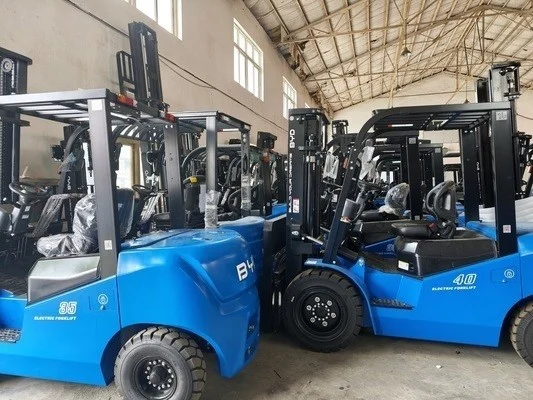
Four-wheel counterbalance trucks are common general-purpose machines in factories, warehouses and loading operations. They suit many indoor and outdoor transfer tasks, but they are not the automatic answer to every handling problem. Very narrow aisles, high racking with limited free lift, or pure horizontal transport over long distances may point to other equipment categories. If your operation depends on those conditions, discuss the boundary openly with the supplier rather than forcing a counterbalance truck into a role it does not serve well.
Questions Buyers Ask Before Choosing
Can one tire type handle both my indoor floor and the yard?
Often it can, but the choice is a compromise. Describe both surfaces, the proportion of time spent on each, and any floor coating or drainage issue. The dealer can then recommend a tire and compound that fits the mix, or explain the trade-off if no single option covers both well.
Is a published turning radius enough to plan my aisles?
No. It is a starting figure. Add the load overhang, the rear swing, clearance to racking and columns, and the effect of any slope. Measure the tightest point on the route. Confirm the final aisle plan against the machine dimensions in the technical documentation.
What should I send when requesting a quote?
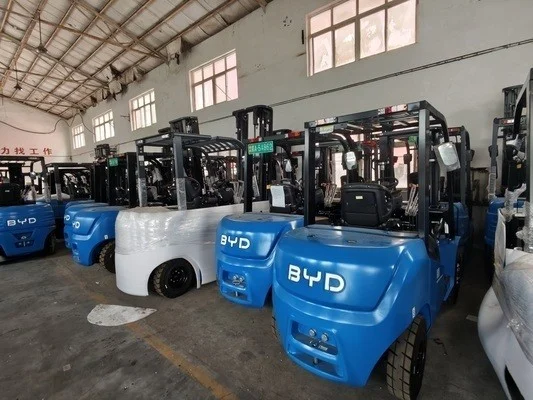
Send the load weight and dimensions, load center, required lift height, floor surfaces, aisle and door widths, ramp details, shift pattern and charging arrangements. Mention any attachments or special handling. With those details, a supplier can propose a four-wheel counterbalance electric forklift configuration and state which specifications still need verification.
Does a lithium battery option change the tire or floor checks?
The floor and tire checks still apply. Battery type affects charging routine, energy management and how the machine is scheduled, not the physical clearance needed to turn. Confirm charging location, power supply and any floor or ventilation requirement with the supplier as part of the same site review.
Before you choose, walk the route with a tape measure and a written list of surfaces, loads and clearances. Then ask the supplier to confirm tire type, capacity at your load center and lift height, and turning dimensions against the exact configuration offered. Those four confirmations turn a nearby listing into a machine that fits your building.