Electric Forklift Procurement Food Industry: Questions to Settle on Battery Capacity, Opportunity Charging and Shift Coverage
News 05/11/2026
Procuring an electric forklift for food industry operations usually comes down to three linked decisions: how much battery capacity you specify, whether the charger can support opportunity charging, and how many shifts each truck must cover. These questions are not independent. A truck that runs three shifts with a single battery and no mid-shift charging needs a different specification than one that returns to a charging point at every break. This article sets out the questions a buyer should settle before requesting a quotation, with the understanding that final figures must come from the manufacturer’s technical data and a site survey.
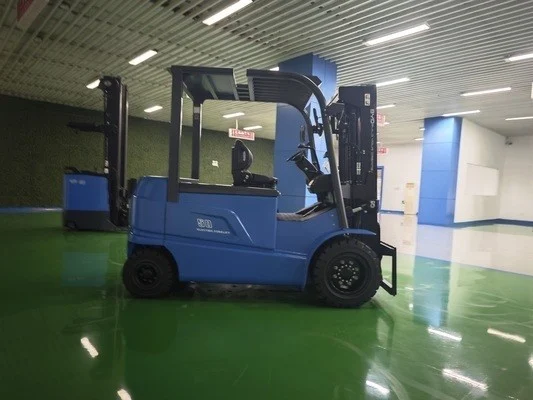
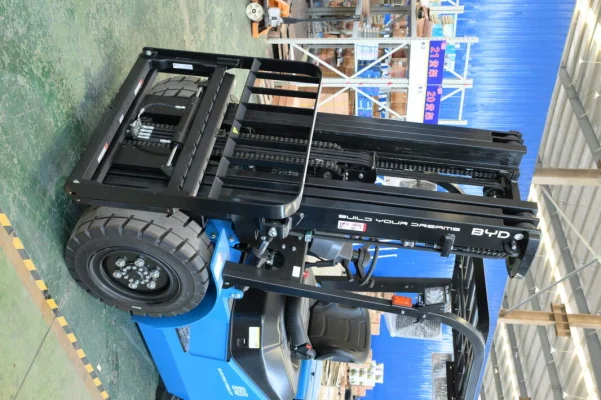
The discussion below assumes four-wheel counterbalance electric forklifts, the general-purpose configuration most often used at loading docks, raw-material intake and finished-goods transfer in food plants. Narrow-aisle and pedestrian equipment sit outside this scope.
Battery Capacity Questions to Settle Before Quotation
Battery capacity is usually expressed in kilowatt-hours or in ampere-hours at a stated voltage. Neither number alone tells you how long a truck will run. The useful figure is the energy the truck consumes per operating hour under your actual duty cycle, and that depends on load weight, lift height, travel distance and how much time the truck spends idling.
Duty cycle and energy demand
Ask the supplier to help you build a simple duty-cycle profile: average load, maximum lift height, distance per trip, trips per hour, and the proportion of time spent lifting versus travelling. A truck that moves pallets across a short, flat dock apron draws far less energy than one that lifts to racking on multiple levels. Without this profile, any capacity recommendation is a guess.
Usable capacity versus nameplate capacity
Nameplate capacity is not the same as usable capacity. Discharge depth limits, temperature and the age of the battery all affect how much energy you can actually draw before the truck needs charging. Lithium battery systems generally tolerate deeper discharge than lead-acid types, but the allowable depth and the manufacturer’s recommended operating window should be confirmed in writing rather than assumed.
Battery type and food-plant conditions
Food plants often combine cold storage, wash-down areas and ambient production halls. Temperature affects battery performance, and the supplier should state the operating temperature range and any derating that applies at the low end. Ask whether the battery compartment and connectors suit wet or humid conditions, and what cleaning routine is permitted around the battery and charger.
Opportunity Charging and Shift Coverage: Questions That Change the Specification
Opportunity charging means connecting the truck to a charger during natural breaks rather than waiting for a full discharge. It can reduce the battery capacity you need, but only if the charging infrastructure and work schedule support it. Shift coverage is the other half of the equation: the number of trucks and batteries must match the hours the operation actually runs, including peaks.
Charging windows in a real schedule
Map every break, shift change and planned downtime, and note how long the truck is actually available at the charger. A fifteen-minute window is not the same as a forty-five-minute window, and travel time to the charger counts against it. If the truck cannot reach a charger without disrupting material flow, opportunity charging is impractical regardless of battery capability.
Charger capacity and electrical supply
Confirm the available electrical supply at each charging location, the charger input and output ratings, and whether the site electrical infrastructure can support simultaneous charging of several trucks. Charger placement affects cable routing, ventilation and the risk of collision in busy areas. These are site-engineering questions, not catalogue questions, and they should be settled before the truck order is placed.
Shift coverage arithmetic
A useful check is to compare total operating hours per day against the energy the truck can accept during available charging windows. If the shortfall is persistent, the options are a larger battery, a second battery with a swap routine, additional trucks, or a revised charging schedule. Each has different implications for floor space, labour and capital cost, and the supplier should be asked to state the assumptions behind any recommendation.
| Question | Information to request | Why it matters |
|---|---|---|
| Daily operating hours | Shift pattern, peak periods | Sets the energy budget |
| Charging windows | Break lengths, charger access | Determines whether opportunity charging works |
| Battery specification | Capacity, voltage, temperature limits | Defines usable energy and derating |
| Charger supply | Input rating, site electrical capacity | Confirms feasibility and installation scope |
Technical Requirements and Acceptance Points to Confirm
Beyond energy, a food-industry procurement specification should address hygiene, safety and documentation. The following points are worth putting in the enquiry so that the quotation can be compared on equal terms.
- Hygiene and cleaning: surfaces that contact product or wash-down water, permitted cleaning agents, and any restrictions around electrical components.
- Load and lift data: rated capacity at the actual load centre, maximum lift height, and the mast and fork dimensions suited to your pallets and racking.
- Site conditions: aisle width, floor condition, ramps and gradients, door heights and floor loading limits.
- Operator environment: visibility, controls, seating and any cold-store or wash-down exposure.
- Documentation: operating manuals, maintenance intervals, spare-parts availability and warranty terms stated in writing.
Ask the supplier to identify which figures are verified product data and which depend on site conditions. A quotation that lists capacity without stating the load centre and lift height is incomplete. Similarly, a charging recommendation without stated assumptions about break length and energy use per hour should be treated as provisional.
When you are ready to compare options, share your duty-cycle profile, shift pattern, lift height and site constraints with the supplier so that a four-wheel counterbalance electric forklift configuration can be proposed against your actual conditions rather than a generic template.
Frequently Asked Questions
Can opportunity charging replace a larger battery?
Sometimes, but not automatically. It depends on whether the truck can reach a charger during breaks and whether the energy accepted in those windows covers daily consumption. The supplier should show the arithmetic behind the recommendation.
How do I compare battery capacity across quotations?
Compare capacity at the same voltage and ask for the usable energy window, the operating temperature range and the assumed duty cycle. A higher nameplate figure does not necessarily mean longer runtime under your conditions.
What should a food plant include in the technical specification?
At minimum: rated capacity at the actual load centre, lift height, aisle and floor conditions, cleaning and hygiene requirements, charging arrangements and the documentation to be supplied. These items let suppliers quote on a common basis.
Is one truck enough for three shifts?
That depends on daily energy demand and the charging windows available. If the shortfall cannot be covered by opportunity charging, a second battery, an additional truck or a revised schedule may be needed. Confirm the assumptions before committing.