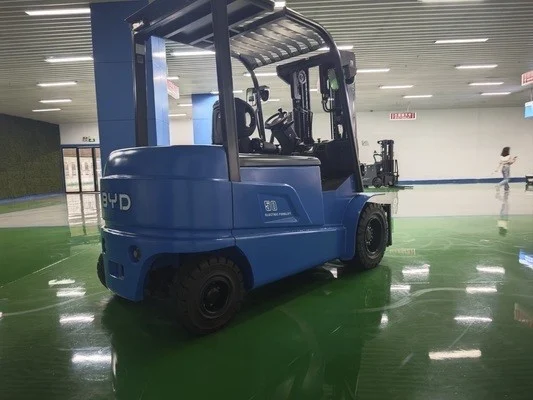
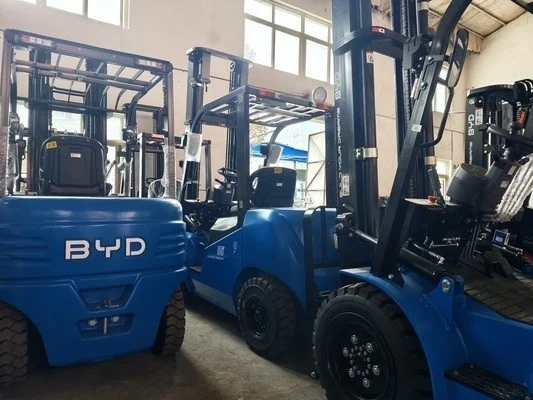
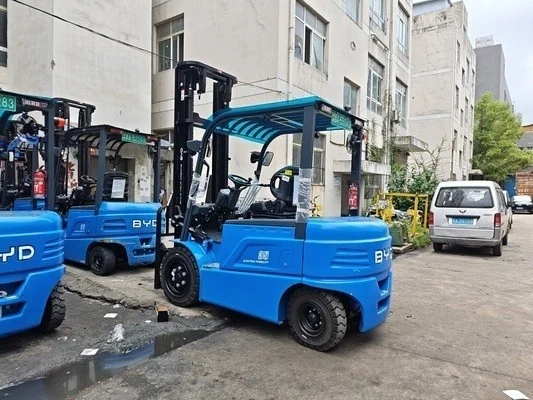
Industrial Forklift Stability on Ramps and Dock Edges: Confirming Gradeability, Braking, and Load Orientation on Four-Wheel Counterbalance Electric Trucks
News 13/11/2026
Ramp and dock-edge stability on a four-wheel counterbalance electric forklift comes down to three verifiable items: the rated gradeability stated under defined load and battery conditions, the braking system that holds the truck on a slope, and the load orientation that keeps the centre of gravity inside the stability triangle. A buyer or operator should confirm each item against the manufacturer’s technical data and the actual site conditions before the truck is put to work. This article explains what to check, how the checks interact, and where the limits usually appear.
Why Ramps and Dock Edges Expose Stability Limits
A counterbalance truck stays upright because its combined centre of gravity — truck plus load — remains inside a stability triangle formed by the steer axle pivot and the two front wheels. A ramp tilts that triangle relative to gravity, and a raised load shifts the combined centre of gravity forward and upward. Dock edges add a second problem: the floor may be uneven, the trailer may move, and the operator has less margin to correct a misjudgement.
Three variables dominate the outcome:
- Slope angle and surface condition. A clean concrete ramp and a wet steel plate at the same angle present very different traction.
- Load weight, load centre, and lift height. Capacity falls as the load centre moves forward and as the forks rise.
- Truck configuration. Battery mass, counterweight, tyre type, and mast type all affect the rated figures.
Because these variables interact, a single number such as a maximum ramp angle is only meaningful when the load, surface, and speed conditions attached to it are stated.
Confirming Gradeability: What the Figure Actually Means
Gradeability is usually published as a percentage or an angle, but the value depends on how it was determined. Before relying on a datasheet figure, ask the supplier to clarify the test conditions: laden or unladen, load weight and load centre, lift height during travel, battery state of charge, tyre type, and whether the figure describes the ability to climb continuously or only to start on the slope.
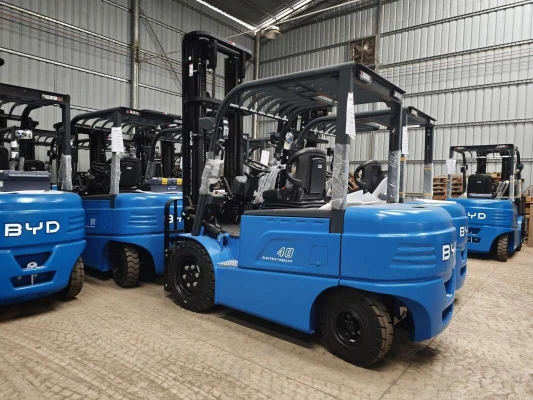
Questions to put to the supplier
- Is the gradeability rating laden or unladen, and at what load centre?
- Does the rating apply to travel with the load lowered, or does it include lifting on the ramp?
- Which tyre and floor combination was assumed?
- Does the battery type and state of charge change the figure?
Electric trucks deliver high torque at low speed, which can help on a ramp start, but traction and braking — not motor torque — often set the practical limit. If the site has an incline steeper than the rated figure, the honest answer is that the route or the load plan needs to change, not that the truck can be pushed harder.
Braking, Parking, and Load Orientation on Slopes
Braking on a ramp has two jobs: stopping a moving truck and holding a stationary one. Confirm the service brake and parking brake ratings with the supplier, and check that the parking brake is rated to hold the truck plus its rated load on the steepest slope on site. Ask whether the brake is applied automatically when the operator leaves the seat, and how the truck behaves if the battery is disconnected or depleted on a slope.
Load orientation rules that matter
- Travel with the load low. Keep the forks as close to the ground as ground clearance allows while moving; a raised load reduces capacity and raises the centre of gravity.
- Point the load uphill when climbing. On a ramp, travel with the load facing uphill so the load cannot slide toward the operator and the truck’s weight distribution stays more favourable. Descend with the load uphill, which means reversing down the slope.
- Avoid turning on the slope. Turn at the top or bottom on level ground; a turn on an incline shifts the stability triangle sideways.
- Check the load centre. A pallet whose centre of gravity sits beyond the rated load centre reduces capacity, even if the total weight is within the nominal rating.
These are general operating principles. The specific limits that apply to a given truck must come from its own capacity plate and operator manual.
Dock-Edge Practice and a Practical Verification Checklist
Dock edges combine slope, gap, and movement. A dock leveller creates a short ramp whose angle changes with trailer height, and the transition plate can be slippery when wet. Trailers that are not restrained can creep during loading, so wheel chocks or a restraint system are part of the stability picture, not an optional extra.
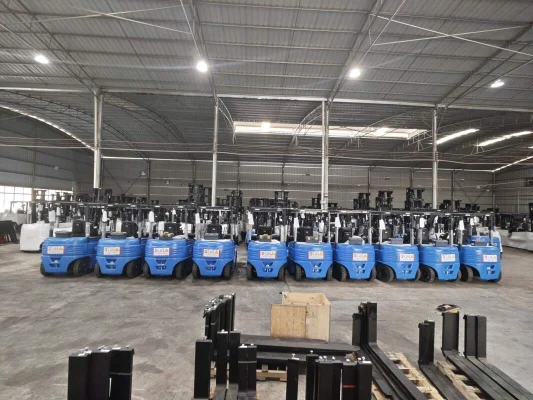
Use the following checklist when evaluating whether a four-wheel counterbalance electric forklift suits a site with ramps and dock edges. Treat each item as something to verify with the supplier and on site, not as an assumption.
| Item to confirm | What to ask or measure |
|---|---|
| Steepest ramp angle | Measure the actual slope, including dock leveller extremes, and compare with the rated gradeability under the same load conditions |
| Surface and traction | Note floor material, cleanliness, and whether the ramp is ever wet or oily |
| Load weight and centre | Confirm the heaviest pallet and its load centre against the capacity plate at the lift heights used |
| Braking and parking | Ask the supplier to confirm service and parking brake ratings on the steepest slope, and check automatic parking brake behaviour |
| Dock edge protection | Check for barriers, wheel guides, trailer restraint, and lighting |
| Operator training | Confirm that operators are trained on slope travel direction, load lowering, and no-turn rules on inclines |
A hypothetical application shows how the checklist works: a warehouse with a 6% ramp to a mezzanine and a dock leveller that reaches a steeper angle at low trailer heights. The buyer would measure both angles, confirm the laden gradeability rating at the actual load centre, check the parking brake rating against the steeper of the two, and set a rule that loads travel low and uphill. If any measured condition exceeds the rated figure, the route or load plan must change. No datasheet can substitute for that comparison.
When the site conditions are clear, share the measured ramp angles, heaviest load and load centre, lift heights, floor type, and shift pattern so the truck configuration — including battery capacity and charging arrangements — can be matched to the duty. Within this site’s range, the relevant product is the four-wheel counterbalance electric forklift; specifications should be confirmed against the manufacturer’s technical data rather than assumed.
Frequently Asked Questions
Can a four-wheel counterbalance electric forklift climb any ramp rated on its datasheet?
Only under the conditions attached to that rating. Gradeability figures usually assume a specific load, load centre, surface, and battery state. A ramp steeper than the rated condition, or a load whose centre sits further forward, can put the truck outside its stated capability even though the datasheet figure looks adequate.
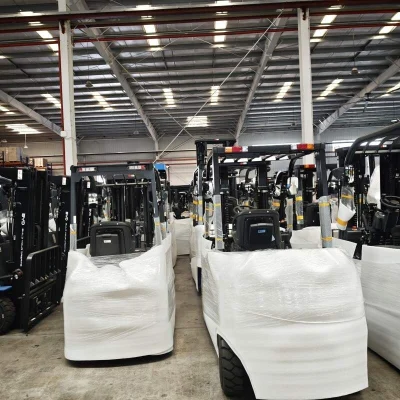
Should the load face uphill or downhill on a ramp?
The common practice is to travel with the load facing uphill, which means reversing down the slope when descending. This keeps the load from sliding toward the operator and maintains a more favourable weight distribution. Follow the operator manual, since specific instructions can vary.
What is the difference between gradeability and drawbar pull?
Gradeability describes the slope a truck can climb under defined conditions. Drawbar pull describes the horizontal force available at the tow point. They are related but not interchangeable, and neither should be used to justify a slope or load beyond the truck’s rated capacity.
How does lift height affect stability on a ramp?
Raising the load moves the combined centre of gravity upward and, with a tilted mast, can move it forward. That reduces the margin inside the stability triangle. Travel with the load low, and avoid lifting or lowering on the incline unless the manual explicitly permits it.